
Wireless & Built-in Charging
Alignment and heat decide wireless charging speed. The wattage badge decides almost nothing.
This is the technology half of the wireless topic: how inductive charging works, what the standards changed, and why the pad gets hot. The commercial side — forms, moulds and wholesale — is in the Wireless Charger Products guide.
- Three routes below cover every wireless charging question
- 27 guides organised by the question they answer
- Every route ends at an alignment rule, a standard and a thermal limit
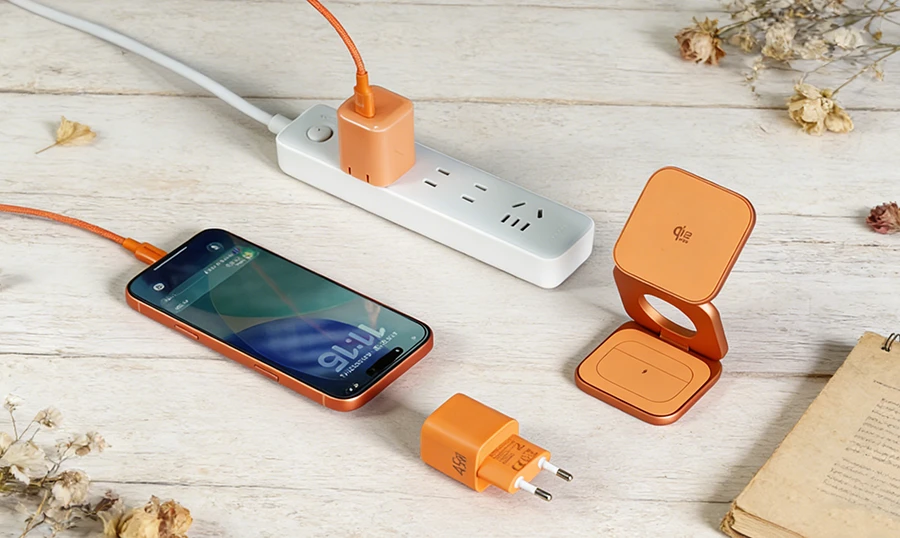
Three routes, and you only need one of them
Understanding the mechanism, tracking the standards and solving the heat are three different problems. Start with the one you are actually facing.
Understand the mechanism
Inductive charging is a transformer with an air gap, and every one of its limits comes from that gap. Start here if the behaviour is surprising you.
Track the standards
Qi2 standardised the magnet, and Qi 2.2 pushed the power higher. What changes for a product roadmap is the certification set and the alignment tolerance, not the headline number.
Solve the heat
Wireless charging loses more energy in the gap than a cable does, and that loss becomes heat. Almost every complaint about speed is really a complaint about thermal behaviour.
In the car, on the desk and in the drawer
The same pad behaves differently in each of these places, and the reason is rarely the pad.
In-car pads
A car pad is the hardest wireless environment there is: heat, vibration, tight clearance and a phone that slides. Factory-fitted pads underperform for mechanical reasons as often as electrical ones, and a vented mount with real airflow fixes more of it than a higher wattage rating does.
Multi-device pads and earbuds
A three-in-one pad splits one power supply across three receivers, and the allocation policy decides which device gets the fast window. Earbud cases are the smallest and most tolerance-sensitive of the three, which is why they are usually the first to misbehave.
Designing and buying wireless power
Once the mechanism and the heat are understood, the remaining question is what to build and what to certify.
Custom hardware
Custom wireless hardware starts from the use case rather than the coil: where the device sits, what thickness the surface is, and how much heat can escape. Get that order right and the electrical design follows; reverse it and the product fails in its own enclosure.
Qi2 power banks
A magnetic power bank is the hardest product in the category: a battery, a coil and a phone stacked with no airflow. Certification is what proves the alignment and thermal claims, and it is the first thing a buyer should ask for.
Where GaN fits
GaN does not change the wireless link itself; it changes the adapter feeding it, which is what made higher-power pads and multi-device stations practical. Understanding that boundary stops vendors selling GaN as a cure for a coupling problem.
What actually decides wireless charging speed
Four things, in this order. The wattage printed on the pad is the least useful of them.
Coil alignment
Inductive charging is a transformer with an air gap. Move the coils apart or sideways and the coupling drops sharply, which is why a magnetic mount outperforms a flat pad even at the same rating.
The gap thickness
A phone case, a furniture surface or a car pad cover all sit between the coils. Every millimetre costs coupling, and the losses show up as heat rather than as a lower number.
Thermal headroom
Once the receiver gets warm it throttles itself. A pad in an enclosed drawer or under a hot phone has nowhere to send that heat, so it charges slowly and blames itself for a design problem.
The standard the device actually supports
Qi, Qi2 and MagSafe negotiate differently, and a phone that falls back to a basic profile will not reach the pad rating. Certification is how a buyer checks which one a product really speaks.
Where to go from here
The wireless technology cluster connects to four neighbours. Pick the one that matches your next question.
Wireless charging questions
The short answers. Each one links into the guide that covers it properly.
Why is wireless charging slower than a cable?
Because the energy crosses an air gap. A cable conducts directly; a pad has to move power through two coils with a gap between them, and every millimetre of separation or misalignment costs coupling. The loss becomes heat, and the heat makes the phone throttle itself further.
Does Qi2 make wireless charging as fast as a cable?
Closer, but not equal. Qi2 standardises magnetic alignment, which removes the misalignment loss and makes the rated speed reproducible. It does not remove the fundamental gap loss, so a cable still wins on both speed and efficiency.
Why does my phone get hot on a wireless charger?
Partly the transfer loss, partly the phone doing work while it charges, and partly the pad having nowhere to send the heat. A thick case, a closed drawer or a car dashboard in the sun all remove the airflow the system assumes, and thermal throttling follows.
Does a phone case affect wireless charging?
Yes. Anything thicker than a few millimetres, or anything metallic, reduces coupling and therefore speed. Magnetic cases are usually thin enough to work because the magnet array forces the alignment the case would otherwise spoil.
Is MagSafe the same as Qi2?
Qi2 is the standard; MagSafe is Apple implementation of a magnetic alignment profile on top of it. Qi2 devices and MagSafe devices are broadly compatible on alignment, but the negotiated power and the accessory ecosystem differ by brand and generation.
Request a wireless review
Send us the device list and where the pad will live — desk, car, drawer or furniture. We will come back with the alignment and thermal conditions that decide the real speed, and the standard and certification the product needs.