
Wireless charging was invented in the 1890s by Nikola Tesla, who demonstrated wireless power transmission using the Tesla coil. The technology stayed mostly experimental for decades, moved to consumer products through commercial inductive charging in the late 20th century, and went mainstream for smartphones in the 2010s with the Qi standard—first on the Palm Pre in 2009, then on Nokia, Google, and Apple devices.
(Last modified date: September 2, 2026)
When was wireless charging invented? Wireless charging was invented in the 1890s by Nikola Tesla, who performed the first experiments in wireless energy transfer using the Tesla coil. Commercial inductive charging followed in the late 20th century, and smartphones adopted it from 2009 onward with the Qi standard.
Key Takeaways
- Nikola Tesla pioneered wireless power transmission in the 1890s with resonant inductive coupling.
- Commercial inductive charging first appeared in low-power devices such as electric toothbrushes.
- The Palm Pre (2009) was the first smartphone with wireless charging, using Touchstone.
- Qi became the global standard in 2010; Qi2 (2023) added magnetic alignment for higher efficiency.
- Modern wireless charging reaches over 90% efficiency and up to 25W on smartphones.
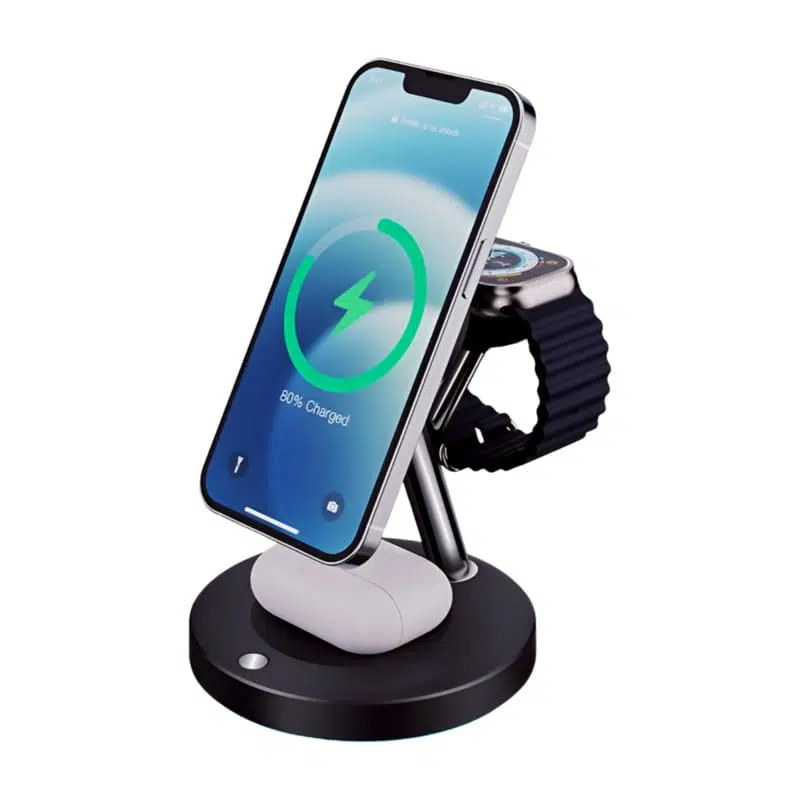
How Did Wireless Charging Begin?
Wireless charging originated with Nikola Tesla’s experiments in the 1890s, where he pioneered methods to transmit energy wirelessly using electromagnetic induction. His Tesla coil lit bulbs without wires and established the foundational science for today’s inductive and resonant charging systems.
From Labs to Consumers
Commercial inductive charging in the late 20th century allowed low-power devices, such as electric toothbrushes, to charge wirelessly—bridging laboratory experiments and consumer applications. Widespread adoption accelerated with the release of the Qi 1.0 standard by the Wireless Power Consortium in March 2010, which unified charging technology for mobile devices.
When Did Smartphones First Get Wireless Charging?
The Palm Pre, launched in 2009, was the first smartphone to support wireless charging using the Touchstone system. Soon after, Nokia’s Lumia 920 and Google’s Nexus 4 adopted the Qi standard, bringing wireless charging to mainstream mobile devices. Apple added Qi to the iPhone 8 and iPhone X in 2017, making wireless charging a near-universal feature.
Why Was Tesla’s Work So Crucial?
Tesla’s work laid the theoretical and experimental groundwork for wireless power transmission, introducing electromagnetic induction and resonance—principles central to modern wireless charging. His vision inspired generations of innovation leading directly to today’s wireless chargers.
Which Technologies Drive Wireless Charging Today?
Modern wireless charging relies on electromagnetic induction (energy transfer between closely coupled coils) and electromagnetic resonance (longer-range transfer and flexible positioning). Magnetic alignment in Qi2 improves efficiency and ease of use, with some Qi2 chargers supporting up to 25W for smartphones.
Key Wireless Charging Milestones
| Year | Milestone | Impact |
|---|---|---|
| 1890s | Tesla’s wireless power transmission experiments | Foundation for wireless charging |
| 1990s | First commercial inductive toothbrush charger | Consumer adoption begins |
| 2009 | Palm Pre launches with Touchstone | First smartphone application |
| 2010 | Qi standard released by WPC | Universal mobile charging standard |
| 2012 | Nokia Lumia 920 & Google Nexus 4 embrace Qi | Mass-market smartphone adoption |
| 2017 | Apple adds Qi to iPhone 8/X | Wireless charging goes mainstream |
| 2023 | Qi2 standard introduced with magnetic alignment | Double speed, greater efficiency |
Comparison of Wireless Charging Methods
| Method | Range | Alignment | Efficiency | Popular Uses |
|---|---|---|---|---|
| Inductive | Short (direct) | Precise | ~80–90% | Phones, wearables, cars |
| Resonant | Moderate | Flexible | ~70–85% | EVs, medical devices |
| Radio frequency (RF) | Long | Flexible | ~30–70% | Prototypes, IoT devices |
Is Wireless Charging Safe for Daily Use?
Extensive research from health agencies confirms that electromagnetic fields generated by wireless chargers are well within safe limits. Built-in temperature control and foreign object detection protect users and devices, and modern chargers are rigorously certified to international safety standards.
Conclusion
Wireless charging, first conceived by Nikola Tesla, has transformed device power management through scientific innovation and standardization. Today it offers convenience, cross-device compatibility, and emerging eco-friendly advances. Brands like Wecent integrate GaN technology to deliver performance-driven, certified, and customizable wireless chargers—and the next wave of resonant and RF technologies promises even longer-range, more versatile power.
FAQs
When was wireless charging invented?
Wireless charging was invented in the 1890s by Nikola Tesla, who performed the first experiments in wireless energy transfer using the Tesla coil.
Is wireless charging safe for everyday use?
Yes. Modern wireless chargers operate within strict safety limits for electromagnetic fields and feature advanced overheat protection and foreign object detection.
Which smartphones first used wireless charging?
The Palm Pre in 2009 was first, followed by Qi-standard devices such as the Nokia Lumia 920 and Google Nexus 4 in 2012.
Can wireless charging be as fast as wired charging?
Wireless efficiency still trails wired charging, but Qi2 and advanced coil designs now reach up to 25W on smartphones with over 90% efficiency, approaching wired speeds.
Are there environmental benefits to wireless charging?
Wireless charging reduces cable wear and electronic waste, but manufacturers must address responsible sourcing and disposal for full sustainability.
This article is part of Wireless & Built-in Charging, the guide that covers this topic in decision order.
Related Articles
- History and Development of Wireless Charging
- What Was the First Wireless Charging Phone?
- Why Does Wireless Charger Overheating Occur?
Official Resources
References
- Wireless Power Consortium – wirelesspowerconsortium.com
- Historical milestones follow the original article; independent verification recommended.