Nissan Pathfinder Wireless Charger Upgrade: Why In-Car Pads Underperform and How to Fix It
In-car wireless charging that works: why vehicle pads charge slowly, how alignment and heat cause it, and what aftermarket and OEM buyers should specify.
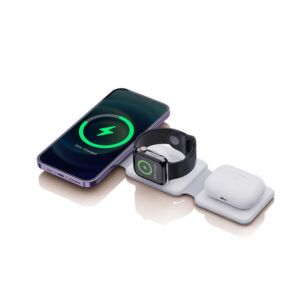
In-car wireless charging has a reputation for being slow and unreliable, and the reasons are structural rather than brand-specific. A phone placed on a horizontal pad moves, the compartment traps heat, and the driver has no feedback while driving.
For an owner the fixes are simple; for an aftermarket or OEM product team they are specification decisions, and they are the difference between a pad that works and one that appears faulty.
Why is in-car wireless charging so slow?
Misalignment and heat.
A moving phone changes the coil coupling, and a closed compartment removes the airflow that would carry heat away, so the pad reduces power to protect itself.
Inductive charging transfers energy through a magnetic field, and the efficiency of that transfer depends on the alignment and distance between the coils. In a vehicle the phone slides on a horizontal surface, so the coupling changes with every corner, and the phone’s charging circuit responds by reducing or interrupting the charge.
The second factor is thermal. Vehicle pads sit in enclosed consoles or under rubber mats, and the natural airflow that cools a bedside pad is absent. When the pad or the phone reaches a temperature threshold, charging slows or pauses, which is why a phone can charge quickly on a short journey and hardly at all on a long one in summer.
Nissan Pathfinder wireless charging: does the pad match the phone?
Compatibility is about standards rather than brands: a pad built to the Qi specification will charge any Qi-compatible phone, and magnetic variants add alignment (Wireless Power Consortium: Qi). Where a phone supports a higher wireless rate than the pad provides, it simply charges at the lower rate, which is a capability difference rather than a fault.
For a buyer, the practical check is the pad’s specified output and the phone’s wireless capability. Where both are stated, the expected behaviour is predictable, and the conversation moves from “it does not work” to “it charges at the lower of the two rates”.
Alignment: why the phone’s position decides everything
Coil alignment is the single largest variable in wireless charging efficiency, and in a vehicle it is also the one most disturbed by normal driving. Three design responses reduce the problem: a magnetic array that holds the phone in a defined position, a recessed or lipped surface that discourages sliding, and a coil sized to tolerate some positional error.
For an aftermarket product, magnetic retention is usually the most effective of the three because it fixes the phone relative to the coil rather than relying on the driver to reposition it. WECENT’s magnetic pads and stands use this approach in their wireless range, including the wireless charger range with magnetic retention and multi-device layouts.
Heat build-up in closed compartments
Heat has two sources: the losses in the inductive transfer and the energy the phone’s own charging circuit dissipates. Both are confined by the compartment, and both increase with ambient temperature, which is why summer journeys produce the most complaints.
Practical owner-level fixes are to keep the compartment lid open where possible, remove thick cases, and avoid charging while the phone is also running navigation on a windscreen mount. Product-level fixes are a thermally conductive pad surface and a design that allows air to move past the phone rather than sealing it against the surface.
Cases, magnets and payment cards
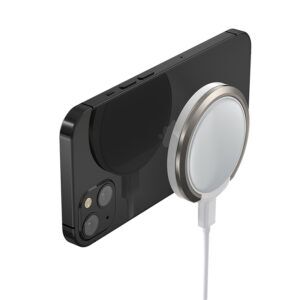
Three accessory interactions cause most in-car failures. Thick or metal-backed cases increase the distance between the coils; magnets in the case can interact with the phone’s magnetic array; and cards with magnetic stripes left in the case can be damaged by the field.
The practical rule for a driver is a thin case with no metal plate, and no cards stored against the phone while it charges. For a product team, the same issue becomes a documentation line: state the maximum case thickness the pad tolerates and whether a magnetic array is required for best performance.
Why OEM pads are often limited
Factory-fitted pads are specified for the whole vehicle programme, which means they must tolerate many phone sizes, operate across a temperature range and survive years of use. That conservatism typically results in lower output and a larger coil, prioritising reliability over speed.
For an aftermarket upgrade, the trade runs the other way: a smaller coil with magnetic retention and a shorter coil-to-surface distance delivers more of the pad’s rating to the phone, at the cost of requiring a compatible magnetic device or a case that supports it.
What aftermarket and OEM buyers should specify
A specification for an in-car charging product contains five lines: specified output, coil geometry and positional tolerance, retention method, thermal behaviour at cabin temperatures, and the case compatibility statement. The protection set belongs in the same document, with over-temperature, over-voltage, over-current and short-circuit protection supported by test records from the quality control gates.
WECENT builds wireless charging platforms including magnetic pads and multi-device stations for aftermarket and OEM programmes, quotes from a written specification through its OEM/ODM programme, and starts at 200 pcs per model for a pilot. EMC requirements for the radio aspects of the product follow market frameworks such as the FCC Part 15 rules (47 CFR Part 15) and the EU radio equipment directive (Directive 2014/53/EU), with Qi certification handled separately (Wireless Power Consortium). Standardisation of the charging interface itself, including the role of adjustable profiles, is maintained by USB-IF where the product also provides a wired output (USB-IF: USB Power Delivery).
FAQ
Does the Nissan Pathfinder have a wireless charger?
Availability depends on the model year and trim, and the pad’s behaviour follows the same physics as any in-car charger. Check the vehicle’s own documentation for the fitted equipment, then apply the alignment, heat and case checks described here before concluding that it is faulty.
Why does my car wireless charger charge so slowly?
Two causes dominate: the phone moving on the pad, which changes the coil coupling, and heat trapped in the compartment, which makes the pad reduce power. Magnetic retention, a thinner case and better airflow address most cases without replacing hardware.
Can I add wireless charging to a car without it?
Yes, through an aftermarket pad or mount that draws power from a 12V socket or USB port. The practical constraints are the retention method, the phone’s wireless capability and the thermal environment, since a windscreen-mounted pad in summer sees high temperatures.
Do phone cases affect in-car wireless charging?
They can. Thick cases, metal plates and magnets increase the distance between the coils or interfere with the phone’s magnetic array, all of which reduce the effective charging rate. Cards stored against the phone also risk damage from the magnetic field.
What should an OEM specify for an in-car charging pad?
Specified output, coil geometry and positional tolerance, retention method, thermal behaviour at cabin temperatures, and a case compatibility statement, plus the protection set with test records. Qi certification is a separate path from the product’s EMC compliance.
Developing an in-car charging product?
Share the vehicle environment, phone mix and target markets, and WECENT will confirm the coil and retention design, protection scheme and MOQ from a written specification.