Apple's guidance — "20W or higher" — is deliberately simple, but the real answer differs by model: newer iPhones accept more, older ones cap lower, and the cable matters at the top end. This reference gives you the model-level numbers to buy, list and recommend chargers honestly.
How iPhone charging wattage has changed
Charging power climbed in stages: standard 5W for years, then 18W with USB-C-era iPhones, then 20W fast charging, and most recently higher wired speeds on newer Pro models. Each generation raised the ceiling, but the charger only needs to meet the phone's request — extra wattage is headroom, not speed.
The trend is upward but bounded: each generation raises the ceiling a few watts while Apple keeps peak power conservative to protect battery longevity and thermal comfort. The practical consequence is that a 20W charger bought for an iPhone 12 still fast-charges an iPhone 17, and a 45W charger bought today remains useful for the next several generations. Buyers who understand this stop chasing wattage and start buying one tier of headroom.
A model-by-model wattage reference table
| iPhone generation | Fast-charge requirement | Practical charger |
|---|---|---|
| iPhone 8–11 (Lightning) | 18W+ | 20W USB-C PD |
| iPhone 12–14 (Lightning) | 20W+ | 20W USB-C PD |
| iPhone 15/16 (USB-C) | 20W+ | 20–30W |
| iPhone 17 Pro/Pro Max | Up to ~40W wired | 45W |
| iPhone 17e / Air | 20W | 20–30W |
The exact maximum for each model is set by Apple's charging firmware; the table reflects current-generation behavior and should be updated as new models launch.
The table is a starting point, not a guarantee: Apple tunes charging per model and firmware version, so the same phone can request slightly different power after an iOS update. When a table appears in your content, date it and link to Apple's official page as the source of truth. A dated, sourced table builds trust; an undated one ages into a liability.
What the phone draws vs what the charger offers
The iPhone requests power through USB PD; the charger supplies up to its rated wattage. A 45W charger on an iPhone that requests 20W delivers 20W. Higher-wattage chargers only matter when the model can draw more — which is why a 45W charger is the sensible "future-proof" pick for a household, not a speed upgrade today.
The negotiation is visible if you know what to watch: plug in a USB-C power meter and you will see the iPhone request a profile near its limit at low battery, then step down through lower profiles as the session progresses. The charger simply follows. That is why "fast charge" is a property of the pairing, not of either device alone — and why testing with a meter beats reading marketing numbers.
Cable and protocol requirements for peak speed
USB-C-to-Lightning cables for older models and USB-C-to-C for newer ones must carry the negotiated current. For 45W-class charging, a quality USB-C cable with proper rating is required; a cheap cable silently caps the session.
Certified cables matter more than brands: a USB-IF certified USB-C-to-C cable rated for 60W carries iPhone fast charging without drama, while a thin data-only cable can drop the negotiated wattage and make a good charger look slow. For Lightning-era iPhones, keep the MFi-certified cable; uncertified Lightning cables often fail negotiation entirely and fall back to slow 5W charging.
Choosing charger wattage for a household with several iPhones
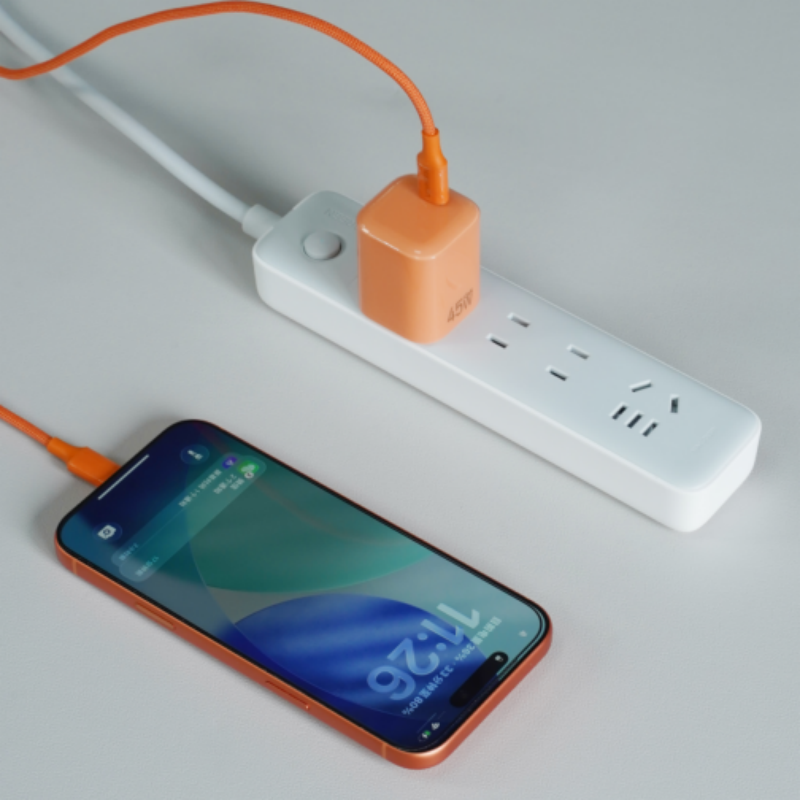
For a household, buy by the peak simultaneous need: one 45W charger fast charges the newest phone and tops up others, while a 65W multi-port model handles two phones plus earbuds at once. The 45W Cosmic Orange charger covers the high end of the iPhone range in a compact brick.
The household math rewards buying one tier up from the newest phone: a 45W charger fast charges the current Pro at its ceiling and remains the right tool for the next upgrade, while 20W units serve the older phones and the nightstand. Add a 65W multi-port for the shared desk where two phones charge at once, and the household is covered with three chargers instead of one per person. The frequent mistake is buying wattage for the average phone instead of the newest one, which guarantees a second purchase at the next upgrade. Because iPhone wattage acceptance rises slowly with generations, a one-tier headroom rule keeps the household's chargers useful for years without overspending on capability no iPhone can use today.
Using the table in listings and buying guides
In listings, state the wattage tier the charger satisfies ("fast charges all USB-C iPhones") rather than claiming a specific model speed you cannot verify. Buying guides should pair the table with the honest note that Apple's own spec is the ceiling.
Listings that pair the table with a buying rule convert better: "matches every USB-C iPhone from iPhone 15 onward," or "covers the whole household with one brick." Avoid model-by-model speed promises you cannot verify; the table supports compatibility claims, and compatibility is what buyers are actually checking.
USB-C vs Lightning era charging
Lightning-era iPhones charge at 18–20W via USB-C-to-Lightning; USB-C iPhones use PD over USB-C-to-C and can accept more. The connector change also simplified cables: one USB-C-to-C cable now covers iPhone, iPad, MacBook and most Android devices.
The connector change also standardized cables across the Apple ecosystem: one USB-C-to-C cable now serves iPhone, iPad and MacBook, which simplifies both household setups and retail bundles. For sellers, this means the cable SKU mix shifts toward USB-C-to-C with a single Lightning option for legacy devices — and the Lightning cable becomes a declining accessory worth forecasting carefully.
Real charging times by wattage
As a practical reference, a 20W charger takes a typical iPhone from empty to about 50% in 30 minutes; a 45W charger shortens the window slightly on models that accept more, and mostly adds headroom elsewhere. Independent charging tests show the same pattern: peak matters less than the first 30 minutes.
The pattern across wattages is consistent: the gain from 20W to 45W appears mainly in the first half of the session and shrinks as the battery fills, because the taper phase dominates the tail. Independent tests of the latest iPhones confirm the early-window difference. When a listing says "50% in 30 minutes," that is the metric that actually describes the experience; total-to-full times converge across chargers and are less useful for comparison.
Why iPhone caps charging at certain watts
Apple limits charging power to manage heat and battery longevity. The cap is firmware-controlled and varies by model and battery temperature — a deliberate trade-off that no charger can override.
The cap is temperature-aware, not fixed: a cool iPhone accepts its maximum, a warm one tapers, and a hot one barely charges. This is why the same charger can produce different curves on the same phone in different conditions. Marketing that promises a fixed speed ignores this reality; honest marketing states the range and the condition, which is exactly what the first-30-minute metric captures.
Charging multiple Apple devices together
An iPhone plus AirPods and Apple Watch fits a 30–45W multi-port charger. For iPhone plus iPad, size toward 65W. Matching the charger to the simultaneous load keeps every device at a reasonable speed without overbuying.
Update cadence for model tables
Model wattage tables age fast: update them at each iPhone launch, verify against Apple's official fast-charge support page, and mark estimates clearly. Content teams that keep this fresh earn trust — and their charger recommendations convert better.
FAQ
What wattage charger does an iPhone need?
20W or higher fast charges all modern iPhones. Newer Pro models can draw more (up to ~40W), so a 45W charger adds headroom for the latest generation.
How many watts does an iPhone 15, 16 or 17 accept?
iPhone 15/16 fast charge at 20W+; newer Pro models accept up to about 40W wired. Apple's official fast-charge page is the authoritative source per model.
Is a 45W charger bad for an iPhone?
No. The phone draws only what it requests, so a 45W charger is safe and future-proof; it simply won't push more power into a phone that caps lower.
Do I need a special cable for iPhone fast charging?
Yes, a cable rated for the negotiated current. USB-C-to-C for USB-C iPhones and USB-C-to-Lightning for older models, from a quality brand.
Building an iPhone-compatible charger lineup? Send your target models and markets to our team through the contact page — we can match wattage tiers and port layouts to Apple's ecosystem.
This article is part of iPhone Chargers, the guide that covers this topic in decision order.