Apple says "20W or higher," so why would anyone buy 30W? Because "20W or higher" is a floor, not a ceiling: newer iPhones can draw more, charging while in use changes the math, and headroom keeps a charger useful across upgrades. This guide separates the real benefits from the marketing.
What Apple's 'fast charging' spec really says
Apple's fast-charge guidance states that 20W or higher fast-charges iPhones — meaning the phone reaches 50% in about 30 minutes. It does not say "20W is the maximum the phone accepts"; it defines the threshold for Apple's stated speed.
Apple's statement is a minimum guarantee, not a maximum: "20W or higher" means the phone reaches 50% in about 30 minutes with at least that much power. It says nothing about what happens with 30W or 45W, which is exactly where newer Pro models and use-while-charging change the story. Reading the spec as a ceiling instead of a floor is the most common misunderstanding in iPhone charging.
How newer iPhones use higher wattage
Recent Pro models accept more power than 20W — independent testing shows newer iPhones drawing up to ~40W wired. A 30W or 45W charger lets those models charge at their actual capability rather than being capped by the brick.
The higher acceptance is not constant: it applies when the battery is cool and low, and it shrinks as the session progresses. This is why a 45W charger and a 30W charger can produce identical curves on the same phone in a warm room — the phone's thermal limit binds before the charger's wattage does. Testing at controlled temperature is the only fair comparison.
30W vs 20W in real charging sessions
In practice, 30W shortens the early charging window on models that can draw it and barely changes the total time on others, because charging tapers as the battery fills. The measurable benefit is a faster 0–50% segment and better behavior while the phone is in use.
The measured difference is concentrated early: on a model that accepts 30W+, the first 20–30 minutes deliver noticeably more charge than at 20W, and the advantage narrows as the battery approaches full. In daily terms, a 30W charger turns a 20-minute airport top-up into a meaningfully larger charge. For models capped at 20W, the two chargers perform identically — the difference is future-proofing, not today's speed.
Charging while using the phone
The biggest real-world benefit of 30W+ is use-while-charging: navigation, gaming or video calls consume power as it charges. A 20W brick may barely hold the level; a 30–45W charger actually fills the battery during heavy use.
Navigation, gaming and video calls each draw 5–15W depending on workload and screen brightness. A 20W charger has little margin above that draw, so the battery creeps up slowly; a 30–45W charger fills the battery while the phone works. For frequent travelers, drivers and mobile gamers, this is the single most convincing reason to step up from 20W.
Future-proofing for the next iPhone
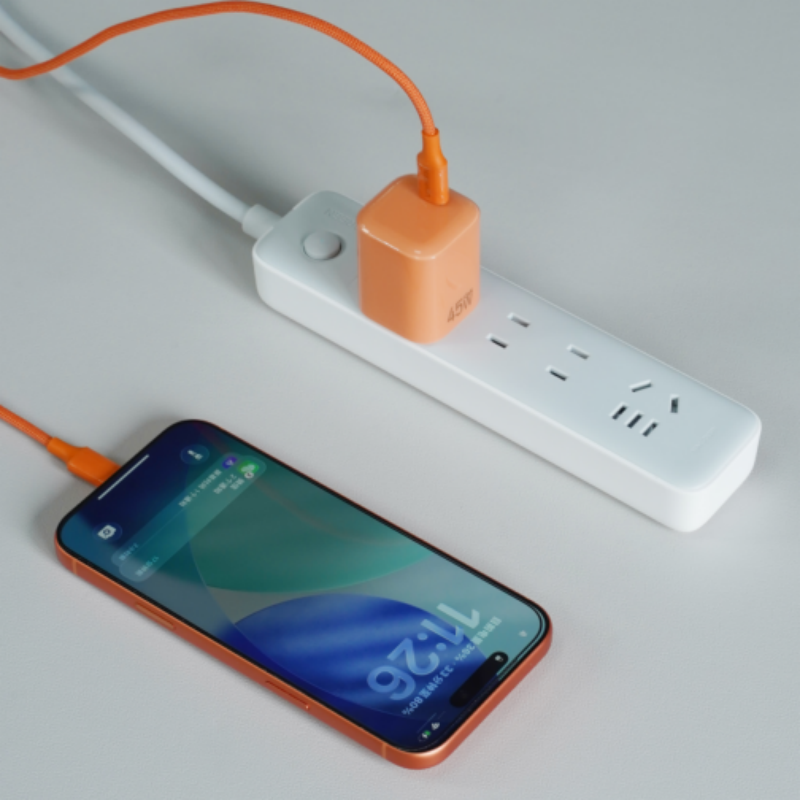
Charger limits rise with each generation, and GaN keeps the higher tiers compact enough to carry. A 30–45W charger bought today covers current models and the next one or two upgrades; a 20W charger becomes the new "slow" option sooner. The 45W Cosmic Orange charger is the practical future-proof tier for iPhone-focused households.
Future-proofing has a cost ceiling: buying beyond 45W for an iPhone today buys nothing measurable, because the phone cannot draw it. The rational buy is one tier above today's need — 30W for a 20W phone, 45W for a 30W phone — which covers the next upgrade without paying for unused capability. The same logic applies to households: one 45W charger serves the newest phone while 20W units cover the rest.
Choosing chargers for an iPhone-focused product line
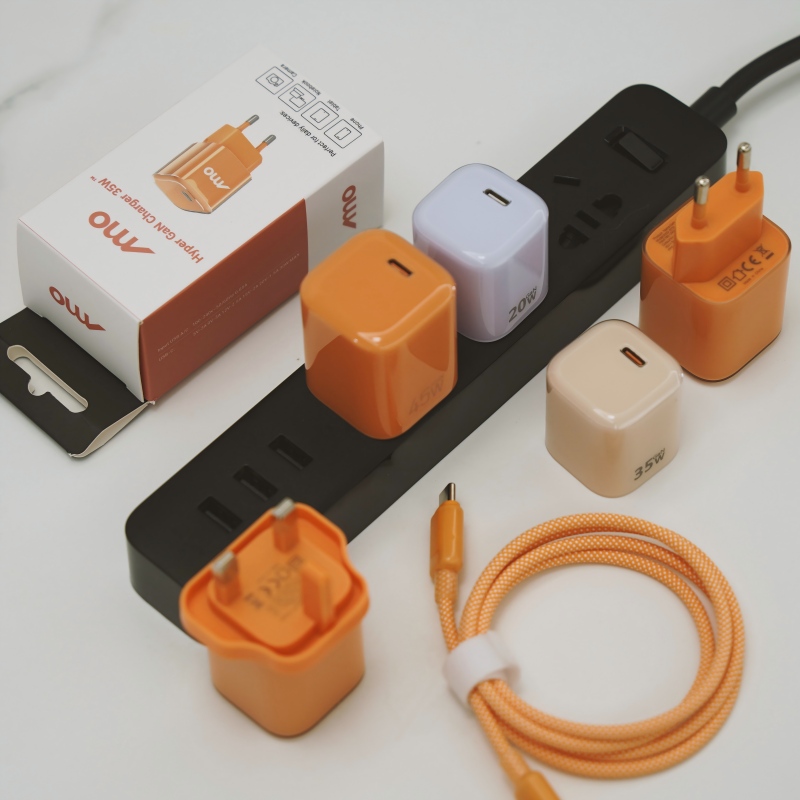
For brands, an iPhone-focused lineup should offer 20W entry, 30W mid, and 45W premium tiers. The 30W tier is the value sweet spot: fast for current models, headroom for use-while-charging, and future-proof for the next generation.
An iPhone-focused lineup benefits from a three-tier story: 20W as the entry and bundle SKU, 30W as the value tier with the broadest compatibility, and 45W as the premium tier for Pro users and future models. Each tier needs its own marketing angle — the 30W story is "fast today, ready for tomorrow," the 45W story is "full speed for Pro, headroom for years." The lineup then sells itself by usage, not by wattage.
Reading iPhone charging tests from independent sources
Trust tests that state the phone model, charger, cable, ambient temperature and starting battery level. Independent charge-speed tests show the same pattern: first-30-minute gains are the honest metric, not the label wattage.
Cable and connector impact on 30W charging
30W needs a cable that carries 1.5A at 20V — most quality USB-C cables handle this easily, but damaged or data-only cables cap the speed. Use a rated USB-C-to-C cable for USB-C iPhones and USB-C-to-Lightning for older models.
Wattage needs of iPhone plus accessories
If the charger also tops up AirPods and an Apple Watch, 30W single-port is fine sequentially, but a 45W dual-port lets phone plus accessory charge at once. Match the charger to the simultaneous load, not just the phone.
Adding accessories changes the wattage math because they charge simultaneously: an iPhone at 20–30W plus AirPods at 5W plus a Watch at 5W needs a 30–45W multi-port charger to keep all three moving at useful speeds. A single-port 20W charger forces sequential charging, which works overnight but slows morning top-ups. The household-friendly configuration is one 45W dual-port at the desk and a 3-in-1 wireless station at the nightstand, which covers every combination of phone, earbuds and watch without anyone queuing for a charger. For product content, this accessory-aware framing sells more than wattage alone, because it matches the real pattern of how people charge their Apple devices.
Battery temperature during 30W charging
Higher wattage generates more heat, and iPhones throttle charging as temperature rises. A 30W session on a cool phone is faster; in a hot car, both 20W and 30W taper. The phone manages this automatically — USB PD negotiation keeps it within safe limits.
More power means more heat, and heat is the main battery-ageing factor — which is why Apple caps and tapers aggressively. A 30W session on a cool phone is faster and safe; in a hot environment the phone throttles both 20W and 30W to the same safe level. The practical guidance: use 30W+ when the phone is cool, and don't charge in direct sunlight at any wattage.
What to check before buying an iPhone charger
Check USB PD support, certification for your market, cable compatibility, and the charger's sustained output. A certified GaN charger with honest specs beats an uncertified "fast" brick every time.
The pre-purchase checklist for iPhone chargers: USB PD support (3.0 or 3.1), certification for your market, a cable rated for the wattage, and honest sustained-output data. Skip chargers that publish only peak wattage, and verify the manufacturer's test conditions. A certified 30W charger from a reputable brand outperforms an uncertified 65W brick on every dimension that matters.
FAQ
Does an iPhone charge faster with a 30W charger?
On models that accept more than 20W, the early charging window is faster; on others the speed is the same. The bigger benefits are use-while-charging and future-proofing.
Is a 30W charger safe for an iPhone?
Yes. The phone negotiates the power it accepts through USB PD, so a 30W charger cannot overcharge or force extra current.
What is the best wattage for an iPhone 16 Pro?
30–45W covers current Pro models comfortably and leaves headroom for use while charging and future upgrades.
Why would I buy 30W if Apple says 20W is enough?
20W is the floor for Apple's stated fast-charge speed; 30W+ adds real-world benefits: faster early charging on newer models, better use-while-charging, and a longer useful life before the next upgrade.
Building an iPhone-focused charger line? Send your tier plans to our team through the contact page — we can spec 20W/30W/45W tiers with the right ports and certifications.
This article is part of iPhone Chargers, the guide that covers this topic in decision order.