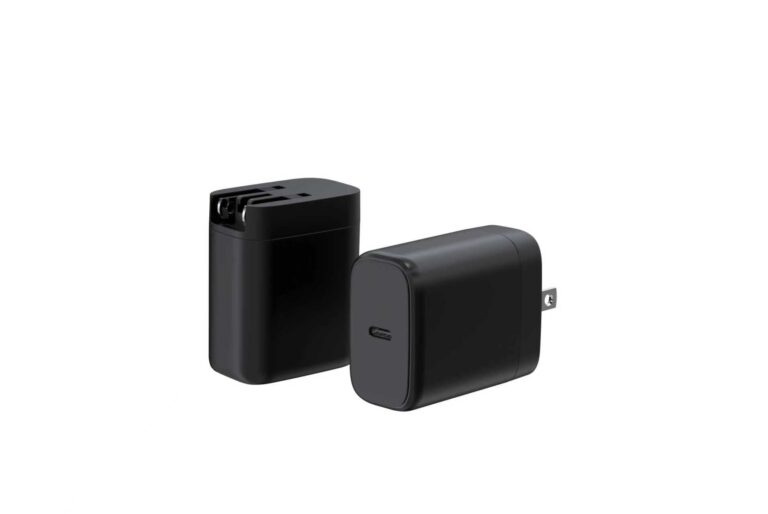
The best 65W USB-C PD charger OEM platform is the one whose configuration choices match the phone-laptop line it serves, and this ranking is organized around the decisions the 65W tier forces: the port layouts the line can defend, the plug strategy the markets require, the SKU matrix the platform can support and the sample path that proves it before volume. The 65W tier is the workhorse of phone-laptop lines — it covers most ultrabooks, adds headroom for a phone and tablet, and fits the majority of business travel — and the platform ranking is scored on how well those four decisions hold together.
Key takeaways
- The 65W platform decision is four choices made together: port layouts, plug strategy, SKU depth and the sample path.
- A flexible platform keeps the SKU matrix small: 1C for laptop-only users, 2C for phone-plus-laptop households.
- The platform is frozen before the SKUs, and the sample path proves it before the volume order.
Content updated: August 2026 — confirm current platform specifications and plug options on the product pages before ordering.
The 65W tier sets the platform question that every phone-laptop line must answer
The 65W tier concentrates the phone-laptop line's demand: the largest cluster of business laptops requests 45–65W, and the same brick is expected to top up a phone and tablet. That concentration makes the platform question concrete — not "how many watts" but "which configurations will the line defend." The ranking below scores platforms on the four decisions the tier forces: port layouts, plugs, SKU depth and the sample path. A platform that answers all four cleanly outranks one that answers one brilliantly and the rest awkwardly.
| Platform decision | What it determines | Where it shows up |
|---|---|---|
| Port layouts | Which SKUs the line can defend | The 1C/2C/1C1A matrix |
| Plug strategy | Which markets the line can enter | Fixed versus interchangeable |
| SKU depth | How simple the inventory stays | The catalog and the spare pool |
| Sample path | Whether the platform is proven | Before the volume order |
Port layouts decide which 65W SKUs the line can defend
The port layout is the physical offer, and the split map is the behavior. A 65W platform that supports the layouts the line needs — a single-port 1C for laptop-only users, a dual USB-C 2C for phone-plus-laptop households and a 1C1A where legacy devices still matter — can build a small SKU matrix on one certificate story. The ranking scores the split behavior first: the laptop must hold its share in each combination, and the map must be published per layout. A platform whose 2C keeps the laptop stable while the phone tops up outranks one that halves both.
| Rank | What to look for in the port layouts | Why it ranks there |
|---|---|---|
| 1 | Published split map per layout | The behavior is known before launch |
| 2 | Layouts matched to the target households | Each cluster gets a SKU |
| 3 | Cables rated for the negotiated profiles | Every path delivers what the map promises |
Fixed and interchangeable plugs serve different market strategies
The plug strategy follows the market list, and the ranking treats fixed and interchangeable plugs as two answers to the same question. A single-region line serves one plug set, and a fixed-plug platform keeps the certificate story and the inventory simple. A global line serves several plug regions, and an interchangeable-plug platform carries a common body with plug variants. The ranking scores the platform on how cleanly it serves the chosen strategy — a fixed-plug platform for a single market, an interchangeable one for a global line — rather than on which strategy is "better."
| Rank | What to look for in the plug strategy | Why it ranks there |
|---|---|---|
| 1 | Plugs matched to the market list | The line can enter its markets |
| 2 | Certificate matrix following the plug set | The evidence follows the markets |
| 3 | Inventory simplicity across variants | The common body keeps the stock clean |
The SKU matrix stays small when the platform stays flexible
The SKU matrix is where the platform decision becomes inventory. A 65W line that starts with two or three SKUs — the 1C, the 2C and, where the markets demand it, an interchangeable-plug variant — covers the clusters the audit names without inviting a long tail. The ranking scores platform flexibility highest: a platform that adds a variant without a new certificate story keeps the matrix small, and every SKU remains a cell the line can defend at reorder. The spare pool, the test records and the reorder thread all follow the matrix, and a small matrix keeps all three simple.
| Rank | What to look for in the SKU depth | Why it ranks there |
|---|---|---|
| 1 | Variants on one platform | New cells without a new certificate story |
| 2 | SKU count matched to the clusters | The catalog stays defensible |
| 3 | One document thread per platform | The reorder is a confirmation, not a rebuild |
The sample path proves the platform before the volume order
The sample path is where the platform decision is tested. Engineering samples validate the configuration; documentation samples validate the evidence; the golden sample becomes the reference; and the pilot proves the factory can reproduce it at volume. The pilot is also the moment to confirm that packaging, labeling and the certificate-to-configuration match survive the real production flow. The ranking treats the sample path as part of the platform decision — a platform that passes the gates with records is a platform that can be ordered with confidence, and one that fails a gate is a signal to re-review before volume.
| Rank | What to look for in the sample path | Why it ranks there |
|---|---|---|
| 1 | Written pass conditions at each gate | The approval is a record, not a feeling |
| 2 | Golden sample sealed and documented | The reference survives the program |
| 3 | Pilot result before the volume order | Production is proven, not assumed |
Freezing the platform before the SKUs is what keeps the line simple
The ranking closes with the sequencing rule: freeze the platform before the SKUs. The market audit names the clusters and the markets; the platform decision answers the port layouts, the plugs and the SKU depth; and the SKU matrix is built from that answer. A line that starts with the SKU list and works backward to the platform usually rebuilds both; a line that freezes the platform first builds once. The supply chain follows the same order — the MOQ, the lead time and the payment structure are confirmed against the frozen platform, and the first order is planned with the full buffer.
The reorder closes the loop the same way the launch opened it. Each shipment is confirmed against the golden sample with batch records and a configuration check, and any drift — a port layout change, a plug substitution or a certificate edition change — re-enters the review before the next order ships. The platform file is a living document: the port layouts, the plugs, the SKU matrix and the sample gates are re-read at the reorder rather than assumed to still hold. A 65W line that treats every order as a confirmation instead of a new negotiation keeps the certificate story current and the inventory simple, which is exactly what the platform decision was built to deliver.
For the platform side of a 65W line, the OEM & ODM Services page at WECENT describes the customization levels, the WEP Series GaN Chargers are the fixed-plug platform for single-region lines, and the WET Series GaN Chargers cover the interchangeable-plug travel side. To start a 65W line, submit the device audit and target markets to WECENT's project engineering team — the review returns the platform, plug and port proposal with the document set for the line.
Frequently Asked Questions
Which laptops does a 65W line cover?
Most ultrabooks and productivity laptops that ship with 45–65W adapters. The line covers the largest cluster of business laptops, with headroom for a phone and tablet.
How do I choose the port layouts for a 65W line?
From the target households: a 1C SKU for laptop-only users, a 2C for phone-plus-laptop households and a 1C1A where legacy devices still matter. The split map per layout is the specification.
Should a single-region 65W line use fixed plugs?
Fixed for a single region: one plug, one certificate story and simpler inventory. Interchangeable plugs earn their cost when the line serves multiple markets.
What documents does the 65W SKU need?
The certificate and test report naming the exact configuration and market, plus batch records for every shipment. The document set follows the market list.
How do I keep the SKU matrix small?
Start with two or three SKUs matched to the audit's clusters, and add a variant only when the platform carries it without a new certificate story. The reorder data decides the next cell.
How do I start a 65W OEM line?
Write the market audit first, freeze the platform against it, then build the SKU matrix and run the sample path. The sequencing is what keeps the line simple.
This article is part of Laptop Charger OEM & Fleet Programs, the guide that covers this topic in decision order.