
A GaN charger is a power adapter built on gallium nitride transistors instead of silicon — the reason 65W now fits in a brick that used to hold 30W. This article covers what actually changes inside, and how to verify a “GaN” claim before you buy or OEM one.
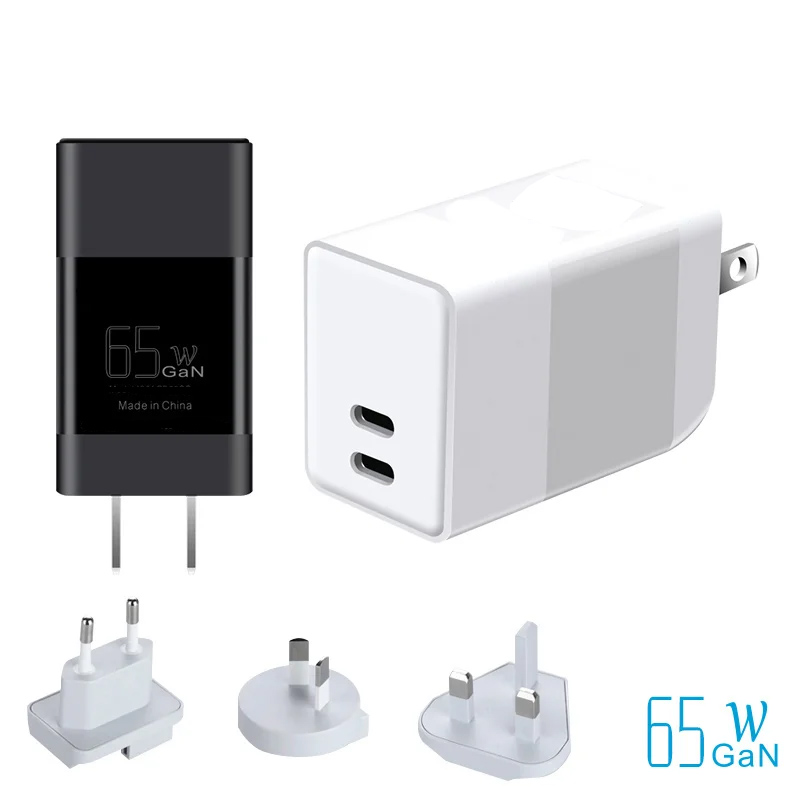
What Is a GaN Charger, in Plain English
Strip away the jargon and the difference is one material swap. The switching transistors inside the charger are made of gallium nitride rather than silicon, and because GaN switches on and off faster while handling higher voltages in a smaller die, the rest of the circuit shrinks with it: smaller transformer, smaller capacitors, less heatsinking.
The visible result is the pocket-size 65W and 100W bricks that did not exist a few years ago. Before GaN went mainstream, a 100W laptop charger was a heavy slab; today the same power fits in a foldable travel adapter that weighs half as much.
GaN vs Silicon: Size, Heat and Efficiency Compared
Here is the comparison that matters to an engineer or a buyer, with the caveats included. GaN is an enabler, not a guarantee: a badly designed GaN charger can still run hot, and a good silicon design can beat a mediocre GaN one.
| Property | Silicon (Si) charger | GaN charger |
|---|---|---|
| Switching frequency | 65–150 kHz typical | Can run 300 kHz – 1 MHz+ |
| Power density | Baseline | Roughly 1.5–2× smaller for the same wattage |
| Typical efficiency | 85–92% at best point | 90–96% at best point (design-dependent) |
| Heat at 65W | Noticeably warm under load | Cooler in a well-designed unit |
| BOM cost | Lower | Higher, but falling every year |
| Best use today | Low-cost 5–20W adapters | 30W–240W fast charging |
What “GaN” Really Means (Gallium Nitride in 60 Seconds)
Gallium nitride is a wide-bandgap semiconductor: its bandgap is about 3.4 eV versus silicon’s 1.1 eV. In practical terms, that means it can block far higher electric fields in a much smaller device, switch faster, and waste less energy as heat. The same physics behind GaN LEDs and 5G amplifiers is what does the heavy lifting inside your charger. For the material science, the Wikipedia gallium nitride article is a solid start, and Infineon’s GaN pages explain the device-level detail.
GaN Fast Charging: PD, PPS and What Your Devices Actually Use
People frequently mix up GaN with USB Power Delivery and PPS. They are different layers: GaN is the semiconductor that converts power efficiently, while PD and PPS are the protocols that negotiate how much voltage and current your phone or laptop receives.
When you plug in, the charger advertises its power profiles and the device picks one — 5V/3A, 9V/3A, 15V/3A, 20V/5A and so on. PPS goes a step further by letting the device request a precise voltage in fine steps for a better charging curve. If you want the protocol layer explained end to end, our guide to what a PD 3.0 charger is and why it matters for B2B buyers walks through it.
How a Factory Verifies a “GaN” Charger (and What You Should Ask For)
Most products labelled GaN really do contain GaN devices — the label just tells you nothing about quality. At our own factory (WECENT, a GaN and wireless charger manufacturer based in Shenzhen Bao’an with a dedicated manufacturing site in Dongguan), “GaN” is checked the same way every other spec is checked: against a defined test and against the batch record. Four checks separate marketing from engineering:
- Ask for the component. Which GaN device (manufacturer and part number) is inside? A real answer names a part; a vague answer is a red flag.
- Ask for measured data. Efficiency at 25/50/75/100% load and surface temperature at rated output. Numbers beat adjectives.
- Match certificates to the model. CE, FCC, RoHS and regional marks such as PSE and KC are model-dependent — confirm the certificate references your exact SKU. Our CE, FCC and RoHS guide for GaN OEM projects lists what to request.
- Check the test evidence. In an ISO9001-based system, every batch is traced: incoming material and BOM verification, ESD-controlled PCBA, board-level visual checks, 100% electrical and functional testing, hi-pot pressure tests, load aging, appearance checks and QA sampling with a per-batch shipment inspection report. That is the paper trail that turns a claim into a record.
Independent teardown and efficiency data from ChargerLAB, plus coverage in Power Electronics News and EE Times, are good reality checks before you trust any claim. The protocol definitions behind fast charging live in the USB-IF specifications, and wireless-related GaN applications are tracked by the Wireless Power Consortium.
What OEM Buyers Get from a GaN-Specialist Factory
For brands and wholesalers, sourcing GaN from a factory that only builds chargers changes three things: the power platform you can start from, the level of customization, and the paperwork behind every batch. Our lines cover 20W–240W across the WEG, WEP and WET series (power range and certifications are model-dependent), and projects move through three customization levels — quick OEM launch, enhanced OEM, and full ODM — so you can validate a SKU at a low MOQ of 200 pcs before scaling. A read-through of the 30W GaN charger breakdown for market-ready SKUs and the 65W GaN charger deep-dive shows the design detail we publish, and the factory page gives the structured capability snapshot.
Start Your GaN Project
Tell us the wattage tier, ports and target markets you need, and we will confirm the platform, certifications and MOQ on that model before you commit. Send the inquiry through the contact page or start from the GaN charger product line; the full project flow is on the OEM/ODM customization page and the quality system behind it on quality control.
FAQ
Is a GaN charger worth it? For 30W and above, yes — smaller, cooler and usually more efficient. Below that, the difference is small.
Can a GaN charger charge a laptop? Yes. 45W+ GaN chargers with USB-C PD cover most thin-and-light laptops; 100W and 240W versions handle high-power machines.
Is GaN safe? GaN itself is safe in certified designs. What matters is the certification and quality control of the finished charger, not the material.
How do I know a charger really uses GaN? Ask for the GaN device part number, measured efficiency data, model-matched certificates and batch test evidence.
Can I OEM a GaN charger with my own branding? Yes. MOQ starts at 200 pcs, with logo, color, plugs and packaging customization across three OEM/ODM levels.