
GaN Chargers
GaN does not raise the wattage. It shrinks the package — and moves the cost into heat and interference.
This is the starting point for every gallium nitride decision. Work down through what the technology changes, the wattage tiers it enables, and the port configurations that outlive the chip choice.
- Three routes below cover every GaN charger decision
- 37 guides organised by the question they answer
- Every route ends at a wattage tier and a port configuration
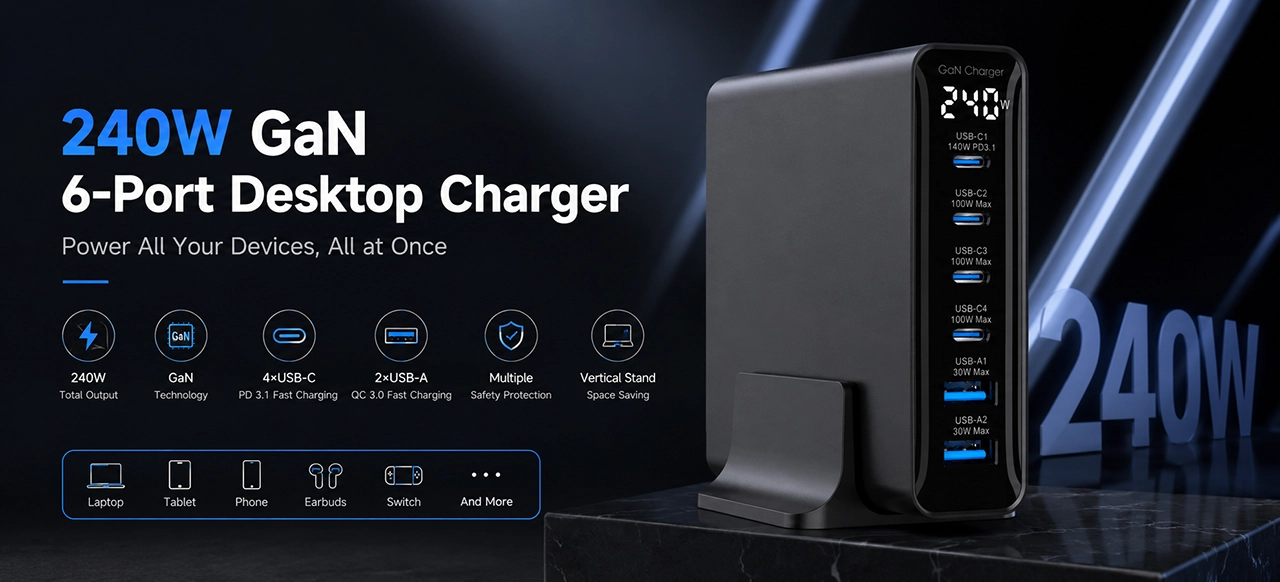
Three routes, and you only need one of them
Understanding the technology, choosing a tier and choosing a port layout are three different decisions, and only one of them is hard to change later.
Understand what GaN changes
GaN switches faster and loses less energy doing it, so the same wattage fits in less copper and less heatsink. That is the entire commercial argument, and it is worth understanding before you compare products.
Pick a wattage tier
Pick the tier from the device list, not from the largest number on the shelf. Above 100W the constraints shift to cables, EPR negotiation and wall-circuit limits.
Choose a port configuration
Port count and split behaviour decide whether a charger is pleasant to live with. A 140W brick that divides badly is worse than two 65W bricks.
The trade-offs the smaller package creates
Every millimetre saved is paid for in heat, noise or interference. These are the three places a cheap GaN design shows its cost.
Thermal design and interference
Thermal design stops being passive when the surface area shrinks, which is why conduction paths and enclosure materials become specification items rather than details. Switching faster also produces more high-frequency noise, and controlling it costs components and board space.
The symptoms you can hear and measure
Coil whine and inrush behaviour are the audible and electrical consequences of compressing a power stage. Both are fixable, but only if they are designed for rather than discovered in the field.
Lifespan and safety
A GaN charger that runs hot ages differently from one that does not. Aging tests are how you find out which one you built, and the safety set is what you show a customer when they ask.
The scenarios GaN unlocked
Once the package is small enough, the product can be designed for the bag rather than the desk, and device classes that never had a proper charger become viable.
Ruggedised and handheld
Drops, vibration and packing pressure are now design inputs rather than afterthoughts. Handheld gaming is the clearest example of a device class that only got a sensible charger after GaN made the power density possible.
Why it is the direction of travel
The reason to plan a line on GaN is not fashion. It is that the same wattage can be sold in a shape customers will carry, and that shape is now the basis of competition in every tier above 30W.
What actually decides whether a GaN charger is any good
Four things, in this order. The GaN chip itself is the least of them.
The thermal solution
A smaller package means less surface area to lose heat from. Conduction paths and enclosure materials decide whether the unit holds its rating or throttles after twenty minutes.
Interference control
Faster switching produces more high-frequency noise. Suppressing it costs components and board space, which is precisely where a cheap design saves money it should not.
The port split behaviour
A multi-port unit shares its total, and the allocation policy decides which device gets throttled. Documented split maps are what separate a usable brick from a disappointing one.
The cable in the box
Above 100W the cable has to be E-marked and rated for 5A. Shipping a unit without it produces a product that never reaches its own headline number.
Where to go from here
The GaN cluster connects to four neighbours. Pick the one that matches your next question.
GaN charger questions
The short answers. Each one links into the guide that covers it properly.
Is a GaN charger actually better than a silicon one?
For the same wattage, yes in most practical terms: smaller, lighter and usually cooler, because switching losses are lower and the thermal solution can be smaller. The advantage is largest above 65W. At low wattages the difference is mostly size, and a well-built silicon charger remains entirely acceptable.
Does GaN shorten a battery life or damage a device?
No. GaN changes the charger internal switching, not the output protocol. The device still negotiates the voltage and current it wants over USB-C PD, so a certified GaN charger behaves like any other compliant supply at the port.
Why do some GaN chargers get hot or make a noise?
Because the package is smaller relative to the power it handles, and faster switching creates high-frequency noise. Heat is managed through conduction paths and enclosure materials, and audible coil whine is a mechanical resonance a good design suppresses.
Is SiC better than GaN for chargers?
Silicon carbide suits higher voltages and higher power, so it appears in industrial and EV applications rather than in a phone charger. For the 30W to 240W range of consumer chargers, GaN is the more cost-effective choice.
What wattage GaN charger should I buy?
Match it to the heaviest device you will charge: 30W to 45W for phones, 65W for ultrabooks, 100W for full-size laptops and multi-device desks, and 140W to 240W only if you genuinely run premium or workstation hardware.
Request a platform review
Send us the wattage tiers you are considering and the devices they have to cover. We will come back with the port configuration that fits, the thermal and EMI constraints of the chosen package, and the SKUs that cover the range without overlap.