
Three figures decide whether a power-bank air shipment is document-ready: the watt-hour rating a carrier can verify, the UN assignment on the file, and the state of charge at which packed batteries actually leave the factory. IATA’s 2026 Lithium Battery Guidance — guidance only, not a substitute for the DGR — puts those figures in writing. This page is the document pack a buyer should request before the first flight, with every threshold taken from that official text, not from memory.
UN38.3, UN3481 and IATA: which document answers which question
UN 38.3 is the test regime; UN 3480, UN 3090 and UN 3481 are classifications; IATA’s DGR and Battery Guidance cover packing, marks and air acceptance. A power-bank OEM file needs all three from official text. A test report does not pick the UN number, and a UN number does not set state of charge.
IATA’s guidance is explicit that power banks “designed to primarily provide power to another device” are classified as batteries, “not batteries contained in equipment,” and “must be assigned to UN 3480, lithium ion batteries, or UN 3090, lithium metal batteries, as applicable.” UN 3481 is the entry for lithium-ion batteries packed with, or contained in, equipment. The keyword in many search boxes is UN3481; the official assignment for a standalone power bank, as that guidance currently reads, is not UN 3481. Write the file against the text, not against the search term.
Keep the deeper official map on IATA’s lithium-batteries cargo page and the 2026 Battery Guidance PDF. Passenger-facing rules sit on a different map, on IATA’s passenger dangerous-goods guidance and the 2026 passenger PDF, together with FAA PackSafe. This article will not invent a fourth map.
Energy (Wh), cell type and what a buyer must be able to show a carrier
Watt-hours, not milliamp-hours, are the energy figure official air-transport texts use. IATA’s passenger guidance records the calculation Wh = Ah × V, and it expects a Wh marking staff can verify. The cargo file should use the same figure as the test summary and as the mark on the battery or pack, for the chemistry actually used — lithium-ion or lithium-metal — because that choice is what selects UN 3480 or UN 3090.
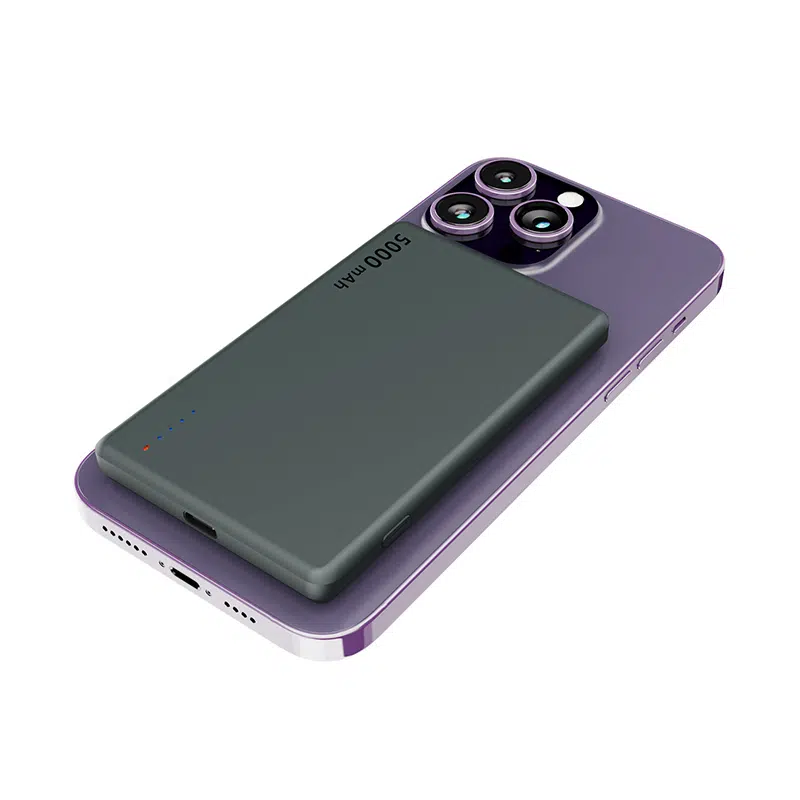
The live L8 product page publishes wireless output as 15W, 10W, 7.5W and 5W, and a Type-C input, and it does not, in that product table, publish a watt-hour rating. A gallery photograph on the same page prints “5000mAh (3.85V/19.25Wh).” That arithmetic follows Wh = Ah × V, but a catalog photograph is not a UN 38.3 test summary, and this article will not treat 19.25Wh as a completed, lot-verified transport figure. If you cannot defend the Wh number from cell documents, do not print it as a finished claim.
State-of-charge at shipment and why a factory default may be wrong for air
For lithium-ion batteries packed by themselves under Packing Instruction 965, IATA’s 2026 guidance requires a state of charge not exceeding 30% of rated capacity, unless approved under Special Provision A331, and it bars passenger-aircraft cargo unless approved under A201. A factory that ages or ships units fully charged is following a production habit, not that packing instruction. Write SoC at shipment into the OEM packing clause, and check it on the units that actually go to the airport.
Retail units that will later travel in a passenger cabin are a different conversation, and the official passenger texts are not identical: FAA PackSafe and IATA’s 2026 passenger guidance do not currently read the same way on 100–160 Wh power banks. A cargo SoC clause does not replace a passenger-facing card, and a passenger card does not replace PI 965. Keep them separate, and re-open the current official pages before either is printed.
The test-summary and design-change rules that surprise first-time exporters
IATA’s guidance requires that lithium cell and battery types have passed Subsection 38.3, and that a test summary be made available by the manufacturer and subsequent distributors. It describes a website or QR as acceptable access. First-time exporters are often surprised by two consequences: the summary has a defined content list — manufacturer, laboratory, tests passed, and a responsible person’s name among them — and a mid-run cell or design change can make the existing summary no longer representative. The OEM contract should say who owns the current summary, how a buyer retrieves it, and that a cell change is a stop, not a colour change.
How this sits with A024’s Qi2 power-bank program view and A037’s label view
A Qi2 program article asks how the cell pack, the magnet array and the charge path are specified as a product. This page assumes that product conversation is in hand, and asks only for the air-freight document pack: UN 38.3, the UN assignment, Wh, SoC, and the test summary. The published explainer on what a Qi2 certified MagSafe-style power bank is is the product-identity companion already on this site; this article will not rewrite it, and it will not point to a document-pack or label-check URL that is not yet live. The front-line label checks that warehouse and carrier staff actually perform are a separate intake job, and should be written against the same official IATA and FAA marks, not as a second copy of this test-regime page.
A document pack to request before the first air shipment
| Document or figure | What the official text is answering | What a buyer should not accept instead |
|---|---|---|
| UN 38.3 tests and the test summary | IATA guidance: tests in Subsection 38.3; a test summary made available by the manufacturer and distributors | A photograph, a “we have UN38.3” email, or a summary that cannot be retrieved |
| UN assignment | IATA guidance: power banks as UN 3480 or UN 3090, not “contained in equipment” | A default UN 3481 mark without reading the current text |
| Watt-hours | Wh = Ah × V, and a marking staff can verify, as passenger guidance describes | A mAh headline, or a catalog figure treated as a lot-verified file |
| State of charge at shipment (PI 965) | SoC not exceeding 30%, unless A331 approval is in hand; passenger-aircraft cargo only with A201 | A factory “ship fully charged” default |
Ask for that pack on the same RFQ as the product specification, and keep a copy with the first air booking. The power banks and power stations catalog is where published product facts live; it is not the transport file.
Retailer and marketplace lithium rules that sit on top of the UN/IATA baseline
Carriers, retailers and marketplaces often add intake rules on top of the IATA baseline: a portal that asks for a test summary before a listing goes live, a warehouse that will not receive a carton without a visible Wh mark, or a marketplace policy that restates passenger limits in its own words. Those rules do not relax the DGR. They also do not authorise a sell-sheet to invent a tighter or looser Wh threshold and present it as “the IATA rule.” Put the official baseline in the OEM file first; then attach the named retailer’s current intake checklist as a second exhibit, dated, and re-checked when the retailer revises it.
Travel-retail programs that sit beside travel chargers and plug adapters, or that ship through the same carton family as a travel-charger SKU, still need a power-bank-specific lithium file. A charger carton and a power-bank carton are not interchangeable for this purpose.
What writers must re-verify on official IATA and UN text — no remembered thresholds
Wh thresholds for passengers, the 30% SoC figure, Special Provisions A331 and A201, and the UN 3480 assignment for power banks were all read, for this article, from the IATA 2026 guidance and the passenger PDF cited above, and from FAA PackSafe as a second official passenger map. Those documents are edition-dated. A later DGR, a later ICAO Technical Instructions cycle, or a stricter airline rule can change what a factory is allowed to print. This page will not freeze a remembered number as if it were permanent, and it will not attribute a WECENT certificate, a WECENT-tested Wh, or a WECENT UN 38.3 report that has not been produced for the lot in question.
When a power-bank OEM program should refuse a cell change mid-run
A mid-run cell change is the event that most often quietly invalidates the file. A different cell, a different manufacturer, a different energy, or a different protection arrangement can take the existing 38.3 summary out of date and can change the Wh figure that must be marked. The honest program response is to stop, re-file the tests and the summary, and only then resume shipment — not to treat the change as a purchasing convenience. Write that stop into the OEM agreement before the first purchase order, so it is not negotiated on the loading dock.
Claims this article will not make: invented Wh limits or WECENT certificates
This article will not invent a Wh passenger limit, a SoC figure, or a UN number that is not in the official text just cited. It will not say that WECENT holds a named UN 38.3 certificate, a completed test summary, or a verified Wh for L8 or any other model, because those items remain to be verified from product documents. It will not treat FAA and IATA passenger texts as if they were one rule. It will not present a catalog photograph as a transport certificate.
Conclusion
A power-bank OEM air-freight file is a short, official pack: a UN 38.3 test summary that can actually be retrieved, a UN assignment that follows IATA’s current classification of power banks, a watt-hour figure that matches the mark, and a state-of-charge clause written against Packing Instruction 965. Anything else is a product conversation, or a label-intake conversation, and should stay on its own page.
If you are scoping a power-bank OEM program and need a sourcing discussion, a quotation or a sample plan — not an order — start from WECENT OEM and ODM and say which documents in this pack you already hold.
FAQ
How does IATA classify a power bank for air transport?
IATA’s 2026 Lithium Battery Guidance Document, which is guidance and not a substitute for the DGR, is explicit: power banks, power packs and similar devices “designed to primarily provide power to another device” are classified as batteries, not as batteries contained in equipment, and “must be assigned to UN 3480, lithium ion batteries, or UN 3090, lithium metal batteries, as applicable.” UN 3481 is the entry for lithium-ion batteries packed with, or contained in, equipment — a different assignment, used only when that description actually applies. A first air-freight file should be written against the assignment in the current official text, not against a casual “UN 3481 on the carton” habit.
What watt-hour figure should be on the file, and how is Wh calculated?
IATA’s passenger guidance uses the relationship watt-hours = ampere-hours × nominal voltage. The same guidance expects a Wh marking that staff can verify. For a cargo program, the Wh figure in the documentation, on the battery case or pack as required, and in the test summary must agree. A milliamp-hour headline, or a number that appears only on a catalog photograph, is not by itself a completed transport file. If a live product page does not publish a Wh figure you can defend, ask for it in the cell documentation before the first shipment.
What state-of-charge limit applies when lithium-ion power banks are shipped as cargo?
For lithium-ion batteries packed by themselves under Packing Instruction 965, IATA’s 2026 guidance states that they must be shipped at a state of charge not exceeding 30% of rated capacity, unless approved under Special Provision A331 by the State of Origin and the State of the Operator, and that they cannot be shipped as cargo on a passenger aircraft unless approved under Special Provision A201. Because the same guidance assigns power banks to UN 3480, a cargo program should write SoC at shipment into that packing instruction. A factory “fully charged for ageing” default is not a substitute for that rule.
Does a UN 38.3 test summary have to travel with every shipment?
IATA’s guidance states that all lithium cell and battery types must have passed the applicable tests in Subsection 38.3 of the UN Manual of Tests and Criteria, and that a test summary as specified in that Manual must be made available by the manufacturer and subsequent distributors. The guidance describes website or QR access as acceptable ways to make the summary available. That is not the same as packing a paper copy in every carton, and it is not the same as a photograph of a nameplate. The OEM file should say where the current summary lives, who can retrieve it, and that a cell or design change requires the summary to be checked again.
{
“@context”: “https://schema.org”,
“@type”: “FAQPage”,
“mainEntity”: [
{
“@type”: “Question”,
“name”: “How does IATA classify a power bank for air transport?”,
“acceptedAnswer”: {
“@type”: “Answer”,
“text”: “IATA’s 2026 Lithium Battery Guidance Document, which is guidance and not a substitute for the DGR, is explicit: power banks, power packs and similar devices “designed to primarily provide power to another device” are classified as batteries, not as batteries contained in equipment, and “must be assigned to UN 3480, lithium ion batteries, or UN 3090, lithium metal batteries, as applicable.” UN 3481 is the entry for lithium-ion batteries packed with, or contained in, equipment — a different assignment, used only when that description actually applies. A first air-freight file should be written against the assignment in the current official text, not against a casual “UN 3481 on the carton” habit.”
}
},
{
“@type”: “Question”,
“name”: “What watt-hour figure should be on the file, and how is Wh calculated?”,
“acceptedAnswer”: {
“@type”: “Answer”,
“text”: “IATA’s passenger guidance uses the relationship watt-hours = ampere-hours × nominal voltage. The same guidance expects a Wh marking that staff can verify. For a cargo program, the Wh figure in the documentation, on the battery case or pack as required, and in the test summary must agree. A milliamp-hour headline, or a number that appears only on a catalog photograph, is not by itself a completed transport file. If a live product page does not publish a Wh figure you can defend, ask for it in the cell documentation before the first shipment.”
}
},
{
“@type”: “Question”,
“name”: “What state-of-charge limit applies when lithium-ion power banks are shipped as cargo?”,
“acceptedAnswer”: {
“@type”: “Answer”,
“text”: “For lithium-ion batteries packed by themselves under Packing Instruction 965, IATA’s 2026 guidance states that they must be shipped at a state of charge not exceeding 30% of rated capacity, unless approved under Special Provision A331 by the State of Origin and the State of the Operator, and that they cannot be shipped as cargo on a passenger aircraft unless approved under Special Provision A201. Because the same guidance assigns power banks to UN 3480, a cargo program should write SoC at shipment into that packing instruction. A factory “fully charged for ageing” default is not a substitute for that rule.”
}
},
{
“@type”: “Question”,
“name”: “Does a UN 38.3 test summary have to travel with every shipment?”,
“acceptedAnswer”: {
“@type”: “Answer”,
“text”: “IATA’s guidance states that all lithium cell and battery types must have passed the applicable tests in Subsection 38.3 of the UN Manual of Tests and Criteria, and that a test summary as specified in that Manual must be made available by the manufacturer and subsequent distributors. The guidance describes website or QR access as acceptable ways to make the summary available. That is not the same as packing a paper copy in every carton, and it is not the same as a photograph of a nameplate. The OEM file should say where the current summary lives, who can retrieve it, and that a cell or design change requires the summary to be checked again.”
}
}
]
}