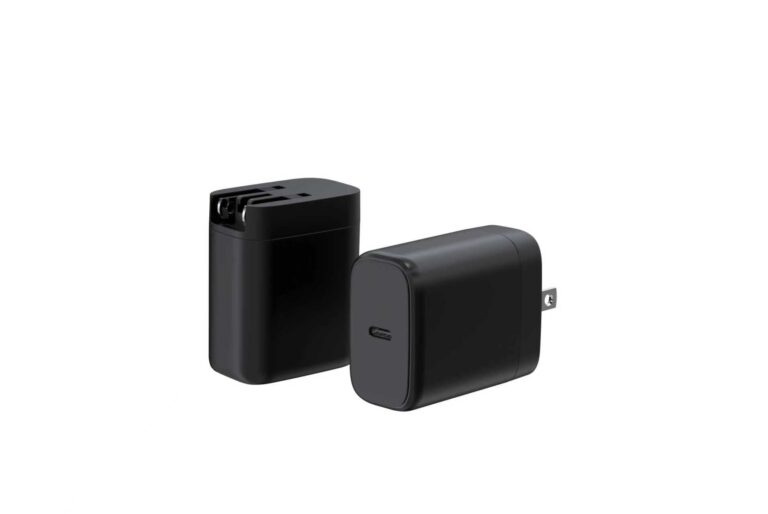
Standardizing laptop chargers means choosing one small set of charger SKUs that covers an entire corporate fleet instead of every laptop model pulling its own adapter out of a drawer. Done well, it cuts inventory complexity, reduces support tickets, simplifies compliance documentation and makes procurement predictable. Done badly, it forces one charger onto machines that need different power and creates the dead stock it was meant to avoid. This playbook walks IT and procurement teams through the audit, the wattage decision, the one-SKU-vs-regional-SKU tradeoff, rollout and replacement cycles, and the metrics that prove the program is working.
Audit the Fleet Before Choosing a Wattage
The standardization decision starts with data, not a catalog. Inventory the fleet: which laptop models exist, what wattage each one requests, which connector each uses, and how many units sit in each tier.
The GaN charger range is a useful reference here because it shows the wattage tiers and port layouts you are standardizing against.
| Device class | Typical charging need | Standardized choice |
|---|---|---|
| Thin-and-light ultrabooks | 45–65W | 65W tier |
| Mainstream business laptops | 65–100W | 100W tier |
| High-performance and workstation laptops | 100–140W+ | 140W tier (or 100W + explicit exceptions) |
The audit usually reveals a long tail: a few models cover most of the fleet, and a handful sit far from the middle. The practical rule is to pick the tier that covers the largest groups cleanly and manage the exceptions explicitly instead of forcing one charger on everything. Matching or exceeding the original adapter’s wattage is the safe rule — a charger rated below the laptop’s request charges slowly or not at all under load.
The audit must also separate USB-C laptops from machines with proprietary connectors. If a legacy model uses a proprietary plug, a USB-C standard cannot cover it, and the program needs a decision: keep a small legacy pool, or accelerate that model’s refresh. Recording three fields per model — wattage, connector type and regional plug — gives you the table every later decision depends on.
One SKU vs Regional SKUs
The second decision is the plug strategy, and it splits into two models with real tradeoffs:
| Approach | How it works | Advantages | Tradeoffs |
|---|---|---|---|
| Fixed-plug SKU per region | One regional plug per SKU (EU, UK, US, AUS) | Lower per-unit cost, simple per-region certification, clean inventory | Each market needs its own stock; a forecast error in one region cannot be absorbed by another |
| Interchangeable-plug SKU | One charger with swappable plugs | One SKU covers global programs and travelers; fewer part numbers | Higher per-unit cost; certification covers each plug configuration |
For a fleet operating in one region, a fixed-plug SKU is usually right: it is cheaper, the label and certification are simple, and inventory is one SKU per market. For a global organization or a heavy travel population, an interchangeable-plug SKU collapses the part count. Many organizations run a hybrid: a regional fixed-plug charger for the standard fleet plus a small interchangeable-plug pool for travelers.
The practical reality includes friction the tradeoff table does not show. Multi-country rollouts mean label and packaging versions per region — a single SKU still needs region-correct regulatory marks and language sets, and someone has to own that mapping. And when the certificate number on the paperwork does not match the shipped configuration, the question of who fixes it — supplier, buyer or importer — should be answered before the PO, not after customs asks. The WEP series is a fixed-plug OEM platform for regional lines, and the WET series is the interchangeable multi-plug platform for travel and global programs; both are useful reference points when you evaluate suppliers.
Expert view — WECENT project engineering team: On SKU strategy, our advice is to start from the fleet geography, not the price list. If 80% of the fleet sits in one region, a fixed-plug SKU for that region plus a small interchangeable-plug travel pool usually beats a global SKU on both cost and certification simplicity. The hybrid is less glamorous than a single part number, but it matches how fleets actually move.
Rollout, Inventory and Replacement Cycles
Standardization only pays off if the operational plan is concrete, and it only proves itself if the metrics are measured. Track these from the start:
| Metric | What it measures | Direction that means success |
|---|---|---|
| Active charger SKUs in the pool | Inventory complexity | Falling |
| Charger support tickets per month | Helpdesk load | Falling |
| Adapter replacement rate | Reliability and user behavior | Falling |
| Compatibility coverage | % of fleet devices covered at full speed | Rising |
| Spare-pool fill rate | Whether the pool matches demand | Stable, not stockpiled |
Rollout. A phased rollout beats a big-bang swap. Start with one department, measure adoption and tickets, then expand. Each phase should verify that the chosen charger covers that group’s devices at full speed.
Inventory. The spare pool is where standardization wins or loses. One charger SKU per region means one pool serves every laptop in that region — fewer part numbers, fewer dead adapters, simpler replenishment. Size the safety stock from the refresh cycle and ticket history rather than a guess; a common planning question is how many spares to hold per 100 devices, and the honest answer depends on your replacement rate and delivery lead time.
Replacement. Laptops turn over every three to five years, and each refresh is a chance to re-verify the standard. When a new generation raises its power request or moves to USB-C, the tier may need to move with it. Schedule a fleet re-audit with every refresh cycle and keep the standard aligned with the device roadmap.
The rollout also needs the documentation support teams live on: a one-page spec per charger, a compatibility list naming covered models, and answers to the two most common tickets — “why is my laptop charging slowly” and “which cable do I use.” When the helpdesk has the same facts the spec freeze was built on, tickets resolve faster and the standard stops being re-litigated at every desk.
Expert view — WECENT project engineering team: The metric that tells us whether a standardization program is working is the replacement rate, not the initial cost per unit. A slightly more expensive charger that survives the refresh cycle and halves the spare pool usually wins the total-cost comparison — and that is the number IT leadership understands.
ESG and Device Lifecycle Angles
Standardization is also a sustainability story, and it should be told with process data, not slogans. Fewer charger SKUs means fewer adapters manufactured and replaced. Efficient chargers — GaN is one example — consume less energy per charge over a multi-year lifecycle.
For the ESG case to hold up:
- Track the SKU count, replacement rate and energy-related documentation instead of inventing percentages.
- Request compliance documentation relevant to your markets, such as substance restrictions (for example RoHS) and energy-efficiency programs where they apply.
- Build an end-of-life path: verified reuse in the spare pool, then responsible recycling or disposal through approved channels.
- Align the charger refresh with the laptop refresh so adapters are not replaced mid-cycle.
The honest framing: standardization reduces the number of adapters, and good design reduces the energy per adapter. Both claims should be backed by the metrics above, not by marketing language.
A Procurement Timeline for Standardization
| Phase | Actions | Output |
|---|---|---|
| 1. Discovery | Fleet audit, wattage and connector map, regional requirements | Fleet inventory table |
| 2. Spec freeze | Choose tier, plug strategy, port layout, certification scope | Approved charger spec |
| 3. Sample and pilot | Validate with real fleet devices; run a department pilot | Pilot results and approval |
| 4. Rollout | Phased deployment, spare pool, support documentation | Standardized fleet |
| 5. Review | Track metrics; re-audit at refresh | Annual standardization review |
Anchor the timeline to the next laptop refresh cycle, because that is when the fleet changes anyway. A program that starts six months before a refresh has a natural test population; one that starts mid-cycle has to justify replacing working adapters. Change management belongs in the timeline too: announce the standard, publish the compatibility list, and give employees a way to report a device that does not fit. The goal is not to eliminate exceptions — a long tail always exists — but to make them visible and deliberate.
Send your fleet model list to the WECENT configuration team — you will receive a charger standardization recommendation with the wattage tiers, plug strategy and sample path for your device mix, without committing to volume.
Frequently Asked Questions
How do I pick one wattage for a mixed fleet?
Audit the fleet first and choose the tier that covers the largest groups at or above their requested wattage. Manage exceptions explicitly instead of forcing one charger onto every machine.
How many spare chargers should we keep per 100 devices?
There is no universal number; size the pool from your replacement rate and delivery lead time. Track the spare-pool fill rate and adjust quarterly until it stabilizes instead of stockpiling.
Should we standardize on fixed or interchangeable plugs?
It depends on where the fleet operates. Fixed-plug SKUs per region are cheaper and simpler for single-region fleets; interchangeable plugs reduce SKUs for global programs and travelers. A hybrid pool is a practical option.
What do we do about laptops with proprietary connectors or 100W+ demands?
Keep them as explicit exceptions with a small dedicated pool, or accelerate their refresh into USB-C models the standard covers. The audit table is where these exceptions become visible instead of accidental.
What certifications matter for a corporate fleet?
The certifications for the regions where the fleet operates — for example CE and RoHS in the EU, FCC in the US. Certificates must name the exact model configuration, and model-specific reports should be available on request.
Can OEM branding be added to standardized chargers?
Yes. WECENT is an OEM/ODM partner, so logo, colors and packaging can be customized on its fixed-plug and interchangeable platforms, with MOQ and customization depth depending on the project level.
Sources
- WECENT – WEP Series GaN Chargers
- WECENT – WET Series GaN Chargers
- WECENT – OEM & ODM Services
- WECENT – Quality Control
- WECENT – Contact Us
- U.S. Department of Energy – Official Website
- European Commission – Official Website
This article is part of Laptop Charger OEM & Fleet Programs, the guide that covers this topic in decision order.