
Wireless Charger Products & OEM
The form factor decides the price band. The mould decides how fast you can launch.
This is the commercial half of the wireless charging topic: which product to build, how to source it, and what a wholesale order should actually verify. The technology itself is in the Wireless Charging guide.
- Three routes below cover the product, the programme and the order
- 30 guides organised by the question they answer
- Every route ends at a form factor, a mould decision and a price band
Three routes, and you only need one of them
Choosing a product, running a programme and placing a wholesale order are three different jobs. Start with the one you are actually doing.
Choose the product form
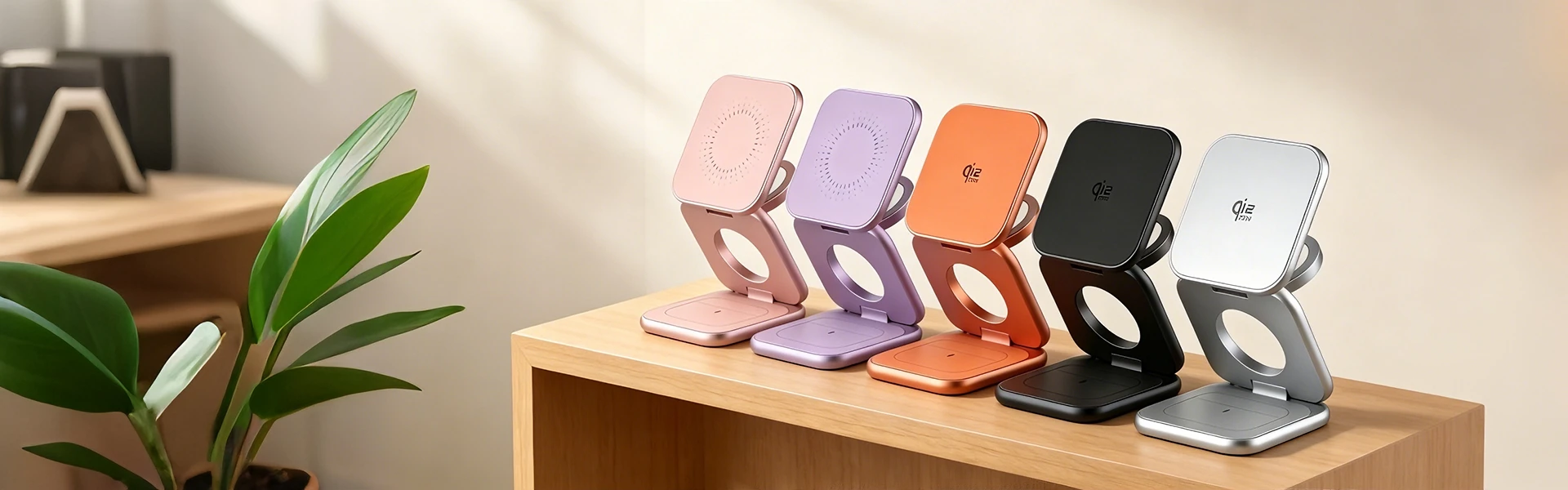
Stand, pad, foldable or built-in. Each form has a different hinge life, thermal path and price band, and the form is what the customer actually buys.
Build and source a line
Adapting an existing mould is weeks; a new enclosure is months plus tooling. The programme type decides which one you are buying before the price conversation starts.
Buy it wholesale
Bulk wireless chargers are a category decision, not a unit decision: price bands, replenishment and the brands you are measured against all matter more than the spec sheet.
Built into furniture and rooms
The fastest-growing use of wireless charging is not an accessory at all — it is a specification inside a table, a nightstand or a hotel room.
Furniture and desk specification
Charging built into a surface has to survive the surface: thickness, finish and the cut-out all affect coupling. A furniture spec is a mechanical problem first and an electrical one second, which is why it is usually the fabricator rather than the electronics buyer who signs it off.
Hotel and hospitality programmes
Guest rooms are a volume application with a durability requirement: the charger has to work for every phone a guest brings, with no instruction and no support call. That pushes the specification towards alignment tolerance and away from headline wattage.
Lamps that also charge
A lamp is the easiest way to put charging where the user already reaches. It also carries the strictest safety expectations of any wireless product.
The lamp charger specification
A lamp charger combines a mains-powered light with an inductive pad, so it inherits both sets of compliance requirements. The practical decisions are the pad position, the cable routing and whether the lamp runs from mains or its own cell.
Rechargeable and LED lamp lines
Rechargeable reading lamps and LED work lights are sold on runtime and convenience, and the charging spec quietly decides whether either promise holds. Charge time, cell chemistry and the connector are what customers actually notice.
What actually decides whether a wireless charger sells
Four things, in this order. The wattage figure is the one buyers argue about and the one that matters least.
The form factor
Stand, pad, foldable or built-in sets the price band, the packaging and who the customer is. Two products with identical electronics sell into completely different channels.
Alignment tolerance
A pad that only works when the phone is placed precisely delivers a fraction of its rating and generates heat. Magnetic alignment is what turned a 15W claim into something customers can reproduce.
Thermal behaviour
Wireless charging loses more energy in the gap than a cable does, so the thermal path decides whether the unit holds its rate or throttles within twenty minutes.
The certification set
Qi and Qi2 certification, plus the regional safety marks, decide which markets a SKU can enter. A mould that only carries the paperwork for one market is a smaller product than it looks.
Where to go from here
The wireless product cluster connects to four neighbours. Pick the one that matches your next question.
Wireless charger product questions
The short answers. Each one links into the guide that covers it properly.
Should I launch with a new mould or an existing one?
An existing mould is weeks to market and lower risk, but the enclosure is shared with every other brand using it. A new mould gives you a product you can defend as your own and costs months plus tooling. Most successful launches start on an existing platform and move to a new enclosure once volume is proven.
What should a wholesale buyer verify before a bulk order?
The Qi or Qi2 certificate and the regional safety marks, the alignment tolerance the unit actually holds, the thermal behaviour under sustained load, and the supplier change-notification process. A cheaper unit usually loses on one of those four rather than on the electronics.
Is 15W worth specifying over 10W?
Only if the phone supports it and the thermal design can hold it. On a phone that negotiates 10W, a 15W pad delivers the same result while running cooler. The number that matters is the rate the unit sustains after twenty minutes, not the peak it advertises.
How long does a private-label wireless charger take?
On an existing mould with standard packaging, weeks rather than months. A custom enclosure, a bespoke pad position or an extra regional certification adds significant lead time, so plan compliance and artwork in parallel with production rather than after it.
Why does built-in furniture charging fail so often?
Because the surface does the failing. Thickness, finish and the cut-out all change the coupling between the coil and the phone, and a specification that ignores them produces a pad that only works through a naked phone case. Test the finished assembly, not the module.
Request a programme review
Send us the form factor you have in mind, the markets you sell into and the volume you are planning. We will come back with the mould decision, the price band at your volume, and the certification set each market needs.