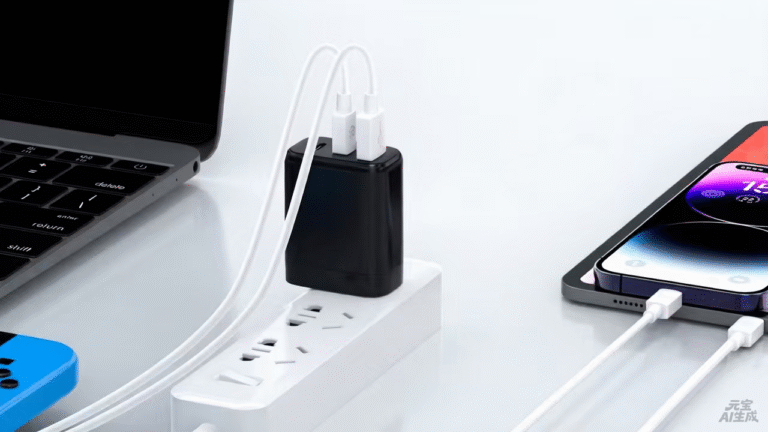
Most lamp manufacturers ask the wrong supplier the wrong question: a rechargeable lamp does not need an LED driver from a charger factory, it needs a battery charging solution. This guide covers how to spec that solution, what to check in the battery and certifications, and how to OEM it with your branding.
What Is a Lamp Charger? (LED Lamp Adapter vs Charging Dock)
The LED chips in a lamp are driven by a constant-current LED driver; the battery that powers the lamp is charged by a constant-voltage charger — a 5V USB adapter, a USB-C input, or a dedicated charging dock. Mixing up the two is the most common specification error in lamp sourcing. Three form factors cover most products:
- USB-C charging input on the lamp — the modern default; the lamp charges from any 5V/1–3A adapter.
- Magnetic charging dock — the lamp snaps onto a dock; a natural fit for bedside and premium designs.
- Dedicated barrel/DC adapter — older cordless lamps use a fixed-voltage adapter (e.g. 5V or 6V); still common in emergency lighting.
USB-C Charging for Rechargeable Lamps and Desk Lamps
USB-C is becoming the default input for rechargeable lamps for the same reason it won everywhere else: one cable charges the lamp, the phone and the power bank. A 5V/2A or 5V/3A input covers virtually all small battery lamps — 1,800 to 5,000 mAh packs recharge in roughly 2–4 hours. USB-C PD inputs add faster charging for larger lamps and let the same wall charger serve the whole bedside setup.
Choosing the Right Voltage and Current (5V/1A to 5V/3A)
Match the charger to the battery, not to the LED wattage. These are the typical pairings, sized roughly at C/2 to 1C for a safe charge curve:
| Input spec | Typical battery | Best for |
|---|---|---|
| 5V/1A | <1,500 mAh | Tiny night lights, candle lamps |
| 5V/2A | 1,500–3,000 mAh | Desk and bedside lamps |
| 5V/3A or USB-C PD | 3,000 mAh+ | Large lanterns, multi-day emergency lights |
Two rules apply to every battery pack: it needs overcharge, over-discharge and short-circuit protection, and lithium cells require UN38.3 transport compliance if lamps ship with batteries installed. Neither is optional.
Wireless Charging Bases for Cordless Lamps
A premium alternative to a cable is a Qi/Qi2 charging base: the lamp sits on the pad and the base charges its battery, which turns “no cable” into a selling point for bedside lamps. Because the same wireless platforms already power our phone chargers, a lamp brand can add this without developing new power technology. For reference platforms and finishes, see the wireless charger collection and the wireless charger with RGB ambient lighting page.
Certifications for Lighting Accessories (CE, UL, UKCA)
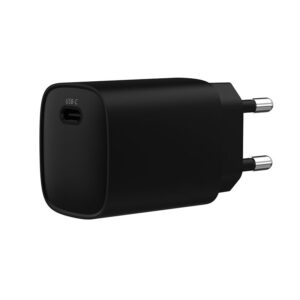
A lamp’s charging solution is certified separately from its lighting functions, so plan for both when you spec the bill of materials — and note that marks such as CE, UL and UKCA apply to specific models rather than to a whole catalog:
- CE (EU) and UKCA (UK) for the adapter and, where applicable, the lamp as an EMC/safety product.
- UL or equivalent for North America — lighting accessories are commonly specified to UL standards.
- FCC for any wireless charging base, which is an intentional radiator.
- Battery compliance — UN38.3 plus regional battery rules if applicable.
Current requirements are published by the Energy Star program and UL Solutions, the LED lamp overview on Wikipedia is a useful orientation to the category, and wireless bases follow the WPC’s Qi/Qi2 specifications plus USB-IF for USB-C inputs.
How We Build Lamp Charging Solutions (OEM/ODM)
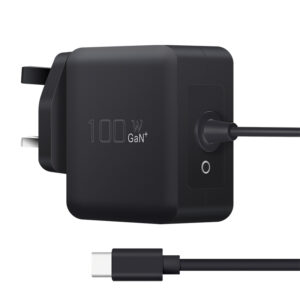
Because the factory already produces GaN wall chargers, USB-C adapters and wireless platforms, a lamp brand can source the charging side of a product from one partner: a branded adapter from the GaN charger product line for 5V/1–3A or USB-C PD inputs, wired or wireless docks built to your mechanical design, and battery-safety support including overcharge protection design and UN38.3 documentation.
Every lamp charging project runs through the same factory gates as our charger lines — incoming material and BOM verification, ESD-controlled PCBA, 100% electrical and functional testing, load aging, appearance checks and QA sampling with a per-batch shipment inspection report. MOQ starts at 200 pcs with fast samples, and standard products carry a 2-year warranty. The capability snapshot is on the factory page and the project flow on the OEM/ODM customization page. Share the lamp’s battery spec and target markets on the contact page to start.
Rechargeable Lamp Battery Types and Charging
The battery inside a rechargeable lamp decides the charging spec, and most lamp batteries fall into a few familiar chemistries.
- Li-ion — the modern default for cordless lamps; needs a proper charge curve and protection.
- NiMH — older and simpler, common in emergency lights; more tolerant of simple charging.
- Lead-acid — rare in consumer lamps but still used in some emergency lighting.
Match the charger to the chemistry and capacity — a Li-ion pack charged like NiMH is unsafe, and vice versa.
Lamp Charging Dock vs USB-C: Which to Choose
Lamp brands pick between a USB-C input and a magnetic or contact dock, and the choice shapes the product experience.
- USB-C input — universal, cheap, and the lamp charges from any adapter; ideal for desk and travel lamps.
- Magnetic dock — cable-free and premium; the lamp snaps into place on a bedside base; higher BOM cost.
- Hybrid — many designs offer both: USB-C as the default and a dock as the premium option.
The dock suits premium bedside positioning; USB-C keeps the SKU simple and cost-effective.
How Long Does a Rechargeable Lamp Take to Charge?
Charging time for a lamp follows the same math as any battery device: capacity divided by charge current, plus a slower final stage.
A 2,000mAh lamp on a 5V/2A input charges in roughly 1.5–2 hours; a larger 4,000mAh lamp on the same input takes 3–4 hours. Using a 5V/3A or USB-C PD input shortens it further if the lamp’s charging circuit accepts it. Expect the last 10–20% to take longer as the charger tapers the current to protect the cells.
FAQ
Is a lamp charger the same as an LED driver? No. An LED driver powers the LED chips; a lamp charger charges the battery. Rechargeable lamps need both, from different suppliers.
What charger do I need for a rechargeable lamp? Usually a 5V/1–3A USB adapter or USB-C PD charger, sized to the battery capacity.
Can I ship lamps with batteries installed? Yes, but lithium cells need UN38.3 transport compliance and regional battery rules.
Do I need a wireless charging base for my lamp? No — it is an option for premium, cable-free bedside designs.
Can you OEM a branded charger for my lamp? Yes. MOQ from 200 pcs; logo, color, plugs and packaging are customizable.
This article is part of Wireless Charger Products & OEM, the guide that covers this topic in decision order.