Refurbished phones come with a compatibility problem: an older iPhone or Android may charge fine with a modest charger, but bundling the wrong one — or an uncertified one — creates returns and safety risk. A deliberate charger strategy protects both your margin and your reputation.
Why refurbished lines need charger strategy
Refurb buyers are price-sensitive but safety-conscious, and the charger is often the first accessory they test. A bundle that works flawlessly builds trust; one that is slow, noisy or uncertified becomes the reason for a bad review — even when the phone itself is fine.
Refurb buyers are often first-time smartphone owners, which means they bring older expectations: they may not know what fast charging is, which cable to use, or why a cheap unbranded brick is risky. A well-matched, certified charger in the box educates them and protects the phone from the undervoltage and surge problems that kill refurbished devices. That makes the charger part of the product's reliability story, not an afterthought accessory.
Matching charger power to older phone models
Match the charger to the phone's supported protocol and wattage — typically USB PD — not to what looks generous. USB-C iPhones fast charge with 20W or higher; older Androids may cap at 18–25W; and PPS-capable chargers help newer Samsung and Pixel models. Oversizing adds cost without speed.
The matching rule has a safety dimension: an old phone with a worn battery should not be pushed at its maximum forever, because the phone's charging management is the only protection between the charger and a degraded cell. A charger that negotiates correctly respects the phone's requests; an aggressive or uncertified charger may not. For refurbished lines, choosing a slightly conservative wattage tier is both a safety and a returns strategy.
Safety marks buyers should look for
Only bundle chargers with recognized safety marks for the target market — CE, FCC, RoHS and model-dependent CCC, PSE, KC — backed by real certification. Safety standards like IEC 62368-1 define what the marks cover; an uncertified charger is a liability in a refurbished bundle.
In refurbished retail, certification is also a marketplace requirement: platforms increasingly require listed sellers to provide certification evidence for accessories, and recalls or delistings hit unbranded chargers hardest. Verify the certificate matches the exact model and market, not a similar product from the same factory. A model number mismatch is a compliance gap that an inspector or a marketplace audit will find.
Bundling vs selling chargers separately
Bundling lifts average order value and simplifies the "does it work with my phone" question, but it locks your cost into every unit. Selling separately suits buyers who already own chargers. Test both models on your best-selling phone tiers before committing.
The economics change with volume: bundling locks charger cost into every unit but raises order value and simplifies the buyer's decision; selling separately keeps the phone price lower but creates a second purchase decision and a compatibility question. Most refurbished sellers find bundling pays on older, cheaper phones where the charger is expected, and separate sales work for premium refurbished models where buyers already own chargers.
Certification and documentation for listings
Listings should show the charger's certifications, wattage, ports and compatibility matrix. Compliance documentation protects you in disputes and reassures buyers; keep certificates and test reports available.
Documentation is also the defense when things go wrong: a certified charger with a retained test report protects you in a liability claim, a marketplace audit or a regulator inquiry, while a no-documentation listing has nothing to show. Keep the certificates, test reports and batch records for every charger SKU, and make them retrievable by model and batch number. Listings should show the certification marks and offer the certificate on request — the offer itself filters out the most cautious and valuable buyers. For refurbished businesses selling across borders, documentation per market is mandatory: a charger certified for the EU is not automatically compliant in the US, and the paperwork must follow the product, not the brand. Treating documentation as part of the SKU, rather than an administrative chore, is what makes volume refurbished sales sustainable.
Building a reliable charger supply for refurb SKUs
Source chargers from a factory that certifies and tests per batch, not from unbranded stock. A certified 18/20/30W charger built for entry tiers covers most refurbished phones, with OEM/ODM support for your own branding.
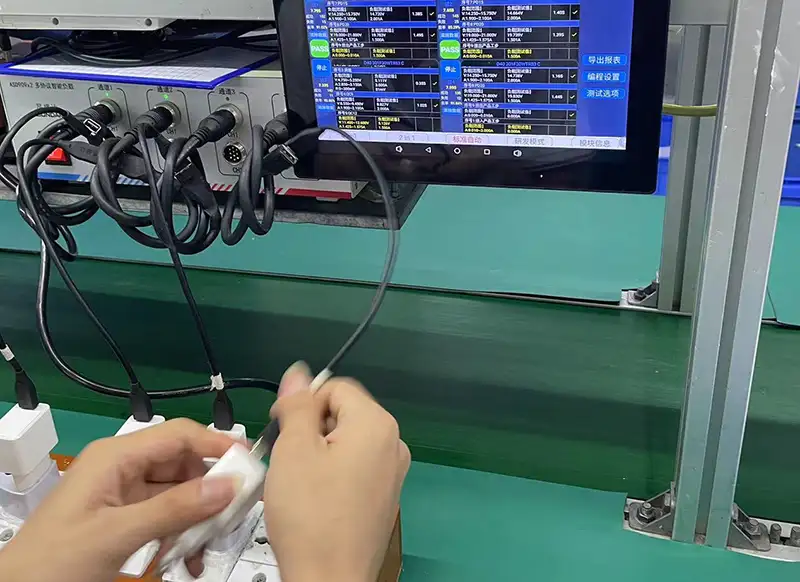
Volume sourcing for refurbished lines rewards a narrow, stable SKU set: two or three certified chargers covering your device generations beats a long tail of one-off models. Stability matters because re-certification and packaging runs follow every change. A factory with per-batch inspection reports lets you audit every shipment rather than trusting the first sample.
Charger compatibility matrix for common refurb models
| Refurb model group | Recommended charger |
|---|---|
| iPhone 11–14 (Lightning) | 20W USB-C PD |
| iPhone 15+ (USB-C) | 20W USB-C PD |
| Older Androids (micro-USB) | 10–18W USB-A |
| Samsung S series (2020+) | 25W PPS |
| Pixel (2019+) | 18–30W PD/PPS |
Safety requirements for resellers
Resellers carry responsibility for the products they sell: chargers must meet market regulations, carry correct labeling and pass documentation checks. Selling uncertified chargers risks fines, marketplace delisting and liability in case of failure.
Sourcing certified chargers in bulk
For bulk sourcing, ask for certification copies, per-batch inspection reports and warranty terms. A factory with batch-level quality control and testing evidence can document that every shipment, not just the sample, meets spec.
Bulk sourcing should lock the BOM and certification before volume: confirm the charger model matches the certificate, the packaging matches the market, and the factory can produce per-batch reports. Price matters, but a certification gap on one shipment can cost more than the savings across a hundred. Build the documentation requirement into the purchase order, not the afterthought.
Packaging and labeling for refurb bundles
Package the charger with clear labeling: wattage, ports, input range and certifications, consistent with energy-efficiency labeling programs. If you add your own branding, ensure the label doesn't obscure required regulatory markings — a common compliance mistake in private-label bundles.
Warranty and after-sales for refurb lines
Offer a warranty on the bundled charger and honor claims quickly. A 2-year charger warranty with structured after-sales signals quality, reduces dispute costs and protects the refurbished-phone brand from accessory-related damage claims.
Warranty terms on the bundled charger should match the phone's warranty window or exceed it, so customers have one point of contact for both. Track claim rates by charger model — a rising claim rate on one SKU is an early signal to re-qualify the supply. Structured after-sales turns accessory problems into a support process instead of a dispute.
Claim data from refurbished bundles is unusually valuable because the phone and charger ship together: a charger claim paired with a phone model reveals compatibility problems that standalone sales hide. Track both dimensions, and when a specific charger-phone pair shows elevated claims, re-test the pairing before reordering. This feedback loop is the competitive advantage of a controlled bundle.
FAQ
What is the best charger for a refurbished iPhone?
A certified 20W USB-C PD charger. It fast charges USB-C iPhones and safely charges Lightning-era models at their supported speed.
Can I bundle a high-wattage charger with an old phone?
You can, but it adds cost without speed — the phone caps the power. Match the charger to the phone's actual protocol and wattage support.
Do refurbished phone resellers need certified chargers?
Yes. Uncertified chargers create safety, compliance and liability risks, plus marketplace policy problems. Certification marks and documentation are non-negotiable.
Should I bundle the charger or sell it separately?
It depends on your buyer: bundling raises order value and simplifies compatibility; selling separately suits buyers with existing chargers. Test both on your best-selling tiers.
Building a refurbished-phone charger bundle? Send your model mix and volume to our team through the contact page — we can supply certified, brandable chargers with batch test documentation.
This article is part of Charger OEM & Wholesale, the guide that covers this topic in decision order.