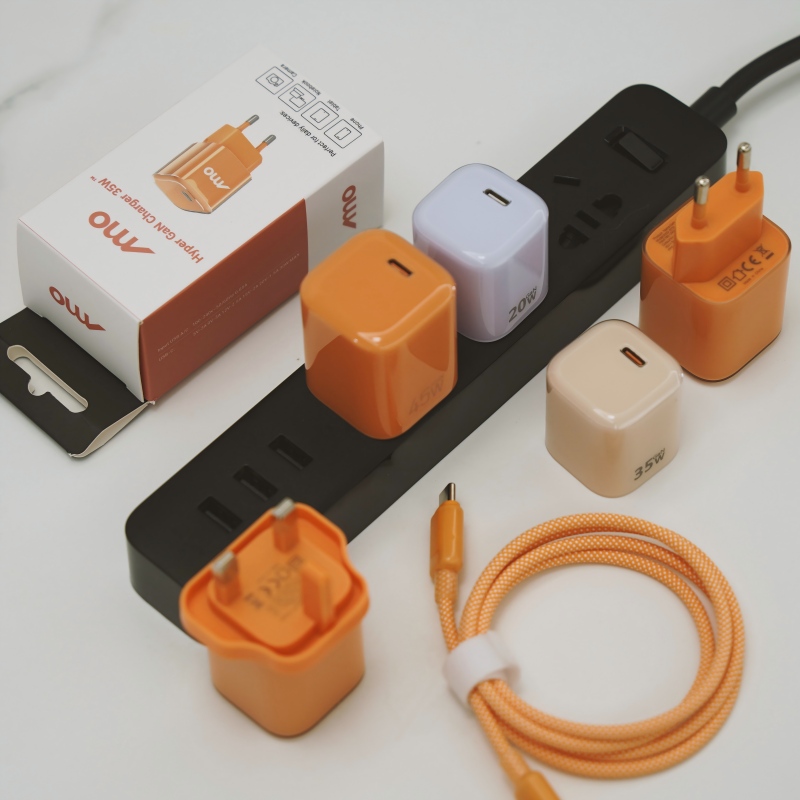
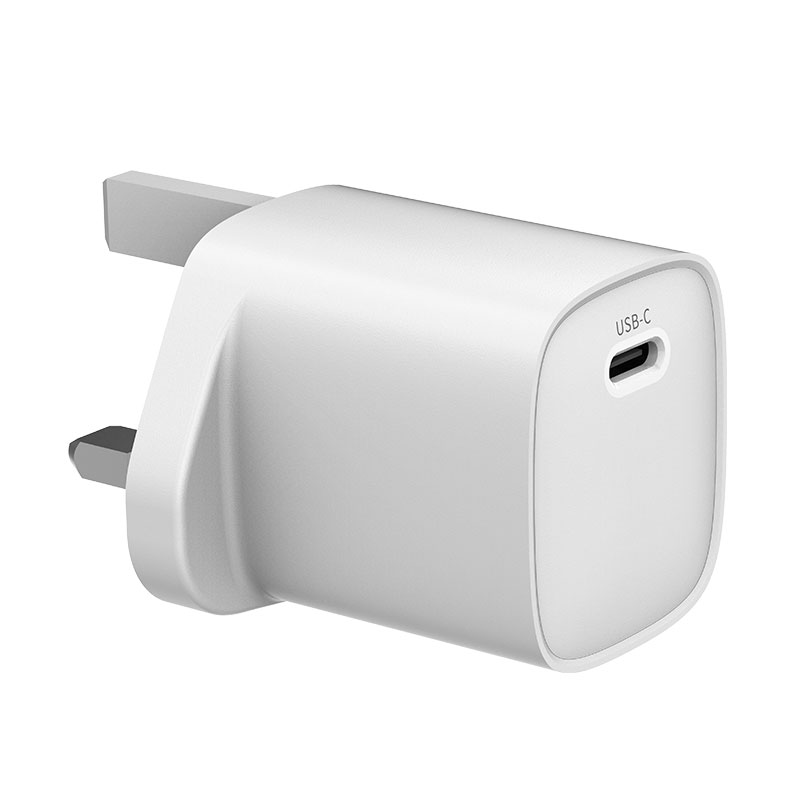
The classic 5W iPhone brick was big because 2010-era silicon needed large transformers and simple, cheap designs. GaN changed the size-power equation by switching at megahertz frequencies, and today a 33W GaN charger fits in a palm. Here is how that happened and what still limits how small chargers can get.
The 5W era: why bricks were bricks
Old 5W chargers switched at low frequency with simple flyback designs and oversized transformers, and nobody prioritized size because phones charged overnight. The result was a "brick" — reliable, cheap, and much larger than the 5W output justified.
How GaN changed the size-power equation
Transformer size scales inversely with switching frequency. GaN devices switch above 1 MHz, allowing much smaller magnetics for the same power, and integrated GaN power ICs cut component count further. That is why modern 33W chargers are smaller than old 5W bricks while delivering six times the power.
The practical proof is the comparison: a 2015-era 12W silicon adapter weighed around 80–100g and measured roughly 60×35×35mm, while a modern 33W GaN charger can weigh under 50g and slide into a coin pocket. The improvement comes from two compounding effects — higher frequency shrinks magnetics, and integrated GaN ICs remove the discrete driver circuitry that used to occupy board space.
Weight and volume at 20W, 33W and 45W
Typical current GaN chargers: a 20W unit weighs around 30–40g — a size enabled by GaN power technology — a 33W around 40–55g, and a 45W around 55–70g — roughly half the weight of equivalent silicon designs from a few years ago. Exact numbers vary by plug type and design, so compare measured weight and volume, not impressions.
Volume is the spec that matters in a bag: a 33W charger around 30–40cm³ occupies about half the space of a 2018-era 18W adapter, and the difference compounds when you carry two or three chargers. The trade-off appears in thermal behavior — smaller volume means less surface to shed heat — which is why the best compact chargers pair aggressive size with honest sustained-output data.
What still limits how small chargers can be
Three constraints remain: thermal management (the case must shed heat), plug and safety requirements (creepage, clearance, touch temperature), and connector ergonomics (a plug has to be grippable and fit outlets). A charger cannot shrink below what safety standards and physics allow.
Plug standards are a fixed constraint: the prong geometry and spacing are dictated by each region's plug standard, so a foldable EU plug occupies roughly the same footprint regardless of the electronics behind it. Safety creepage and clearance add mandatory board space, and thermal requirements demand enough surface area to shed heat without active cooling. These three limits explain why charger size stops shrinking long before the silicon does.
Trade-offs hidden in ultra-compact designs
Extreme miniaturization can hide compromises: thinner thermal materials, smaller bulk capacitors, tighter margins and reduced sustained output — the trade-offs power supply design references document. A tiny charger that derates in a warm room is only small on paper. Check sustained output, not just the label.
Hidden trade-offs often sit in the input stage: smaller bulk capacitors reduce hold-up time during brief brownouts, and tighter layouts can increase EMI without careful filtering. None of these show on the size sticker, but all show up in certification and field behavior. Ask suppliers what they gave up to hit the dimensions — the answer is the real spec sheet.
Using size data in product copy and comparisons
Size sells — but only with honest context. Publish weight, volume and a photo next to a familiar object (coin, credit card) so buyers can visualize. State the measurement method (with or without prongs) so comparisons are fair.
Size data for popular charger tiers
| Tier | Typical GaN weight | Typical volume | Notes |
|---|---|---|---|
| 20W | 30–40g | Small, plug dominates | Foldable plug variants |
| 33W | 40–55g | Fits in palm | Best size-per-watt |
| 45W | 55–70g | Still pocket-friendly | Covers tablets |
| 65W | 70–110g | Travel-charger size | Often foldable plugs |
The size data is only comparable when the measurement basis matches: include or exclude the prongs, state whether the number is from CAD or a caliper on a production unit, and note the plug variant, because a foldable EU plug and a US fixed plug change both dimensions and weight. Within a tier, the spread is real — two 33W chargers from different factories can differ by 20% in volume while both claim the same wattage. The difference usually comes from thermal strategy (potting and heat spreaders cost volume) or from component choices (smaller bulk capacitors save space but reduce hold-up time). When a buyer compares size across brands, the honest comparison includes sustained output at the same ambient, because the smallest charger in a tier is not always the one that holds its wattage. Publishing both dimensions and sustained-output data is the standard that separates serious compact-charger brands from box-sticker marketers.
Weight comparisons across brands
Weight varies more than size between brands because of enclosure material, plug construction and internal shielding. Use measured weight in grams, and beware marketing that quotes the lightest variant with a different plug.
Weight differences that look small on paper feel large in a pocket: 20g is the difference between a charger you carry daily and one you leave at home. Enclosure material drives much of the gap — polycarbonate is lighter than aluminum but conducts heat differently — and plug construction adds grams. Compare weight with the same plug variant and state the measurement method in product copy.
Why bigger is not always better
Bigger chargers are not automatically better quality — they may just use older silicon or cheaper thermal design. Conversely, the smallest charger is not automatically best: it may derate, run hot or compromise reliability. Judge on measured performance, not volume.
Bigger chargers are not necessarily better cooled either: a large brick with thin thermal management can run hotter than a compact design with potting and a heat spreader. Size is a design outcome, not a quality score. The reliable comparison is sustained output and skin temperature at the same wattage and ambient, regardless of dimensions.
Design trade-offs in tiny chargers
Miniaturization forces choices: foldable plugs add a hinge, multi-port models add size, and low-profile designs may limit heat spreading. A foldable-plug ice-cube charger balances pocket fit and thermals across 20–65W, while a 33W WEG-33W-1A shows how far single-port designs have shrunk.
Every millimeter of shrinking comes from a decision: thinner thermal pads, smaller bulk capacitors, tighter component spacing and more complex assembly. Each decision has a cost in thermals, reliability or manufacturing yield. A responsible supplier documents these trade-offs instead of hiding them, which is why the best compact chargers publish sustained-output data alongside their dimensions.
How to use size specs in product copy
Lead with the buyer's scenario ("fits in a jeans coin pocket"), then the numbers (grams, cm³, dimensions), then the honest caveat (sustained output at real ambients). This combination converts better than a bare "smallest charger" claim — and the USB PD spec behind the wattage keeps the story grounded.
Use concrete anchors buyers can visualize: "fits in a jeans coin pocket," "about the size of a credit card stack," "lighter than the phone it charges." Pair every size claim with a measured number and a fair comparison basis, and include a scale reference photo. Vague "ultra-compact" language without numbers teaches buyers to discount the entire category.
FAQ
Why are GaN chargers so much smaller than old ones?
GaN switches at much higher frequencies, which shrinks transformers and magnetic components — the parts that dominated charger size. Integrated GaN ICs also reduce component count.
How small can phone chargers get?
Practical limits come from heat, plug ergonomics and safety standards. Current 33W designs fit in a palm; further shrinking requires better thermal materials and packaging rather than just smaller chips.
Is a smaller charger lower quality?
Not necessarily — but miniaturization can hide thermal compromises. Check sustained output and temperature, not just size and wattage.
How should I compare charger sizes fairly?
Compare measured weight and volume with the same method (with or without prongs), at the same wattage tier, and pair size with sustained-output data.
Planning compact charger SKUs and honest size specs? Send your targets to our team through the contact page — we will share measured weight, volume and thermal data for our compact GaN lineup.
This article is part of GaN Chargers, the guide that covers this topic in decision order.