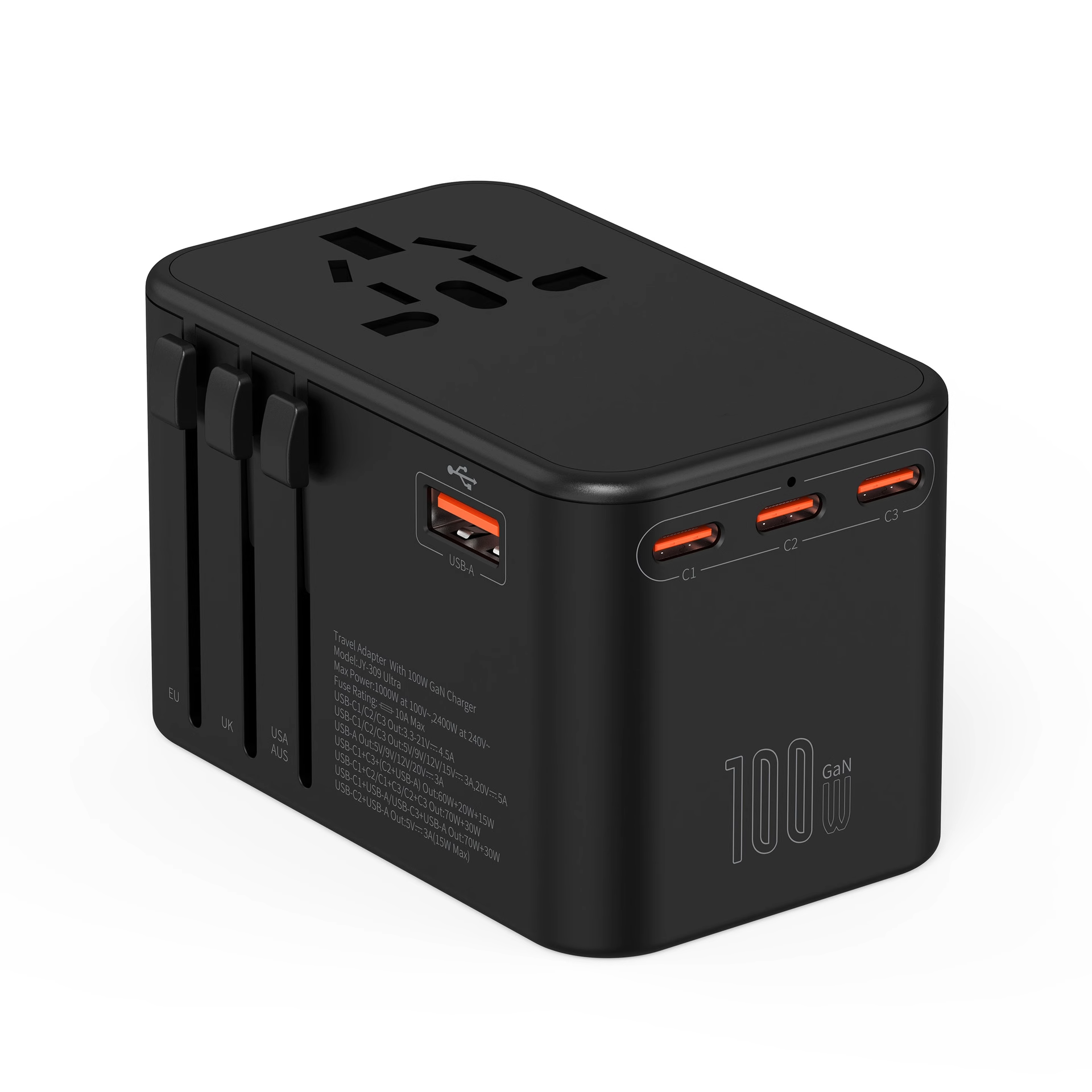
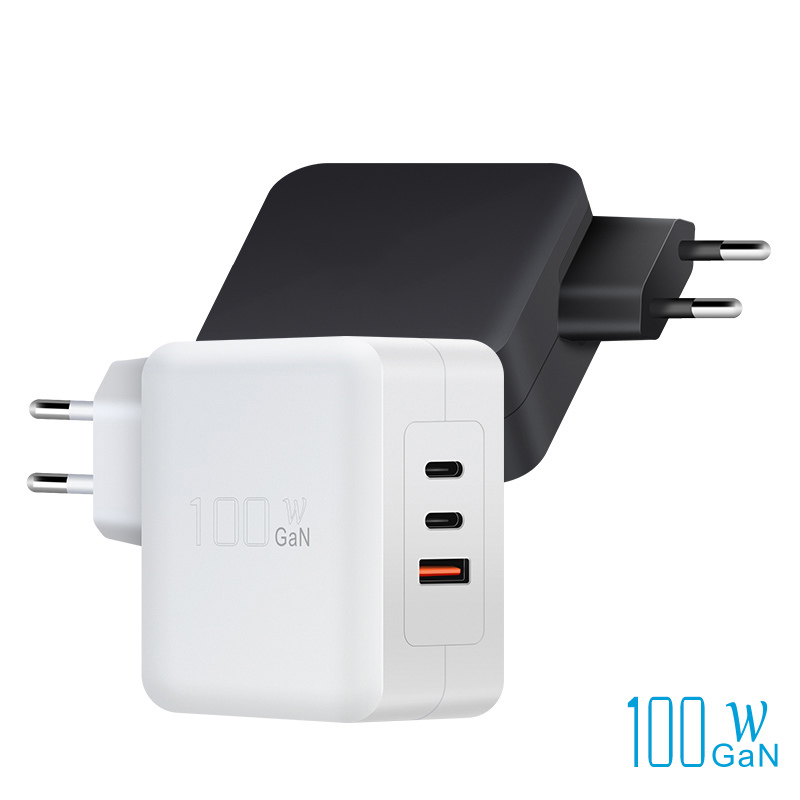
The 90W laptop brick of a decade ago was roughly the size and weight of the laptop's own hinge; a modern 100W GaN charger fits in a travel pouch. This guide compares charger dimensions across the 65W–240W range, explains how to measure and read size claims fairly, and shows what ultra-compact designs give up to get there.
How laptop chargers shrank over time
Silicon-era laptop chargers were large because their switching frequencies were low, forcing oversized transformers, and because nobody prioritized size in a desk accessory. GaN changed the equation: higher frequency shrinks magnetics, and integrated GaN power ICs cut component count. A modern 100W GaN charger is typically one-third to one-half the volume of the 2015-era equivalent at the same wattage.
The shrink happened in two waves: first silicon efficiency improvements trimmed existing designs, then GaN's frequency advantage collapsed the magnetics that dominated volume. The EPC technology resources document the frequency story, and IEEE PELS coverage shows the integration wave that followed. For buyers, the history matters because it explains the current price ladder: older designs are cheaper, GaN designs are smaller, and the premium for size is real.
Measuring size: volume, weight and footprint
Size is three numbers, and they tell different stories: volume (cm³) describes how much bag space it takes, weight (g) describes how it feels in a pocket, and footprint (the largest face) describes how it sits in a wall outlet. The same charger can win on one and lose on another — a tall narrow brick may have small footprint but awkward volume. Compare all three with the same measurement basis.
65W to 240W dimension comparison
| Charger tier | Typical GaN weight | Typical volume | Notes |
|---|---|---|---|
| 65W | 90–150g | 60–100cm³ | Travel-friendly, often foldable plugs |
| 100W | 150–250g | 100–180cm³ | The single-brick sweet spot |
| 140W | 200–320g | 140–240cm³ | Multi-port headroom |
| 240W | 350–600g | 250–450cm³ | Desktop-class, still portable |
The numbers are illustrative ranges for current designs; measure the actual unit for any comparison.
What ultra-compact designs give up
Shrinking a charger forces trade-offs that are invisible on the size sticker: thinner thermal management raises operating temperature, smaller bulk capacitors shorten hold-up time during brownouts, and tighter layouts demand better EMI filtering. The result is a size-versus-sustained-output trade-off — the smallest 100W charger may derate sooner than a slightly larger one. Pair every size claim with sustained-output data at realistic ambients.
The give-ups cluster in the input and thermal stages: smaller bulk capacitors reduce hold-up time during brownouts, thinner thermal paths raise operating temperature, and tighter layouts complicate EMI filtering. Each trade-off is a design decision with a certification or reliability consequence, which is why power supply design references treat size and robustness as a paired specification. Ask suppliers what they gave up to hit the dimensions — the answer is the real spec sheet.
Using size data in product marketing
Size sells when it is concrete: "fits in the laptop sleeve's accessory pocket," "lighter than the phone it charges," "smaller than the OEM brick it replaces." Pair each claim with a measured number and a scale-reference photo (coin, credit card, original adapter). Vague "ultra-compact" language without numbers teaches buyers to discount the category.
Setting size targets for OEM designs
For OEM projects, set size targets as requirements, not wishes: maximum volume, weight and footprint at the target wattage, plus the thermal and sustained-output limits that go with them. The engineering trade-off then happens inside the target box, and the supplier documents what was given up. A size target without a thermal requirement produces a charger that looks great and derates badly.
Reading charger dimension charts correctly
Dimension charts are comparable only when the basis matches: with or without prongs, CAD versus measured, and the plug variant. A foldable-plug 100W charger may measure smaller "without prongs" than a fixed-plug model while being larger in the pocket. Read the fine print before comparing two charts, and ask suppliers for the measurement method.
The reading discipline applies to weight as well as volume: a charger quoted at "180g" may weigh 220g with the cable and plug variants, and the difference shows up in the bag, not the chart. Compare charts with the same basis — with or without prongs, same plug variant, production units rather than CAD — and ask suppliers for the measurement method in writing. The honest comparison adds sustained-output data at the same ambient, because the smallest charger in a tier is not always the one that holds its wattage. Dimensions and thermals are two sides of the same spec sheet.
How size claims are measured differently
Two measurement traps appear constantly: including or excluding the prongs changes the number by 20–30%, and quoting the smallest dimension (height × width) instead of true volume flatters the product. The honest metric is measured external volume including the plug body where it matters for packing. When a claim seems impossibly small, ask which method produced it.
Travel cases and chargers that fit together
The practical test is the pouch: a 100W GaN charger plus its cable should fit in the laptop sleeve's accessory pocket or a standard travel pouch, with the plug folded. The GaN 100W travel charger and the WEP-100-CCA 100W adapter represent the two common form factors — single-port travel and multi-port desktop — and both travel better than any 2015 brick.
Thermal behavior of smaller laptop chargers
Smaller chargers run hotter at the same wattage because there is less surface area to shed heat. The consequence is derating: an ultra-compact 100W charger may hold 100W for 20 minutes then step down in a warm room, while a larger unit sustains it for hours. Thermal data — skin temperature and derating curve at 25°C and 40°C — is the spec that separates a great compact charger from a small one.
Choosing between size and charging speed
The choice is rarely all-or-nothing: most travelers benefit from the 100W tier because it balances size, speed and headroom, while the 140W tier earns its extra grams when a workstation or heavy multitasking laptop is involved. Set the requirement by the workload and the bag, then compare candidates on measured size, sustained output and temperature — not on the dimensions alone.
The size-versus-speed choice resolves through the workload, not the label: a traveler charging overnight can accept a smaller charger that derates slightly, while a user charging between meetings needs sustained output. The compromise tier is 100W — small enough for a pouch, strong enough for most laptops. The USB-C charging ecosystem makes the trade portable: the same charger serves the laptop and the phone, so the size investment pays across the whole kit.
FAQ
How big is a 100W GaN charger?
Typically 150–250g and 100–180cm³ depending on ports and plug design — roughly one-third the volume of a 2015-era silicon equivalent, and small enough for a travel pouch.
How do I compare charger sizes fairly?
Compare measured volume, weight and footprint with the same basis (with or without prongs, same plug variant), and pair size with sustained-output data so the trade-offs are visible — and state the basis in listings so buyers can compare without decoding.
Is a smaller laptop charger worse?
Not necessarily — but compact designs trade thermal headroom for size. Check skin temperature and derating before buying, and choose the tier that sustains your workload. Size and thermal data belong on the same page; a charger that publishes both is doing the comparison for you.
What is the best size tier for travel?
The 100W tier is the travel sweet spot for most laptop users: it covers the workload, fits a pouch, and leaves headroom for phone and tablet charging. A 140W unit only earns its weight for workstation-class laptops.
Choosing compact laptop chargers for your product line or fleet? Send your wattage and size targets to our team through the contact page — we will share measured dimensions, weight and thermal data.
This article is part of Laptop Chargers, the guide that covers this topic in decision order.