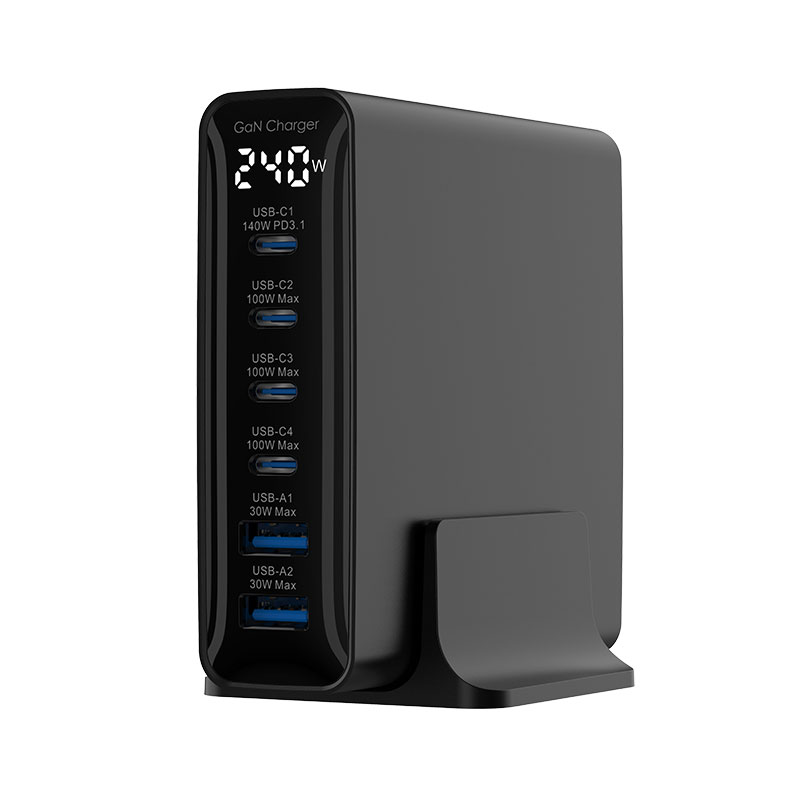
A 240W USB-C charger is the first mainstream adapter that forces a real conversation about wall outlets and input current. Before you put a 240W SKU on your roadmap, understand how much current it actually draws, how input voltage changes the math, and what your manual and label need to say so customers plug in safely.
How much current a 240W charger really draws
A 240W charger draws about 1.2A at 220–240V mains, about 2.5A at 110–120V, and closer to 3A at 100V — well within any standard household circuit, but the exact number depends on efficiency. Because USB PD 3.1 Extended Power Range delivers up to 240W over USB Type-C, the input side is a normal high-efficiency power supply rather than a special appliance.
The math is simple: input watts = output watts ÷ efficiency. At 240W output and 90% efficiency, the charger draws roughly 267W from the wall, which is about 2.4A at 110V and 1.2A at 230V — before accounting for inrush current at plug-in.
Inrush is the moment that deserves attention: when the charger first connects, its input capacitors charge rapidly and the instantaneous current can be several times the steady-state value for a few milliseconds. This is normal, but it is why a 240W charger plugged into a switched power strip can produce a visible spark at the switch, and why the manual should mention connecting to a live outlet rather than switching power at the strip. Breakers rarely trip from inrush on a single charger; the risk climbs only when several high-power devices switch on at the same instant.
110V vs 220V: why input voltage changes the math
Current is inversely proportional to voltage: the same power at half the voltage draws twice the current. This is why a 240W charger looks different in the US (110–120V) than in Europe (220–240V) or Australia (230V).
- At 230V: ~1.2A continuous input — trivial for any wall outlet.
- At 120V: ~2.3A continuous input — fine on a standard 15A US circuit.
- At 100V (Japan): ~2.7A continuous input — still fine, but shared circuits deserve attention.
For regions with 100–110V mains, input current is the spec to communicate, not output wattage. The USB Type-C specification and the USB PD 3.1 specification define the output side; the input side follows the electrical codes of each market.
Input voltage also sags under load in real buildings. Long extension cords, old wiring and shared circuits can pull 120V down toward 110V or lower exactly when the charger is at full power. Because current rises as voltage falls, the worst case is not the nominal 120V but the sagged value — which is why derating curves and low-line tests matter more for a 240W product than for a 20W one.
Outlet, circuit and breaker considerations
Standard household outlets and breakers handle a 240W charger easily: a US 15A circuit at 120V carries up to 1,800W continuous, and the charger uses about 12% of that. The practical risks are shared circuits, long extension cords and old wiring — not the outlet itself.
The four markets also differ in grounding and protection. A US NEMA 5-15 outlet is grounded and unswitched; a Schuko socket is grounded with the charger carrying its own input fuse in most designs; a UK BS 1363 socket provides a fused plug, which adds a local protection layer; Australian outlets are grounded with a switch. None of these differences changes the current math, but they change manual guidance: tell customers which plug variant they are using and keep the charger's own input fuse and certification aligned with the target market.
| Region | Typical outlet | Circuit rating | 240W charger load |
|---|---|---|---|
| US/Canada | NEMA 5-15 | 15A @ 120V | ~2.3A (≈15%) |
| EU | Schuko / CEE 7/7 | 16A @ 230V | ~1.2A (≈8%) |
| UK | BS 1363 | 13A @ 230V | ~1.2A (≈9%) |
| Australia | AS/NZS 3112 | 10A @ 230V | ~1.2A (≈12%) |
Derating behavior when input voltage drops
Chargers are rated for a nominal input range, usually 100–240V, but behavior at the edges differs by design. At low line voltage, a charger must draw more current for the same output; designs with weak input protection or thin input capacitors can derate output to protect themselves.
Ask suppliers for the input-voltage derating curve: sustained output at 100V, 120V and 230V, verified with power supply design practice. A 240W model that only sustains full output at 230V will disappoint customers on 100–120V mains — a common hidden difference between otherwise identical spec sheets.
To make the trade-off concrete: the same 240W output that needs ~1.2A at 230V needs ~2.7A at 100V, and during a brownout at 90V it would need ~3A before losses are even counted. Input stages sized for that current are more expensive, so budget designs often cap output instead — dropping to 200W or 180W at low line. That is a legitimate design choice, but it must be printed, because a customer in Japan or on a sagging US circuit experiences it as "the charger doesn't deliver what I paid for."
Product safety and documentation implications
A 240W charger's label must state the input range and current honestly, and the manual should address outlet, extension cord and circuit guidance. Certification testing for markets like CE, FCC and UL checks the input side as well as the output, including inrush current and thermal behavior at low line — and for the US market, DOE external power supply standards and ENERGY STAR govern efficiency labeling.
What to tell end users before they plug in
Most users never think about input current, so a few clear manual notes prevent confusion and support calls.
- Plug the charger directly into a wall outlet for full power; avoid daisy-chained power strips.
- Use a quality extension cord rated for the current if extension is unavoidable.
- If output drops on 100–120V mains, it may be input-voltage derating, not a faulty product.
- Don't cover the charger; 240W sustained output generates heat that needs airflow.
Add a short troubleshooting line to the manual for the two most common complaints: "output lower than expected on 100–120V mains" and "charger warm at full load." Both are normal behavior, and pre-answering them in print prevents most support tickets and negative reviews from users who see any power drop as a defect.
Real input current at 100V vs 220V
The table below shows typical input current for a 240W charger at different mains voltages, assuming 90% efficiency. Exact values depend on the design; request the measured values from your supplier.
| Mains voltage | Input power | Input current |
|---|---|---|
| 100V | ~267W | ~2.7A |
| 120V | ~267W | ~2.2A |
| 230V | ~267W | ~1.2A |
| 240V | ~267W | ~1.1A |
Outlet types and circuit ratings by region
The outlet table above summarizes the four markets most charger brands target. The common thread: every standard household circuit in these regions has comfortable headroom for a 240W charger, so "will my outlet handle it" is rarely a real problem — "is my circuit shared with other high-power appliances" is the more relevant question.
Derating at low voltage explained
Low-voltage derating happens when the input side cannot deliver enough energy at high current. Weak input capacitors, long thin input cables and conservative thermal limits all contribute. For a 240W GaN charger, ask for the measured output at 100V under full load — that number tells you more than the "100–240V" printed range.
What to print on the label and manual
Print the input rating (voltage range, current, frequency) and output profile (each port's wattage) clearly. In the manual, add a short "power requirements" section covering outlet types, extension cords and derating. This is also where quality-control documentation matters: certification reports and factory test data verify what the label claims.
When to recommend a higher-rated circuit
You only need to recommend a dedicated circuit when the charger runs alongside other heavy loads on the same circuit — a 240W charger plus a microwave or heater on one 15A circuit can approach the breaker limit. For typical desk setups, a standard outlet is sufficient; document the exception cases in the manual and let customers make the call.
FAQ
Can a wall outlet handle a 240W charger?
Yes. A 240W charger draws about 1.2A at 230V and about 2.2–2.7A at 100–120V, far below the 10–16A rating of standard household outlets in every major market.
How much current does a 240W USB-C charger draw?
Roughly 1.1–1.2A at 220–240V and 2.2–2.7A at 100–120V, depending on efficiency and exact mains voltage. Divide input power (output ÷ efficiency) by mains voltage for the exact number.
Does a 240W charger need a special outlet?
No. Standard household outlets handle it easily; the practical concern is shared circuits or long, undersized extension cords, not the outlet itself.
Why does my 240W charger output less at 100V?
Some designs derate output at low input voltage to protect components. Check the supplier's input-voltage derating curve before choosing a model for 100–120V markets.
Planning a 240W product for multi-region markets? Send your target regions and volume to our team through the contact page — we can share input-current measurements, derating curves and certification plans for our 240W GaN designs.
This article is part of USB-C PD and PPS, the guide that covers this topic in decision order.