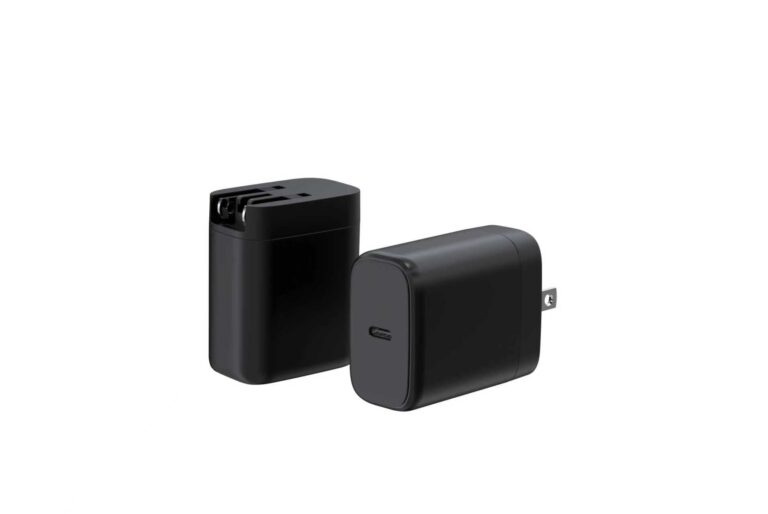
The 65W tier is the workhorse of phone-laptop charger lines: it covers most ultrabooks, adds headroom for a phone and tablet, and fits the majority of business travel. For an OEM, the 65W decision is a line decision — the platform, the plug strategy, the port layout and the certification story are chosen together. This guide covers what 65W covers in a product line, fixed versus interchangeable plugs, port layouts that fit the tier, certification and documentation for the SKU, and the OEM path to a 65W line.
Key takeaways
- 65W covers most ultrabooks and productivity laptops, plus phone and tablet headroom.
- The plug strategy follows the market: fixed for single regions, interchangeable for global.
- The OEM line is a platform decision with the certification story attached.
Content updated: August 2026 — platform power ranges are confirmed per product page; check the specific platform's range before ordering.
Scope note: This guide is general industry information; platform and power details are confirmed against the current product pages.
What 65W Covers in a Product Line
The 65W tier covers the majority of business laptops: ultrabooks and productivity machines that request 45–65W over USB-C. It also leaves headroom for a phone and a tablet on the same charger, which is why it is the natural single-SKU answer for a phone-laptop line.
The tier map is the product line's backbone. A line that starts at 65W covers the largest cluster of devices with one SKU, and the exceptions — high-power machines and workstations — are handled by higher tiers or explicit exceptions. The 65W SKU is the volume seller, and the line is built around it.
The 65W decision also interacts with the fleet audit. A line that serves mostly ultrabooks finds 65W covers the cluster at or above its request; a line with a hidden cluster of 100W machines needs the exception named. The audit keeps the tier honest.
The 65W tier also carries the travel story. The same charger that powers an ultrabook tops up a phone and a tablet, which makes it the natural single-SKU answer for a business-travel line. The packaging and the support story both read from this combination — one charger, the workday covered.
The tier's position in the line matters commercially as well. As the volume seller, the 65W SKU carries the line's pricing and inventory economics, and the higher tiers exist to serve the exceptions. A line built around the workhorse tier is a line with a clear center of gravity.
Choosing Between Fixed and Interchangeable Plugs
The plug strategy follows the market:
| Strategy | Best when | Trade-off |
|---|---|---|
| Fixed plug | Single-region line | Simpler certification and inventory |
| Interchangeable | Global or travel line | One SKU, multiple plug heads |
A single-region line uses a fixed plug with one certificate path; a global line uses interchangeable heads or per-market configurations. The choice drives the SKU count and the certification matrix.
The plug decision is made with the market list, not after it. A line that adds a market changes the plug story and the certificate story together, so the market list and the plug strategy are frozen at the same time.
The plug choice also affects the sample and inventory story. A fixed-plug line holds regional stock and one certificate path; an interchangeable line holds one SKU with multiple heads and a travel story. The choice is reflected in the MOQ and the lead time as well as the certificate matrix.
For a line serving multiple regions, the interchangeable platform keeps the SKU count low and the certificate story manageable. The plug heads are the region-specific part, and the certificate names the configuration with its plug set — the same discipline as the regional matrix elsewhere in the cluster.
Port Layouts That Fit the Tier
The port layout follows the use case. A 65W tier can be single-port for a minimal SKU, 1C1A for phone-plus-laptop convenience, or 2C for multi-device desks. The layout is chosen against the simultaneous-device pattern the line serves.
The split map is part of the SKU specification. A 65W dual-port charger may deliver 45W to one port and 20W to the other, and the split row for the real combination — laptop plus phone — is what the buyer checks. The split is published and validated.
The port layout also affects the packaging story. The number of ports and the split behavior are what the buyer sees, so the packaging names the combination rather than the total wattage. The layout is a selling decision, not just an engineering one.
The port choice also carries the cable story. A 65W tier needs a cable rated for the top profile, and the packaging and the spec should state it — an under-rated cable caps the delivered power regardless of the charger. The cable is specified with the SKU, and the support story answers the "why is it slow" question before it is asked.
The layout decision is also a future-proofing question. A line that expects to add a tablet or a second phone can choose the port layout with that combination in mind, so the split map covers the next generation of use rather than only today's.
Certification and Documentation for the SKU
The 65W SKU carries its own certification story. The certificate names the exact configuration — ports, plugs and output profiles — and the standard edition, and the documents travel with each shipment.
The documentation set is part of the line economics. A fixed-plug single-region SKU keeps the document set small; a global line multiplies it. The certification plan is put next to the platform decision, because the certificate path determines the timeline.
The model-match rule applies as everywhere: the certificate must name the exact SKU and configuration. A certificate for a similar model is context, not evidence, and the line's document file is kept current with every change.
The certification plan is also the timeline plan. The certificate path determines how long the line takes to launch, and the buffer belongs in the plan before the launch date is promised. A line that schedules the certification as a last step misses the date.
The documentation story is also the retail story in regulated markets. The certificate is what listings, customs and corporate accounts ask for, and the line's packaging should name the configuration without overstating it. The documents and the shelf story are reviewed together.
The OEM Path to a 65W Line
- Audit the target devices. The machines and their requests.
- Choose the platform. A proven 65W power stage.
- Decide the plugs and ports. Market list and use case together.
- Confirm the certification. The document set for each market.
- Validate the sample. Real devices at the real combination.
- Gate the volume. Batch records and inspection.
The 65W OEM line sits on the WET Series GaN Chargers at WECENT, the interchangeable-plug platform for travel and global lines, and the OEM & ODM Services page describes the customization levels. To start a 65W line, submit the device audit and target markets to WECENT's project engineering team — the review returns the platform, plug and port proposal with the document set for the line.
The 65W line closes with the same discipline as the rest of the cluster: the devices are audited, the platform is chosen with its certification story, the sample validates the real combination and the volume order is gated on batch records. The workhorse tier earns its name by covering the largest cluster with one reliable SKU — and the line earns its margin by running the process the same way for every order.
For the OEM starting the conversation, the practical first step is the device audit: the machines, their requests and the target markets, written down before any supplier contact. The audit is the input to the platform, plug and port decisions, and the supplier's proposal is only as good as the brief it answers. The 65W line is a workhorse line, and it is built the way workhorses are — on a clear spec, a proven platform and the discipline to repeat it.
Frequently Asked Questions
Which laptops does 65W cover?
Most ultrabooks and productivity laptops that request 45–65W over USB-C. High-power machines need a higher tier, and the fleet audit names the exceptions.
Should my 65W line use fixed or interchangeable plugs?
Fixed for a single-region line, interchangeable for a global or travel line. The choice drives the SKU count and the certificate matrix.
What does a 65W dual-port charger deliver to both ports?
It depends on the split map, typically around 45W and 20W for a 1C1A layout. Read the split row for the real combination before buying.
Which documents belong in the 65W SKU file?
Model-specific certificates and test reports naming the exact configuration, plus batch records for every shipment. The document set follows the market list.
How do I start a 65W OEM line?
Audit the target devices, choose the platform, decide plugs and ports, confirm certification and validate the sample. The line is a platform decision with the documents attached.
This article is part of Laptop Charger OEM & Fleet Programs, the guide that covers this topic in decision order.