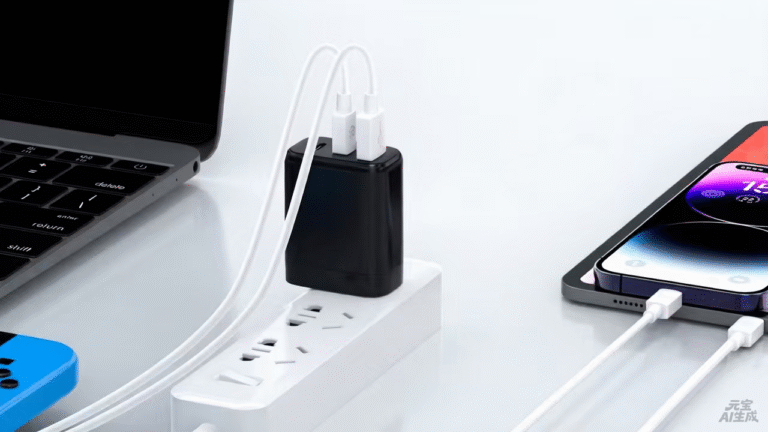
The EU Common Charger Directive expands in April 2026 to mandate USB-C for all laptops, requiring USB Power Delivery support for fast charging above 15W. Simultaneously, device-charger unbundling lets consumers buy laptops without included chargers, creating massive third-party retail demand for compatible USB-C chargers. Multi-port USB-C GaN fast chargers (65W–140W) from Shenzhen manufacturers like Wecent offer the optimal solution for European distributors and Amazon EU sellers to capture this market opportunity with compact, efficient, certification-ready inventory.
What Does the EU Common Charger Directive Require for Laptops in 2026?
Starting April 28, 2026, all new laptops sold in the EU must feature a USB-C charging port, support USB Power Delivery (PD) for fast charging above 15W, and display clear packaging pictograms indicating whether a charger is included. The directive applies across 27 EU member states plus Iceland, Liechtenstein, Norway, and the United Kingdom.
Directive (EU) 2022/2380 amended the Radio Equipment Directive 2014/53/EU, extending the common charger requirements that already covered smartphones, tablets, and cameras since December 2024. Laptops received a two-year extension because higher-power charging (up to 100W standard, 240W with PD 3.1) required additional technical development.
Key compliance requirements for laptops:
In Wecent’s Shenzhen production facility, we’ve prepared bulk orders for European private label clients with pre-certified 65W and 100W GaN chargers that already meet EN IEC 62680 compliance, reducing certification timeline by 6–8 weeks compared to starting from scratch. Our OEM team has configured EU plug heads with CE marking and RoHS documentation ready for customs clearance across all 27 member states.
Why Does Device-Charger Unbundling Create a Massive Third-Party Charger Market?
The directive explicitly allows consumers to purchase laptops without bundled chargers, limiting unused chargers and reducing 11,000 tonnes of annual e-waste. This unbundling policy means manufacturers must offer “no-charger” variants, creating immediate demand for standalone compatible chargers in retail channels.
European consumers spent €2.4 billion annually on standalone chargers before the directive, with 420 million devices purchased in 2020 alone contributing to significant e-waste. The new rules project €250 million in annual consumer savings by eliminating unnecessary charger purchases, but simultaneously create a robust third-party market for consumers who need replacement or additional chargers.
For Amazon EU sellers and electronics distributors, this translates to predictable, high-volume demand:
-
Every laptop sold without a charger represents one potential charger sale
-
Consumers seeking replacement chargers for existing USB-C laptops
-
Multi-device households needing additional chargers for travel, office, or secondary locations
-
Corporate buyers procuring bulk chargers for employee laptop deployments
Wecent’s Shenzhen factory has processed 15+ bulk orders from European cross-border sellers in Q1 2026, with MOQ starting at 200pcs for private label runs. One German Amazon seller scaled from a 200pc pilot order to a 5,000pc container load within 4 months after the April 2026 deadline announcement, focusing on 65W and 100W multi-port GaN chargers.
How Does GaN Technology Outperform Traditional Silicon Chargers for Laptop Charging?
GaN (gallium nitride) chargers achieve over 95% energy efficiency compared to approximately 87% for silicon transistors, delivering faster charging with significantly less heat generation. GaN chargers are 40–50% smaller than equivalent silicon models while supporting higher wattage up to 240W with USB PD 3.1.
The semiconductor advantage stems from GaN’s wider bandgap (3.4 eV vs. 1.1 eV for silicon), enabling higher switching frequencies, lower resistance, and improved thermal performance.
GaN vs. Silicon Charger Comparison:
In Wecent’s production line testing, our 65W GaN charger achieves 95.2% peak efficiency under USB PD 3.1 PPS load testing, with thermal rise reduced by 8°C through redesigned secondary-side synchronous rectification compared to our previous silicon-based design. This thermal advantage is critical for multi-port operation where simultaneous charging of laptop, phone, and tablet generates cumulative heat.
For European distributors sourcing from China, GaN technology means premium positioning: consumers actively seek GaN-labeled chargers willing to pay 15–25% price premium over silicon alternatives, improving margin potential for wholesale buyers.
Which Wattage Tier Should Distributors Prioritize for EU Laptop Charger Inventory?
USB PD 3.1 defines standardized wattage tiers: 20W, 33W, 65W, 100W, 140W, and 240W, with 65W and 100W covering the majority of consumer laptops. The 65W tier addresses ultrabooks and mainstream laptops, while 100W–140W serves performance laptops and workstation-class devices.
According to Intel Market Research, the 65W GaN charger market was valued at USD 1.45 billion in 2025 and is projected to reach USD 1.68 billion in 2026, growing to USD 3.12 billion by 2034 at a 9.7% CAGR. The multi-port USB wall charger market specifically reached $4.8 billion in 2025, projected to double to $10.2 billion by 2034 at 8.8% CAGR.
Wattage Tier Recommendations for EU Market:
Wecent’s Shenzhen facility maintains stock readiness for 65W, 100W, and 140W multi-port GaN chargers with 2C+1A and 3C+1A configurations. Our 140W GaN PD 3.1 model supports the new 28V EPR voltage level required for high-power laptops, with E-Marker chip integration for 240W cable compatibility. For private label brands, we offer low-MOQ pilot runs at 200pcs scaling to bulk container orders with customized packaging and logo printing within 15–20 days lead time.
Where Should International Buyers Source USB-C GaN Chargers for EU Compliance?
Shenzhen, China remains the global epicenter for consumer electronics charging accessories, hosting concentrated supply chains for GaN semiconductors, USB-C connectors, certification labs, and container shipping. The city’s Baoan District alone contains hundreds of charger manufacturers with established export infrastructure to EU markets.
Wecent operates from Shajing Street, Baoan District, Shenzhen, with 15+ years manufacturing experience and 200+ global clients across 40+ countries. Our facility holds CE, FCC, RoHS, PSE, and KC certifications, enabling direct export to EU, US, Japan, and Korea without additional country-specific testing for most markets.
For procurers searching “China GaN charger manufacturer” or “Shenzhen USB-C charger supplier,” evaluation criteria should include:
-
Certification readiness: CE marking mandatory for EU, RoHS compliance for hazardous substances
-
OEM/ODM capability: Logo printing, packaging customization, specification adjustments
-
MOQ flexibility: Low minimum orders (200pcs) for testing vs. bulk pricing at 5,000pc+
-
Lead time: 15–20 days for production, 7–10 days shipping to EU ports
-
Quality control: 2-year warranty, pre-shipment testing reports, batch traceability
Wecent’s cross-border supplier model includes complete compliance documentation packages: CE Declaration of Conformity, RoHS test reports, factory audit reports, and commercial invoices pre-validated for EU customs. One UK private label client reduced their time-to-market by 6 weeks using our pre-certified 65W GaN platform versus developing custom design from scratch.
Can Multi-Port GaN Chargers Capture Both Laptop and Mobile Device Demand Simultaneously?
Yes—multi-port GaN chargers with 2–4 USB-C/USB-A ports enable simultaneous charging of laptop, phone, tablet, and accessories from a single unit, addressing the “one charger for all devices” consumer demand created by the common charger directive. A 65W 2-port charger can deliver 45W to a laptop + 20W to a phone, while 100W 3-port models support 65W+30W+5W distribution.
The multi-port configuration aligns perfectly with EU directive goals: consumers purchase one high-quality charger instead of multiple single-device chargers, reducing e-waste while gaining flexibility for travel, office, and home use cases.
USB PD Power Distribution Examples:
In Wecent’s Shenzhen production line, our 100W 3-port GaN charger achieved 94.8% efficiency under simultaneous 65W+30W+5W load testing, with intelligent power allocation automatically adjusting based on connected devices. This feature is critical for Amazon EU sellers who receive customer reviews praising “charges my MacBook Pro and iPhone simultaneously at full speed.”
For private label brands, multi-port configurations command higher price points: 100W 3-port GaN chargers retail at €45–65 in EU markets versus €25–35 for single-port 65W models, improving wholesale margin potential for distributors.
Wecent Expert Views
“The April 2026 laptop mandate creates a perfect storm for third-party charger sellers: mandatory USB-C compatibility, unbundled charger sales, and consumer awareness that one charger works across all devices. In our Shenzhen facility, we’ve observed European private label clients shifting from single-port 65W to multi-port 100W–140W GaN configurations because corporate buyers and power users specifically request ‘one charger for laptop, phone, and tablet.’ The key procurement insight is that certification readiness matters more than price—CE + RoHS + USB-IF compliance eliminates 6–8 weeks of testing delays. Wecent’s pre-certified platform with 200pc MOQ lets brands test market response before committing to bulk container orders.”
— Wecent Senior Product Manager, 15+ years GaN manufacturing experience in Shenzhen
Conclusion
The EU Common Charger Directive’s April 2026 expansion to laptops creates an unprecedented opportunity for European distributors and Amazon EU sellers to capture massive third-party charger demand. Key takeaways for international procurement:
-
Market timing is critical: April 28, 2026 deadline means laptops sold after this date require USB-C, creating immediate standalone charger demand from unbundling
-
65W–100W GaN is the sweet spot: These wattages cover 80%+ of consumer laptops with optimal price-performance ratio
-
Multi-port configurations win: 2–4 port chargers address “one charger for all devices” consumer demand, commanding premium retail pricing
-
Shenzhen sourcing advantage: Pre-certified manufacturers like Wecent with CE/RoHS/OEM capability reduce time-to-market by 6–8 weeks
-
Low-MOQ testing: 200pc pilot orders let brands validate demand before scaling to 5,000pc+ bulk container orders
For brand sourcing managers, electronics buyers, and private label owners seeking a reliable China sourcing partner, Wecent’s Shenzhen factory offers 15+ years GaN expertise, 200+ global clients, complete certifications (CE, FCC, RoHS, PSE, KC), and flexible OEM/ODM services with 2-year warranty support. Actionable next step: request samples of 65W and 100W multi-port GaN chargers to evaluate before placing bulk order for Q3 2026 inventory buildup.
FAQs
What is the minimum order quantity (MOQ) for private label GaN chargers from Wecent?MOQ starts at 200pcs for private label orders including logo printing, custom packaging, and color customization. Bulk order pricing tiers apply at 1,000pc, 3,000pc, and 5,000pc+ with progressively lower per-unit costs.
How long does production and shipping take for bulk orders from Shenzhen to EU?Production lead time is 15–20 days after sample confirmation and deposit. Shipping to EU ports (Rotterdam, Hamburg, Felixstowe) takes 7–10 days by sea freight. Express air shipping is available in 3–5 days for sample orders.
What certifications do Wecent GaN chargers carry for EU market compliance?All Wecent GaN chargers include CE marking, RoHS compliance, and FCC certification as standard. Additional certifications available include PSE (Japan), KC (Korea), and USB-IF compliance upon request. Complete documentation packages provided for EU customs clearance.
Can Wecent customize charger specifications for specific laptop models?Yes—Wecent’s ODM service supports custom power profiles, port configurations, and cable length specifications. Our engineering team has developed tailored designs for European private label brands requiring specific wattage distribution across multiple ports.
What warranty and quality support does Wecent provide for bulk orders?Wecent offers a standard 2-year warranty on all GaN chargers, including replacement for manufacturing defects. Pre-shipment quality control testing reports and batch traceability documentation included with every bulk order.
Sources
-
Granite River Labs – EU USB-C® Law & How the New Mandate Impacts Chargers
-
Acroname – The EU’s Universal USB-C Mandate: The April 2026 Laptop Deadline
-
TechOutlet.eu – EU deadline 28 April: USB-C mandatory for all new laptops
-
SmartGear Outlet – USB PD 3.1 Explained: The Complete UK Guide
-
DataIntelo – Multi Port USB Wall Charger Market Research Report 2034
-
Wecent – USB-C GaN Charger Factory: Leading Manufacturers and Suppliers