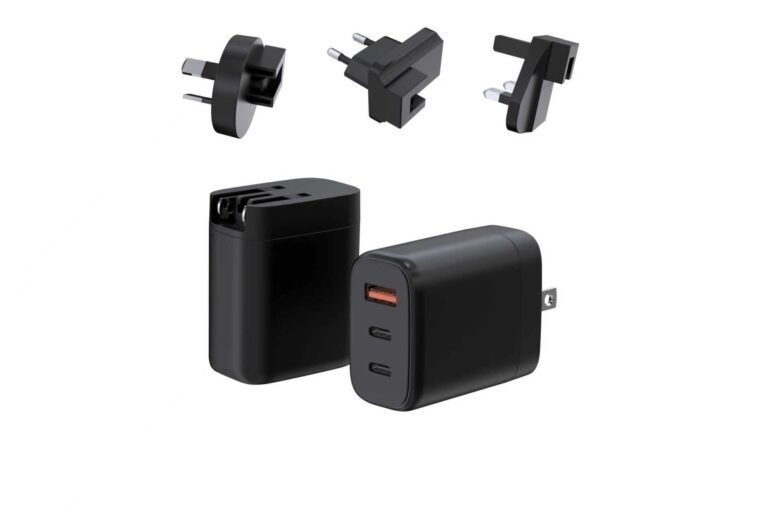
The safety of a laptop charger is designed in, not printed on: the thermal management decides whether the charger survives sustained use, the protection circuits decide how it behaves under a fault, and the certification records prove the design was tested. The label on the box is the floor, not the ceiling. This guide explains what happens inside a charger under load, the protection layers that matter, why certification is a floor rather than a ceiling, the factory test evidence buyers should request, and the red flags in cheap laptop chargers.
What Happens Inside a Charger Under Load
Under load, a laptop charger converts mains power into the laptop’s USB-C profile, and the conversion is never perfect:
- The power stage works hard. The transistors switch at high frequency, and each switch carries current.
- Heat is generated. The conversion losses appear as heat inside the housing.
- The housing must move the heat out. The thermal path — the components, the board and the housing — decides the sustained behavior.
The load story is why the sustained test matters: a charger that reaches a thermal plateau and holds its output is a charger that works; one that keeps climbing is throttling or aging. The same physics apply whether the design is GaN or silicon — the efficiency and the thermal design decide the outcome.
The sustained test method belongs in the plan: run the charger at its rated output for an hour in a defined ambient, measure the housing at the same point, and record whether the output holds. The plateau, not the peak, is the number that separates a real laptop charger from a label — and the same method the factory applies in aging is the method the buyer applies on the bench.
The Protection Layers That Matter
The protection set is the charger’s safety net:
- Overcurrent protection (OCP). Limits the current a port delivers.
- Overvoltage protection (OVP). Clamps the output if regulation fails.
- Overtemperature protection (OTP). Reduces output or shuts down on excess heat.
- Short-circuit protection. Cuts the output on a fault.
The protections are the difference between a charger that fails safely and one that fails dangerously. The specification should name them, and the factory test should verify them — a protection listed in marketing without a test behind it is a claim, not a design.
Expert view — WECENT project engineering team: The laptop charger is the hardest daily case for a power supply: hours of sustained output at high wattage. Our design and test focus is the thermal plateau and the protection behavior under fault — the two things a spec sheet cannot show and a sustained test reveals. Buyers should ask for both.
Certification as a Floor, Not a Ceiling
Certification is the minimum evidence, not the maximum assurance:
- The certificate proves testing. The product was tested against the applicable standards for the market.
- The certificate names a configuration. The model, the plug and the configuration are in the document.
- The certificate is a floor. Passing the standard is the entry ticket; the design quality and the factory process sit above it.
The discipline is the certificate-to-configuration match: the shipped product and the certificate must name the same model, plug and configuration. A certificate for another variant does not cover the product in hand.
The marketplace dimension adds urgency: major online and retail channels increasingly verify the safety documentation before a listing stays live, and a laptop charger without the certificate for its market risks delisting or a return spike. The certificate is therefore a listing requirement, not just a safety nicety — and the model-specific match is what keeps the listing valid.
Factory Test Evidence Buyers Should Request
- Electrical functional testing on every unit.
- Aging under load, the sustained run that catches early failures.
- Insulation (hi-pot) testing, the elevated-voltage check of the insulation.
- Shipment inspection records, the batch-level QA evidence.
- Batch traceability, the record linking materials, line and tests to a batch.
The evidence stack turns the safety story from marketing into a file. WECENT describes 100% functional testing before shipment plus aging and pressure tests in its production flow, which is the kind of evidence a safety-minded buyer should request.
Red Flags in Cheap Laptop Chargers
- No certificate or a vague one. A certificate that does not name the model and configuration is no certificate.
- No test plan. A supplier that cannot describe its production testing is selling hope.
- A suspicious price. A laptop charger far below the category price has cut something — components, protections or testing.
- No thermal evidence. A charger whose sustained behavior has never been demonstrated is a gamble for a laptop user.
- No batch records. A supplier that cannot trace a batch cannot answer for it.
For a laptop charger decision, the GaN Charger Category lists the platforms and power ranges, and the WECENT solutions team can confirm the protection, test and certification details for your configuration. The WECENT support FAQ covers the safety questions buyers raise.
The red flags close the buyer’s checklist: no certificate, no test plan, a suspicious price, no thermal evidence, no batch records — each flag is a reason to stop, and the absence of all five is the reason to proceed. The checklist is the same for a single charger and a fleet order, and it is what keeps the laptop charger decision evidence-based.
The safety decision, in one path: check the certificate names the configuration, confirm the protection set is tested, request the aging and insulation evidence, run the sustained test on the bench, and review the batch records. The path is the same for a single charger and a fleet, and the evidence is the deliverable.
For a line, the safety story is the sales story: the certificate, the test plan and the batch traceability are what a buyer can verify, and the verification is what converts the safety claim into a purchase. The red flags are the inverse — the missing evidence that stops the purchase before it starts.
The laptop charger safety story, in the end, is an evidence story: the certificate names the configuration, the test plan verifies the protections, and the batch records trace the production. The buyer who asks for the evidence gets the safe charger; the one who accepts the label gets the risk. The evidence is the product.
The Evidence Folder
The laptop charger safety decision runs on a folder of evidence: the certificate naming the model and configuration, the test plan covering the protections and the electrical tests, the aging and insulation results, the shipment inspection records and the batch traceability. The folder is the deliverable that turns the safety claim into a file, and the buyer should request it with the sample and re-confirm it per batch. The same folder is what a marketplace or a customs review asks for, which makes it a market-entry requirement as much as a safety document.
The red flags are the inverse of the folder: no certificate, no test plan, a suspicious price, no thermal evidence and no batch records. The buyer who checks the folder against the five flags gets the safe charger; the one who accepts the label gets the risk.
The safe laptop charger, in the end, is the one whose evidence folder is complete — and the folder is what the buyer should carry into every sourcing decision.
The last safety note: the evidence folder grows with the relationship — every batch adds a record, and the records are what keep the safety claim true over time.
The safety story, in the end, is a folder that grows with every batch — and the folder is the trust the buyer can actually hold.
For buyers, the safety folder is the deliverable: certificates, test reports and batch records that match the shipped configuration.
Frequently Asked Questions
What makes a laptop charger safe?
Thermal management, protection circuits (OCP, OVP, OTP, short-circuit), certification for the market, and factory test evidence — the design and the process, not the label.
Why does my laptop charger get hot?
Conversion generates heat under load; the housing must reach a stable plateau. A charger whose temperature keeps climbing is either throttling or has a thermal design weakness.
Is a cheap laptop charger dangerous?
The cheapest units often cut corners on components, protections and testing, which increases the risk. Buy from suppliers that document their process.
What is an aging test?
The sustained-load run in production that catches early failures — the factory-side version of the user’s long session.
How do I verify a charger’s certification?
Ask for the certificate that names the model, the plug and the configuration, and check the match per batch. A certificate for another variant does not cover the product.
Does WECENT test laptop chargers before shipment?
WECENT describes 100% functional testing plus aging and insulation tests in its production flow. Confirm the test details for your specific model and configuration.
Sources
- WECENT – GaN Charger Category
- WECENT – Quality Control
- WECENT – FAQ
- WECENT – Contact Us
- U.S. Consumer Product Safety Commission – Official Website
- International Electrotechnical Commission – Official Website
This article is part of Laptop Chargers, the guide that covers this topic in decision order.