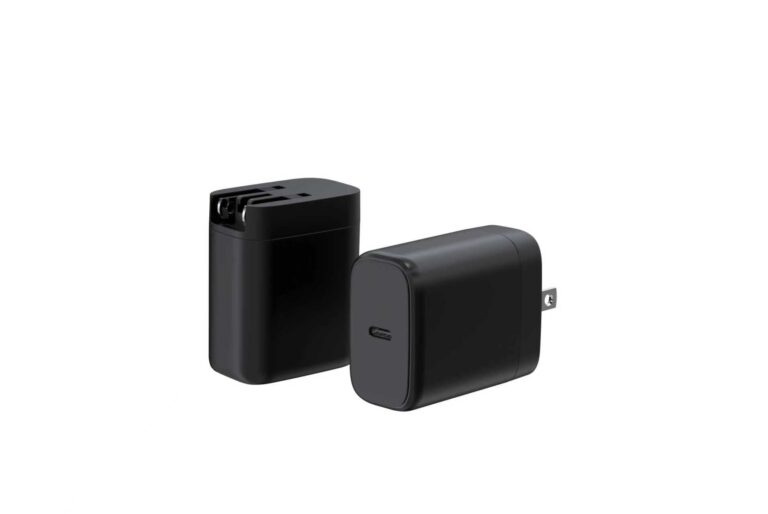
"SiC vs GaN" sounds like a material battle, but for charger design it is a band selection problem: each wide-bandgap technology wins in a different voltage and power range. Before your roadmap commits to either, this guide maps where each one performs best, why 20W–240W USB-C chargers overwhelmingly stay with GaN, and the decision criteria that matter for your product.
GaN and SiC: two wide-bandgap cousins
For USB-C chargers from 20W to 240W, GaN is the practical choice; SiC only earns its place at high voltages and power levels far above the charger market. Both are wide-bandgap semiconductors that switch faster and tolerate higher temperatures than silicon, but they are engineered for different voltage and power bands, so the question is never "which is better" but "which fits this product."
Wide-bandgap material fundamentals are well covered in EPC's GaN technology resources and a peer-reviewed overview of GaN HEMT architecture and reliability. What matters for a charger buyer is where each material sits on the voltage and power map.
Where each technology performs best
The short version: GaN owns high-frequency, low-to-mid power conversion; SiC owns high-voltage, high-power conversion. The table below compares the attributes that decide charger design.
| Attribute | GaN (gallium nitride) | SiC (silicon carbide) |
|---|---|---|
| Voltage class | 650V mainstream; 1200V+ emerging | 600V–1700V+ established |
| Switching frequency | MHz range | Tens to hundreds of kHz |
| Efficiency sweet spot | 20W–240W USB-C | 500W+ high-voltage power |
| Die-level thermal conductivity | Moderate (GaN-on-Si) | High |
| Cost at USB-C wattages | Low and falling | Higher, substrate-driven |
| Typical applications | Chargers, adapters, data-center power | EV chargers, solar inverters, industrial PSUs |
SiC in high-voltage, high-power industrial supplies
SiC's advantages are real, but they sit at the top of the power curve: high-voltage blocking, high thermal conductivity and robust operation in demanding industrial conditions. That is why silicon carbide dominates EV onboard chargers, solar inverters and industrial power supplies above roughly 500W, where GaN-on-silicon reaches its practical limits — see IEEE's overview of SiC MOSFET advantages in high-power electronics.
None of those advantages appear inside a USB-C charger. At 20–240W, SiC devices would be oversized, overpriced and no more efficient than GaN — which is why you will not find them in phone, laptop or travel chargers.
Why most 240W chargers still choose GaN
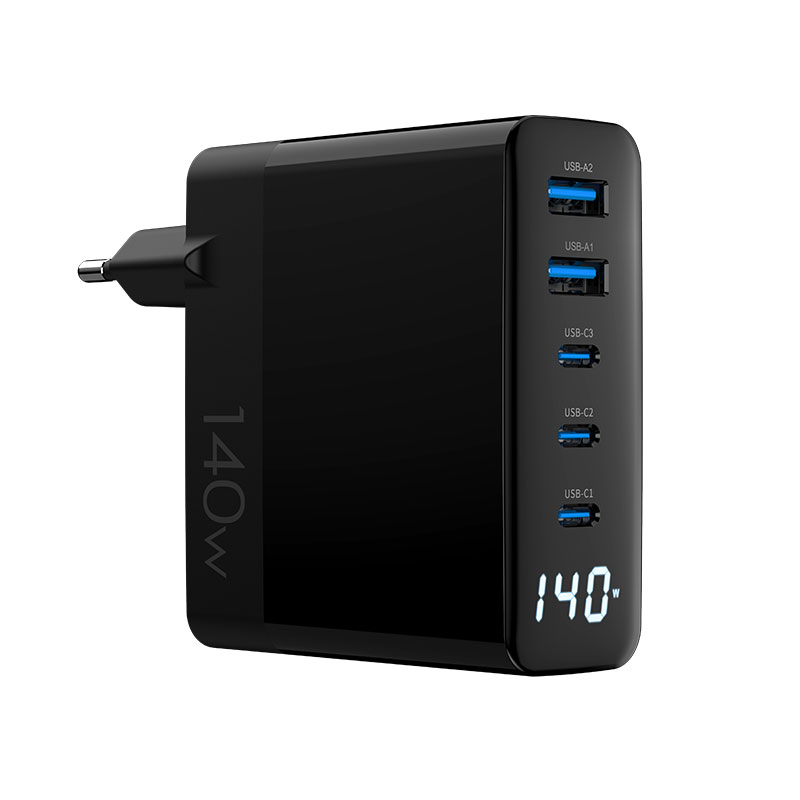
240W is the top of the USB-C ladder, and it still belongs to GaN. USB PD 3.1 Extended Power Range delivers up to 240W over USB-C, and today's 240W adapters use multi-stage GaN designs with synchronous rectification and careful thermal management — not SiC.
SiC becomes relevant mainly at higher voltages and far higher power, in applications USB-C never touches. If a supplier suggests SiC for a 240W charger, ask what problem the material actually solves; in this band, the honest answer is usually none.
Cost and availability considerations
Cost and supply chain favor GaN for charger programs today. GaN-on-silicon rides mature semiconductor fabs with multiple qualified vendors, while SiC substrates are more expensive and production capacity is largely allocated to automotive and industrial demand.
- GaN devices are available from multiple suppliers with drop-in datasheets, supporting dual-sourcing.
- SiC pricing follows automotive cycles and is harder to optimize for consumer volumes.
- For a charger SKU, GaN's cost trajectory is falling faster as consumer and data-center volume grows.
The manufacturing economics explain the gap. GaN-on-silicon is produced on mature silicon wafer lines, which amortizes the technology across huge volumes and multiple foundries; SiC needs dedicated substrate growth and processing, and its capacity is largely pre-sold to EV and industrial customers. For a charger program that needs predictable pricing and dual sourcing, that structural difference matters more than any datasheet comparison.
How to decide which technology fits your product
The decision framework is short: match the material to the product's wattage, voltage and form factor.
- 20W–240W USB-C chargers: specify GaN for size, efficiency and cost.
- High-voltage embedded or industrial units (500W+): evaluate SiC with your factory, comparing total cost, yield and certification effort.
- Compact form factors: GaN's frequency advantage shrinks magnetics, which SiC cannot match at these sizes.
- Medical or compliance-driven products: decide on isolation, protection and certification before material.
Comparing switching frequency and efficiency
GaN switches into the megahertz range, while SiC typically runs at tens to hundreds of kilohertz. For chargers, higher frequency means smaller transformers and magnetic components — the entire reason GaN bricks are smaller than silicon ones. Integration has pushed this further, as documented in IEEE PELS coverage of fourth-generation GaN power ICs.
Efficiency follows the same band logic: in the 20–240W range GaN delivers comparable or better efficiency than SiC at a fraction of the size and cost; SiC's efficiency advantage appears at high voltage and high power.
Voltage classes: where SiC pulls ahead
Voltage is where SiC earns its keep. GaN has long been a 650V-class technology; SiC is established from 600V to 1700V and beyond, which suits industrial grids, EV architectures and renewable energy. The boundary is not static — cascode GaN architectures now reach 2200V, blurring the old "GaN is low voltage, SiC is high voltage" line for some industrial uses.
For charger products, the 650V GaN class covers mains input with margin in every major market, so voltage class is rarely a charger decision factor.
Thermal performance in real enclosures
At the die level, SiC's thermal conductivity is higher than GaN-on-silicon. Inside a real charger enclosure, however, the package, PCB copper, potting and housing dominate heat transfer — and GaN's lower switching losses at these wattages mean less heat to move in the first place.
The practical result: thermal performance in a 20–240W charger is decided by the thermal design, not the material. A well-designed GaN charger runs cooler than a poorly designed SiC one at the same wattage.
The reason is packaging, not physics: at USB-C wattages, the dominant thermal resistance is the path from die to case — package, solder, copper and enclosure — not the die material itself. SiC's high die-level thermal conductivity only starts paying off when die-level losses are large, which happens at high power. Below that threshold, GaN's smaller losses and mature packaging produce the better real-world result in the same footprint.
Supply and cost outlook for both technologies
Both materials are winning, but in different rooms: GaN expands in consumer and data-center power conversion while SiC anchors the highest-voltage infrastructure, as PCIM 2026 coverage from TechInsights summarizes. For charger OEMs, the outlook favors GaN for the next several years, with hybrid topologies and better protocol support driving the real product improvements.
Watch the design-win pipeline as the leading indicator: each server, industrial or automotive GaN design win adds volume that pushes 650V GaN pricing down, and the same devices flow into chargers. SiC design wins grow the substrate ecosystem but rarely touch USB-C products. For buyers, the practical forecast is simple — GaN gets cheaper and more available, SiC stays a high-power specialty — which is a strong argument for standardizing a charger roadmap on GaN.
Which technology suits your product roadmap
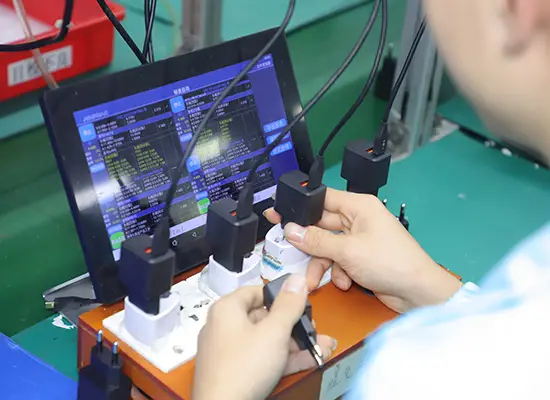
For a charger roadmap, GaN is the defensible default from 20W to 240W, and our GaN charger range spans exactly that band with model-dependent PD 3.1 and PPS support. If your roadmap includes high-voltage embedded or industrial power, evaluate SiC with engineering support rather than a datasheet label — compare total cost, yield, thermal performance and certification effort across a real design. Our OEM/ODM program and factory engineering teams work through exactly these trade-offs, and quality control verifies the chosen design per batch.
FAQ
Is silicon carbide used in chargers?
Not in USB-C chargers. SiC appears in high-voltage, high-power industrial and EV charging systems, where its voltage class and thermal robustness justify the cost; phone, laptop and travel chargers stay with GaN.
Will 240W chargers need SiC?
No. USB PD 3.1 EPR chargers at 240W use multi-stage GaN designs today. SiC becomes relevant mainly for higher-voltage industrial power, not for consumer USB-C chargers.
Is SiC better than GaN?
It depends on the band. Above roughly 500W and at high voltages, SiC has advantages; in the 20–240W USB-C range, GaN delivers comparable or better efficiency with smaller size and lower cost.
How do I decide which technology to use?
Match the material to wattage, voltage and form factor: specify GaN for 20–240W USB-C products; evaluate SiC only for high-voltage, high-power embedded or industrial units.
Planning a charger launch and wondering whether GaN or SiC fits your roadmap? Send your wattage targets, voltage class and volume projections to our team through the contact page, and we will walk you through the material and topology trade-offs with real design data.
This article is part of GaN Chargers, the guide that covers this topic in decision order.