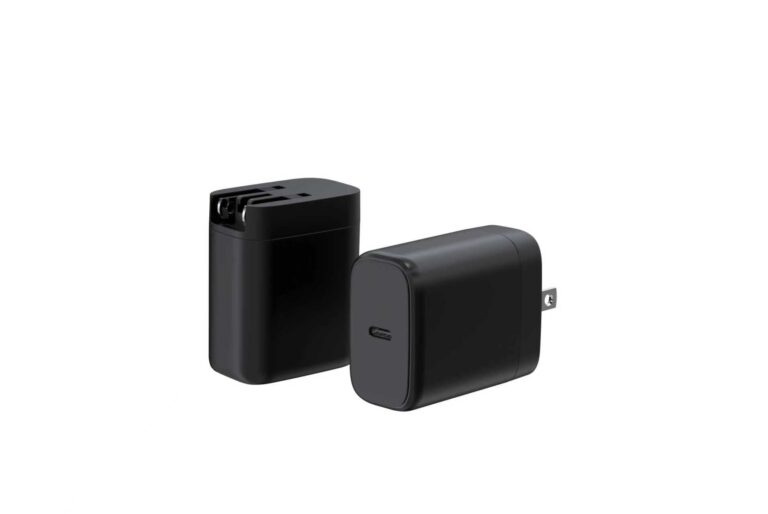
The foldable plug charger is the answer to a small daily problem: the prongs. A charger with pins that fold flat slides into a pocket without catching, packs into a pouch without scratching, and stops being the thing that snags the bag liner. For anyone who carries a charger daily — commuter, traveler, student — the fold is not a gimmick; it is the difference between a charger that lives in the bag and one that stays on the desk. This guide covers why foldable plugs change the carry experience, the wattage options in foldable designs, pocket and travel use cases, the Ice Cube form factor, and how to choose a foldable charger for a product line.
Why Foldable Plugs Change the Carry Experience
The carry experience is a sequence of small interactions: the charger goes into a pocket, comes out at a desk, goes into a bag, comes out at a hotel. With fixed prongs, every interaction is a snag risk — the pins catch on fabric, bend under pressure or scratch other items in a pouch. Foldable pins remove that friction: the charger becomes a smooth slab about the size of a key fob, and the prongs only exist when you need them.
The engineering tradeoff is real. A foldable mechanism adds moving parts, and moving parts are where cheap chargers fail first — a hinge that loosens, a prong that stops locking. The reliability of the design depends on the mechanism's cycle testing and the quality of the latch, which is why the foldable category separates well-made chargers from lookalikes. A mechanism rated for repeated cycles is a spec; a mechanism that "feels fine in the store" is not.
Wattage Options in Foldable Designs
Foldable designs span the useful phone-charging range, and the tier changes the size and the use case:
| Wattage | Size class | Use case |
|---|---|---|
| 20W | Key-fob small | Phone and earbuds, daily carry |
| 35W | Compact | Phone plus a small tablet, faster top-ups |
| 45W | Pocket-friendly | Phone, tablet and some ultrabooks |
| 65W | Bag-ready | Phone plus ultrabook, travel workhorse |
The pattern is simple: below 35W, a foldable charger disappears into a pocket; at 65W, it earns a permanent spot in a bag. A 20W foldable is the right everyday-carry companion for a phone; a 65W foldable is the right travel companion for a phone-plus-laptop stack. The choice is a size-versus-coverage trade, and most buyers who carry daily choose the smaller tier while travelers choose the larger one.
The 35W tier deserves special mention because it is the sweet spot for many buyers: large enough to fast-charge most phones and a small tablet, small enough to stay in a pocket, and cheap enough to be an impulse purchase at a counter. For a retail line, the 35W foldable is often the SKU that converts first-time buyers, with the 65W version waiting for the bag-carrying upgrade path.
Expert view — WECENT project engineering team: The hinge is the part buyers never see and we test the hardest. A foldable charger that fails at the hinge fails at its whole reason to exist, so the mechanism is cycle-tested and the latch is designed to hold its position. When you evaluate a foldable charger, ask for the cycle-test evidence — it separates a real design from a lookalike.
Pocket, Bag and Travel Use Cases
Three use cases define the category:
- Pocket carry. A 20–35W foldable in a jacket or trouser pocket, ready for a café, a co-working desk or a friend's place. The flat form matters because a pocket is the smallest real-estate a charger occupies.
- Bag carry. A 45–65W foldable in a work or travel bag, covering the phone and the laptop. The fold keeps the charger from scratching the laptop or tangling with cables in the main compartment.
- Travel. A foldable with the right plug for the destination, or with interchangeable heads for multi-country trips. The fold and the plug set together decide whether the charger is packable and usable abroad.
The common thread is that the fold converts a charger from a desk object into a carry object. Buyers who only charge at home rarely need it; buyers who charge where they land need it daily.
The pocket use case deserves its own detail because it is the hardest test. A charger in a pocket shares space with keys, coins and a phone, which means the housing takes abrasion and the prongs take pressure. The flat form helps, but the materials decide the outcome: a hard shell resists scratches, a snug hinge resists accidental opening, and a latch that holds under pressure keeps the prongs from deploying mid-pocket. Buyers who carry a charger daily should treat the pocket test — in, out, pocket again, twenty times — as part of the evaluation, because that is the cycle the product lives through.
The Ice Cube Form Factor and Its Appeal
The Ice Cube line at WECENT is a direct answer to the foldable question: a compact cube with foldable prongs, available in 20W, 35W, 45W and 65W versions, with a choice of colors. The form factor does two things at once.
First, it makes the power obvious: a small cube that delivers 45W or 65W contradicts the expectation that high power means a big brick, which is exactly the surprise that sells in retail. Second, the cube shape is brandable — a clean face for a logo, a color story for a collection, and a compact box for retail packaging. For a channel or brand team, that combination is rare: a genuinely pocketable charger that also works as a branded hero SKU.
The color and finish options turn the cube into a collection rather than a single product: a black-and-white pair for a neutral line, a vivid accent color for a youth or travel collection, and a pastel finish for a lifestyle brand. For a retailer, a three-color cube shelf reads as a range; for a brand, the color is the cheapest way to make a commodity charger feel designed. The packaging should show the folded and unfolded states, because the fold is the feature the box cannot assume the buyer knows.
The new product category page lists the Ice Cube family and the current configurations; color and power availability are confirmed per model.
For a line planner, the Ice Cube family also demonstrates how one form factor spans power tiers: the 20W and 35W versions serve the pocket market, the 45W and 65W versions serve the bag and travel market, and the shared design language keeps the shelf coherent. That is the practical value of a family — the retail customer recognizes the range, and the assortment stays simple while covering different carry profiles.
Choosing a Foldable Charger for Your Line
- Define the carry profile. Daily pocket carry (20–35W) or bag/travel carry (45–65W) — the tier drives the size and the story.
- Verify the mechanism. Ask about the fold-cycle testing and the latch design; a foldable charger is only as good as its hinge.
- Match the plug to the market. Foldable pins for a single region, interchangeable heads for a global line.
- Confirm the power profiles. Check the PD/PPS output list against the phones and tablets in your target market.
- Plan the packaging. The flat form factor allows compact retail packaging; use it to tell the "fits in a pocket" story.
- Validate samples. Charge real devices, fold and unfold the mechanism repeatedly, and drop-test the charger in a pouch.
For a line decision, start from the GaN charger range for the wider power range, then request an Ice Cube sample with your color and packaging requirements from the WECENT sourcing engineers.
Frequently Asked Questions
Are foldable plug chargers as reliable as fixed-plug chargers?
They can be, when the mechanism is properly tested. Ask about the fold-cycle testing and the latch design; a well-made foldable is rated for repeated use, while a cheap one fails at the hinge.
What wattage should a foldable phone charger be?
For daily phone-and-earbuds carry, 20–35W is enough. For a phone plus laptop, choose 45–65W. The tier decides whether the charger lives in a pocket or a bag.
Do foldable prongs work with all outlets?
The pins must match the destination's plug standard. Foldable pins are regional; for international trips, use a charger with interchangeable heads or confirm the plug set for your destinations.
What is the Ice Cube charger?
Ice Cube is WECENT's compact foldable GaN charger family, available in 20W, 35W, 45W and 65W versions with a choice of colors. Current configurations are listed on the New Products page.
Can a foldable charger be branded?
Yes. The cube's flat face is suitable for a logo and color customization, which makes it a natural hero SKU for retail or gifting lines. Confirm the customization depth and MOQ with the project team.
Is a 65W foldable charger safe to carry in a bag?
Yes, when the prongs fold fully and the mechanism locks. Choose a charger from a manufacturer that states its testing, and avoid units with loose or bent prongs.
This article is part of Travel Chargers & Plug Adapters, the guide that covers this topic in decision order.