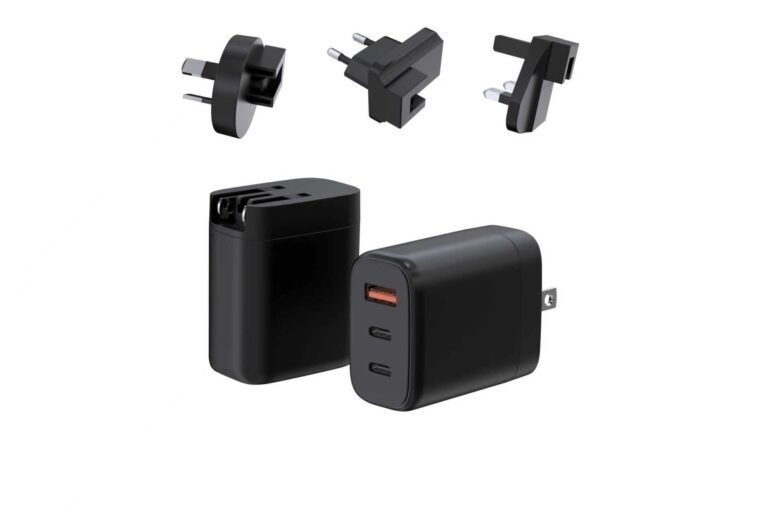
A wholesale travel charger line is a portfolio puzzle: the right plug coverage, the right wattage tiers, the right kit composition and the right seasonal timing. Travel chargers sell as sets as much as single products — charger, cable, pouch — and the SKU decisions made at planning stage decide whether the line moves in volume or sits in a warehouse. This guide walks distributors and gifting teams through travel kits as a SKU strategy, global plug coverage, wattage tiers, seasonal demand windows and how to build a lineup that matches a channel.
The Travel Charger Kit as a SKU Strategy
Travel charging sells better as a kit than as a bare adapter, because the buyer's problem is the whole bag, not one brick. The standard kit composition is a charger plus a cable plus a pouch or travel case, and the composition is a strategy: it raises average order value, bundles the cable that the user would otherwise buy separately, and tells a complete "ready to travel" story on the package.
For a distributor, the kit also simplifies shelf planning. One kit SKU replaces the "charger, cable, pouch" three-way cross-reference that retail buyers hate, and it reduces the SKU count on the assortment sheet. The tradeoff is packaging: a kit needs a box or pouch that protects the cable and communicates the plug set, which adds cost per unit. The decision is a margin-versus-message trade, and most travel lines settle on two formats — a compact single-device kit and a fuller multi-device kit.
The cable inside the kit is a planning decision on its own. A kit with an under-rated cable caps the charger's output, so the cable rating must match the wattage tier — a 65W kit needs a cable that carries the current, and a 100W kit needs a 5A e-marked cable. The pouch or case also sets the perceived value: a branded pouch with a drawstring and a printed logo costs a little more and changes the unboxing entirely, which is why gifting programs treat the pouch as part of the product, not as packaging.
Plug Coverage Across Global Destinations
The core of a travel line is plug coverage. The mainstream destinations for a global line are:
| Region | Plug standard |
|---|---|
| Europe | EU (Type C/E/F) |
| United Kingdom | UK (Type G) |
| North America | US (Type A/B) |
| Australia / Oceania | AUS (Type I) |
Two approaches cover these markets. Interchangeable plugs — one charger with swappable EU, UK, US and AUS heads — collapse four regional SKUs into one, which is ideal for a global travel line and for airport and travel-retail channels. Fixed regional plugs keep one SKU per market, which is simpler for a distributor serving one region and cheaper per unit. For a wholesale travel lineup, the interchangeable-plug path usually wins because the buyer's destination is unknown at purchase time; the plug set becomes the product's headline feature.
Voltage coverage belongs in the same conversation. A travel charger must handle the input voltages of the destinations — modern GaN chargers typically cover 100–240V, which spans the mains voltage of the EU, UK, US and AUS markets. The plug set solves the socket, and the input range solves the voltage; a charger with the right heads and a narrow input range is still a travel failure. Confirm both on the spec sheet before freezing a kit, and make sure the label lists both the input range and the plug standards.
Wattage Tiers for Travel Kits
Wattage decides which travelers the kit serves:
| Tier | Traveler profile | Kit contents |
|---|---|---|
| 20–30W | Phone and earbuds, light packer | Single charger + short cable + pouch |
| 45W | Phone plus tablet | Compact multi-port charger + cable |
| 65W | Phone plus ultrabook | 1C1A or 2C charger + rated cable |
| 100W | Phone, tablet and full-size laptop | Multi-port charger + 5A cable |
The practical insight is that travelers underpack power more often than they overpack it. A 20W kit is enough for a phone, but a traveler who opens a laptop on a trip will need 65W or more. A two-tier lineup — a compact 30W kit and a workhorse 65W kit — covers most buyers without sprawling into five SKUs. The third tier, 100W, belongs in lines serving business travelers who carry full-size laptops.
Seasonal Demand and Gifting Windows
Travel charger demand follows seasons, and the wholesale calendar runs ahead of the consumer calendar:
| Window | Buyer | Planning trigger |
|---|---|---|
| Back-to-school (Jul–Sep) | Students, parents | Order lead time 2–3 months ahead |
| Winter holidays (Oct–Dec) | Gift buyers, corporate programs | Design and samples 3–4 months ahead |
| Business-travel peaks | Corporate accounts | Replenishment through the year |
| Summer travel (May–Aug) | Retail travelers | Pre-season shelf loading in spring |
For gifting programs, the kit format is the gift. Corporate buyers order travel sets with a logo, a color and a pouch; the lead time for branded packaging must be planned before the season, not during it. A 90-day rule works well: branded travel kits need design freeze, sample approval and production scheduled at least 90 days before the first gifting date.
Seasonal planning also changes the SKU mix. Back-to-school demand favors compact phone-and-tablet kits; winter gifting favors fuller multi-device sets with premium packaging; corporate programs run year-round but peak before fiscal-year end. A distributor that maps its assortment to the seasonal windows can run a smaller evergreen core and rotate the gifting variants, which keeps inventory lean instead of stocking every possible kit all year.
The shelf presentation is part of the plan, too. A travel kit sells on the unboxed image — charger, cable, pouch arranged together — so the retail packaging should show the set, not just the charger. In travel retail, the plug set is the first thing a buyer checks, so the front of the box should name the regions covered; in corporate gifting, the brand color and the logo do the selling. Planning the callouts at the same time as the SKU saves a packaging redesign later.
Expert view — WECENT channel team: The seasonal mistake we see most is ordering after the season starts. Travel kits with branded packaging need the artwork, the pouch and the box approved before production, so the planning window is the product — a gifting line that starts late either misses the window or pays for air freight to catch it.
Building a Travel Lineup for Your Channel
- Choose the kit formats. One compact kit and one workhorse kit is the cleanest starting point; add a 100W tier only if your channel serves laptop-heavy business travelers.
- Decide the plug strategy. Interchangeable plugs for global travel retail; fixed regional plugs for a single-market line.
- Fix the wattage ladder. 30W and 65W cover the widest demand; match the cable rating to each tier.
- Plan the packaging. The pouch, the box and the label must communicate the plug set and the wattage before the buyer opens anything.
- Book the seasonal calendar. Work backwards from the gifting or travel window: design freeze, sample, production, sea or air freight.
- Confirm the documentation. Certificates and customs paperwork per destination — a travel line is only as fast as its paperwork.
For a portfolio plan, start from the WECENT travel charger range and the WET series chargers, then request a kit configuration with your plug set, wattage tiers and packaging requirements from the WECENT OEM team.
Frequently Asked Questions
What should a wholesale travel charger kit include?
The standard kit is a charger, a cable rated for the charger's output and a pouch or travel case. Some lines add a power bank or a plug adapter, depending on the traveler profile.
Interchangeable plugs or fixed regional plugs?
For a global travel line, interchangeable plugs collapse four regional SKUs into one and match the buyer's unknown destination. For a single-market line, fixed regional plugs are cheaper and simpler.
How many wattage tiers does a travel line need?
Two tiers cover most buyers: a compact 30W kit for phone-and-earbuds travelers and a 65W kit for phone-plus-laptop travelers. Add a 100W tier for business lines serving full-size laptops.
When should a gifting travel line be planned?
At least 90 days before the first gifting date, because branded kits need design freeze, sample approval and production before the season. Seasonal demand windows repeat every year, so the calendar is predictable.
Can WECENT produce branded travel kits?
Yes. WECENT is an OEM/ODM partner and can customize charger, cable, pouch and packaging on its travel platforms, with the plug set and wattage configured per project.
What certifications apply to a travel charger line?
The certificates follow the destination markets — CE and RoHS for the EU, FCC for the US, and the relevant marks for other regions. Confirm the certificate names the exact model and plug configuration.
This article is part of Travel Chargers & Plug Adapters, the guide that covers this topic in decision order.