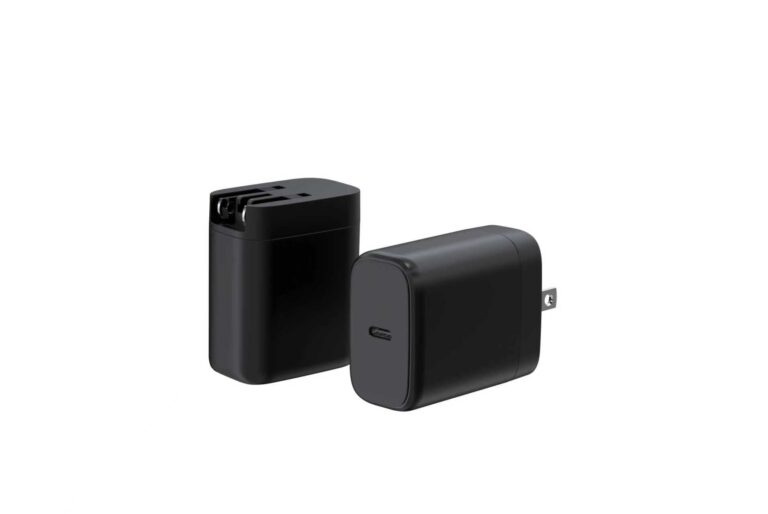
A quick scope note before anything else: “medical charger” is a buyer term, not a certification. It describes chargers used in healthcare settings — carts, workstations, device programs and home care — and whether a specific unit must meet medical electrical safety standards depends on the device, its classification and the environment. That decision belongs to your QA or regulatory team, confirmed per configuration. This guide explains the term, the clinical scenarios where charging matters, the electrical safety framework in plain language, how healthcare charging differs from consumer charging, and the OEM sourcing path.
Why “Medical Charger” Needs a Definition Before Sourcing
In sourcing conversations, “medical charger” usually means one of three things:
- A charger for healthcare IT — laptops, tablets and phones on carts and workstations.
- A power adapter for a medical device program, where the device may or may not fall under medical electrical safety standards.
- A consumer or commercial charger used in a clinical or home-care environment, where reliability and documentation expectations are higher.
None of these automatically mean “medical-grade certified.” A charger can be perfectly suitable for a workstation cart while carrying standard consumer certifications, and another configuration may need far stricter requirements because of its device context. The sourcing discipline is to define the term for your program before contacting suppliers: the device, the environment and the applicable framework decide the specification, not the label the buyer searched for.
Expert view — WECENT project engineering team: The first question we ask on a healthcare project is not “do you want a medical charger” but “what device is it powering, in what environment, and for how many hours a day.” Those three answers decide the requirements; the label the buyer searched for does not. Until the device context is defined, no supplier can honestly quote a compliant configuration.
The definition also sets the documentation expectation. A program that calls its chargers “medical” without defining the framework will discover the mismatch at the first audit or the first field failure, when the certificates do not match the claims. Defining the term early — in the sourcing document, not in the marketing copy — keeps the specification honest and the conversation productive.
What Counts as a Medical Charger?
The forms are familiar even when the label is loose:
- Wall chargers and adapters powering laptops, tablets and phones in clinical settings.
- Cart charging solutions for mobile workstations with multiple devices.
- Charging cradles and docks for devices that live in a fixed spot.
- Wireless pads and stands for bedside and desk use in care environments.
- Device-specific adapters where the charger is part of a medical device program.
The common thread is the environment: continuous operation, staff who are not chargers specialists, and documentation expectations that exceed a consumer purchase. The charger itself may be standard hardware; the program around it — specification, validation, documentation — is what makes it “medical” in practice.
Where Medical Chargers Are Used in Clinical Settings
The clinical scenarios set the requirements:
| Scenario | What charges | What it demands |
|---|---|---|
| Medical cart / mobile workstation | Laptop, screen, phone, battery | Multi-port power, sustained load |
| Patient monitor station | Monitors and peripherals | Continuous or near-continuous power |
| Infusion pump program | Pumps and batteries | Defined duty cycle, backup behavior |
| Examination light | Light and battery | Reliable input, controlled environment |
| Home care / telehealth | Devices in patient homes | Ease of use, safety, clear documentation |
Each scenario changes the duty cycle, the environment and the documentation burden. A cart charger runs for hours at a time; a home-care charger runs in a patient’s bedroom where misuse is more likely. The scenario list is the starting point for the specification, and it belongs in the sourcing document before any supplier conversation.
Electrical Safety and Standards That Apply
When the device context does require medical electrical safety, the widely referenced framework is the IEC 60601 series, which addresses areas such as leakage current, isolation and electromagnetic compatibility for medical electrical equipment. This is industry knowledge about the framework — not a statement that any particular supplier holds 60601 certification.
The framework concepts in plain terms:
- Leakage current. How much current can flow where it should not; the limits are tighter where the device can contact a patient.
- Isolation. The separation between the mains side and the parts a user or patient touches.
- EMC. Electromagnetic compatibility, so the device neither disturbs nor is disturbed by other equipment in a clinical environment.
The applicable framework is decided by the device program’s QA or regulatory team, market by market and configuration by configuration. A charger for a cart that powers standard laptops may be specified under consumer safety standards instead, depending on the device classification. The buyer’s job is to determine which framework applies and then ask suppliers which certificates and reports exist for the exact configuration.
The documentation requirement deserves its own line in the plan. A healthcare program should ask for the certificate, the test report and the batch record together, and it should confirm that all three name the same configuration. The certificate-to-configuration match is the same discipline that applies in any market, but in healthcare the cost of a mismatch is higher — an audit finding or a field issue that a consumer program would survive becomes a program-level problem.
How Medical Chargers Differ From Consumer Chargers
The hardware may look identical, but the program differs:
| Dimension | Consumer purchase | Healthcare program |
|---|---|---|
| Specification | “Will it fit my phone” | Device list, duty cycle, environment |
| Documentation | Receipt and warranty | Certificates, test reports, traceability |
| Validation | Try it at home | Defined tests against the spec |
| Risk | Personal inconvenience | Clinical continuity and safety |
| Supply | Replace on failure | Batch consistency, after-sales process |
The difference is the discipline around the hardware, not the hardware itself. A healthcare program that treats charger sourcing like a consumer purchase discovers the gap at an audit or a field failure; one that treats it like a qualified component keeps the program running.
The OEM Sourcing Path for Medical Chargers
- Define the device and environment. The device list, the duty cycle, the clinical setting and the market list.
- Determine the framework. Work with your QA or regulatory team to decide which standards apply to the configurations.
- Shortlist platforms. Compare chargers across power, ports and plugs; existing platforms beat bespoke designs for cost and reliability.
- Request samples and evidence. The PDO table, the split map, the test plans and the documentation trail travel with the sample.
- Lock a golden sample. The approved physical and documented reference that production is measured against.
- Validate at your duty cycle. Run the sustained-load and compatibility tests on the actual devices.
- Plan the program. Batch traceability, shipment inspection and the after-sales process in writing before the PO.
For a program start, the GaN Charger Category lists the platforms and power ranges, and the WECENT project team can review the device list, markets and documentation requirements. The quality documentation describes the test flow behind the platforms.
Questions to Ask Before You Commit
- Which framework applies to my device context, and who decides it?
- Which certificates and test reports exist for my exact configuration?
- What testing is built into production, and what evidence comes with each batch?
- How is the batch traced, and what happens when a field issue appears?
- What is the golden-sample process, and how is production measured against it?
- What are the MOQ, sample terms and lead time for the configuration?
Work through the checklist with a candidate supplier and keep the answers on file — the file, not the brochure, is what a healthcare program is built on.
Frequently Asked Questions
What does “medical charger” mean?
It is a sourcing term for chargers used in healthcare environments — carts, workstations, device programs and home care. It does not by itself indicate medical-grade certification; the applicable standards depend on the device context.
Do I need IEC 60601 certification for every healthcare charger?
Not automatically. The IEC 60601 series applies to medical electrical equipment and depends on the device classification and environment. Determine the framework with your QA or regulatory team, then ask suppliers which certificates exist for your exact configuration.
What documents should I request from a charger supplier?
Model-specific certificates and test reports for each market, the output profile table, the split map, test plans including aging and load testing, batch traceability and shipment inspection records.
Can a consumer charger be used on a medical cart?
It depends on the device context and the applicable requirements. Where clinical continuity and patient safety are in scope, the expectations for reliability, documentation and testing are higher. Evaluate the framework and verify the evidence.
Can WECENT support a healthcare charging project?
WECENT is a GaN and wireless charger manufacturer offering OEM/ODM support. For any healthcare project, discuss the device context, markets and documentation requirements with the project team, and confirm which certifications and reports apply to the exact configuration.
How do I shortlist healthcare charger suppliers?
Ask every candidate the same five questions: which certificates exist for my configuration, what testing is in production, can you share test plans and reports, how do you trace batches, and how does after-sales work.
Sources
- WECENT – GaN Charger Category
- WECENT – Quality Control
- WECENT – FAQ
- WECENT – Contact Us
- International Electrotechnical Commission – Official Website
- U.S. Consumer Product Safety Commission – Official Website
This article is part of Medical Power Supplies, the guide that covers this topic in decision order.