
A travel-charger line is easier to run as one architecture than as four isolated wattage SKUs that only share a logo. This page uses the live 40 W, 45 W, 65 W and 100 W travel products as a reference ladder, with the discrepancies those pages currently show. It is a brand-architecture path, not a universal-adapter how-to, and it will not invent wattages or plug maps beyond what a live page publishes and a sample confirms.
Line context is in travel chargers and plug adapters and in the travel charger category.
A 40W–100W travel line as one architecture: shared design language, shared plugs, shared pack
A 40 W–100 W travel line is cheaper to run as one architecture — shared design language, shared plugs and a shared pack — than as four isolated SKUs that only share a brand name. Wattage is the second decision. The first is whether the ladder is one product with four ratings.
Shared design language means a recognizable housing family, a common silk rule, and a manual structure that changes only where the rating and the port map change. Shared plugs means a mechanism and a regional set that a safety file can actually follow. A shared pack means a carton and a pouch a channel can mix on one shelf without teaching two unpacking stories.
Which wattage to launch first, and which can wait for a second PO
Launch first the wattage that matches the channel’s main device, and that you can support with a consistent specification and a sample. A phone-led travel retail set may start at 40 W or 45 W. A laptop-led corporate program may need 65 W or 100 W on the first purchase order. Do not launch a 100 W SKU first only because the number is larger, if the published table and the housing are still inconsistent, or if the pack and the cable are not ready. A second purchase order can add a step once the architecture is stable.
Shared packaging and manual structure across the ladder
Write one pack architecture: a shared outer size where the housing allows it, a shared legal-block layout, and a manual that keeps the same section order, with a clearly marked wattage and port map for each SKU. A channel that already listed the 45 W SKU should be able to list the 65 W SKU without a new unpacking video. The wattage, the ports and any AC-socket warning must be impossible to confuse on the front panel and in the manual.
Using 40W, 45W, 65W and 100W travel catalog products as the reference ladder
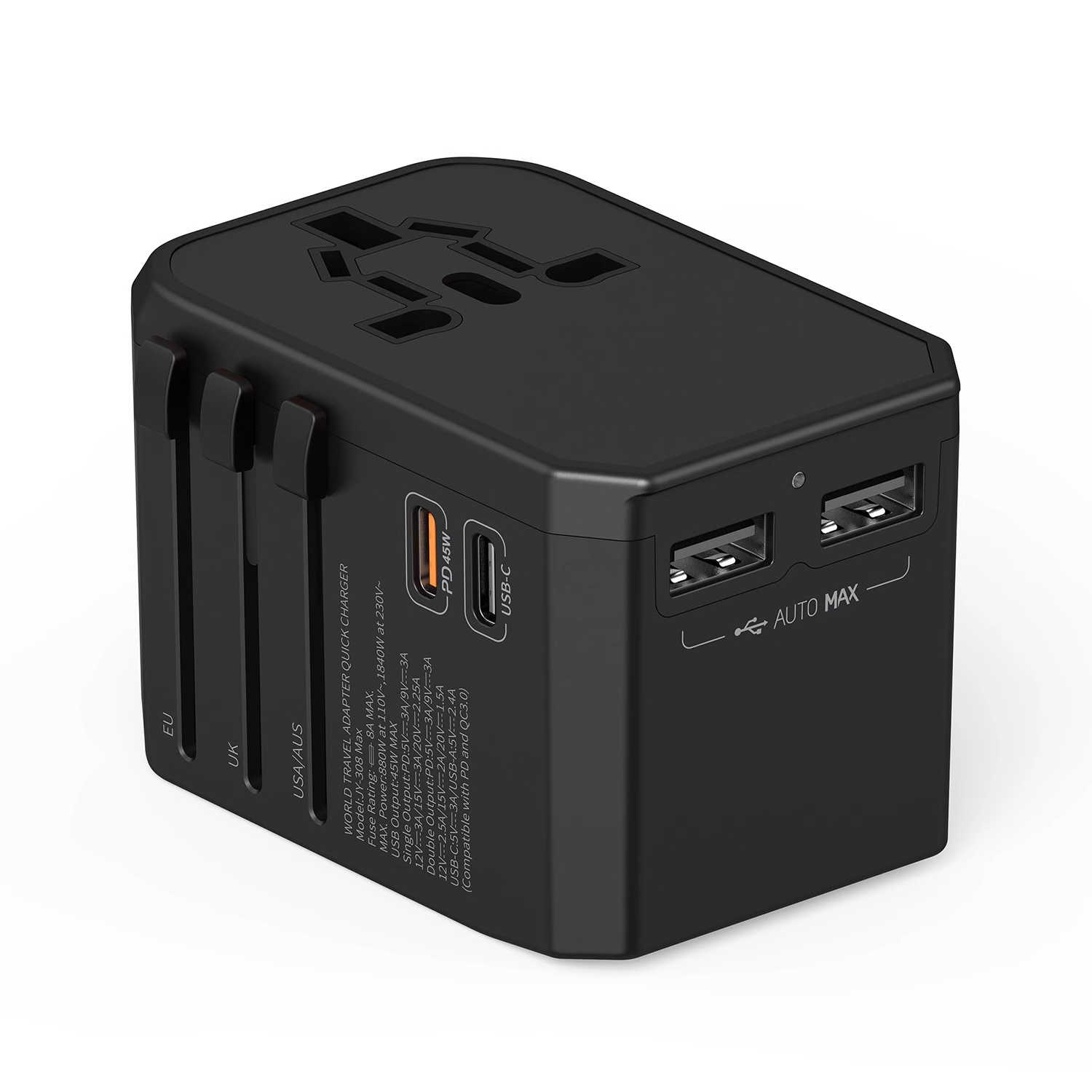
Use the live pages only as they currently publish. The GaN 40W travel charger page, as opened for this article, titles a 40 W product, states 2×USB-C and 2×USB-A, colours including Oceanic Orange, Desert Gold, Matte Black, White and Metallic Silver Black, a size of 88 × 50 × 31.5 mm, and pins US, UK, AU and EU. The same page carries two contradictory input lines, 100–240 V at 8 A and 100–240 V at 1 A; a buyer should require a single consistent input statement. The GaN 45W travel charger page publishes a USB total of 45 W max, an AC power figure of 1840 W, a size of 54.7 × 78.2 × 52.7 mm, and a ports line that lists more than one map; photographs show a hybrid sliding-pin housing with an AC socket. The GaN 65W travel charger page titles a 65 W dual USB-C and USB-A product, while its specification table repeats a 100 W maximum, a three-USB-C map and a size of 54.7 × 83.9 × 52.7 mm that match the GaN 100W travel charger table. A housing photograph on the 65 W page shows a 65 W 2C1A marking. Those table-versus-title conflicts must be reconciled on a consistent document and on a sample before a brand architecture treats 65 W and 100 W as two clean ladder steps. Certificates named on those pages are page claims.
| Live catalog page | What the page, as opened for this article, actually states | What a buyer should reconcile before using it as a ladder step |
|---|---|---|
| 40 W | 40 W USB, 2C+2A, stated colours and 88 × 50 × 31.5 mm, US/UK/EU/AU pins | Contradictory 8 A and 1 A input lines |
| 45 W | 45 W USB max, AC 1840 W, 54.7 × 78.2 × 52.7 mm, US/UK/EU/AU | More than one ports line; hybrid photograph versus any dedicated-cube assumption |
| 65 W | H1 and short text at 65 W, dual USB-C and USB-A; housing photograph marked 65 W 2C1A | A specification table that repeats a 100 W, three-USB-C map and the 100 W size |
| 100 W | 100 W USB max, AC 1840 W, same table figures as currently on the 65 W page, 54.7 × 83.9 × 52.7 mm | A sample and a unique table that are clearly this SKU, not a pasted 65 W file |
Certification leverage and where a wattage step breaks a report family
A report family is a certification-engineering question, not a brand wish. A wattage step, a port-map change, a housing change, or the addition of an AC socket can break a family and require a new evaluation. Ask the factory and the certification body which steps can share a report and which cannot. This page will not invent that boundary. Official CB-scheme context is on the IECEE site; the product standard and the report scope are the documents that settle the question.
Kit contents that should stay identical so channels can mix SKUs
Where the architecture allows it, keep the pouch style, the legal-block layout, the cable length rule and the regional-plug set identical, so a channel can mix 45 W and 65 W on one planogram. The cable rating must still match the brick; a shared pouch is not a reason to ship a cable that cannot carry the 100 W step. Differences should be limited to the wattage marking, the port map and any AC-socket warning.
Forecast mix for travel retail versus corporate travel programs
Travel retail and a corporate travel program will not take the same mix. Retail often wants a compact, gift-able 40 W or 45 W SKU and a clear front-of-pack number. A corporate program may want 65 W or 100 W, a quieter colour, and a kit that includes the right cable. Forecast them as two mixes under one architecture, not as two unrelated lines. This page does not publish a forecast figure.
When a 140W travel SKU is not worth the size and heat
A 140 W travel SKU is not automatically the next step on this ladder. The live travel-catalog pages used here stop at 100 W as opened. A higher-wattage travel housing has to earn its size, its heat and a new certification file. If the channel’s devices are satisfied at 100 W, or if a 140 W product would no longer share the pack and the plug architecture, it can wait, or it can live as a desktop SKU rather than as a travel SKU. This article does not invent a 140 W travel product in the catalog.

A brand-architecture one-pager a catalog team can keep
Keep a one-pager that names: the shared housing language; the plug or pin mechanism; whether an AC socket is in the family; the wattage steps and the live-page URL for each; known table conflicts still to be reconciled; the shared pack and manual rule; the cable rule per step; and the certification-family question still open. Update it when a page or a sample changes. The one-pager is an internal control, not a marketing claim.
Claims limited to published product-page wattages and plugs
Artwork, a website and a distributor sheet should use only the wattage and the plug set a current product page publishes, and only after contradictions on that page have been closed. Do not copy a 100 W table onto a 65 W carton. Do not describe a hybrid AC-socket product as a dedicated USB brick. External-power-supply efficiency rules, where they apply, are set by regulators; a U.S. federal overview is on the U.S. Department of Energy external power supplies page, and should be read against the actual SKU, not against a brand-architecture slogan.
USB logo or TID work, where a SKU needs it, is described on USB-IF compliance and in the USB-IF document library. A European low-voltage framework, where it applies, is in Directive 2014/35/EU. Common-charger obligations, where they apply to a device brand rather than to a standalone charger, should be read in Directive 2022/2380, not inferred from a travel-line one-pager.
Conclusion
Build a 40 W–100 W travel line as one architecture: shared design language, shared plugs and a shared pack, with wattage steps taken from live pages after their conflicts are reconciled. Launch the step the channel actually needs first, and do not invent a 140 W travel SKU or a clean 65 W table that the current catalog has not yet published.
If your team is planning a travel-charger ladder and wants to discuss a shared architecture against live catalog models, you can send that scope through the OEM and ODM page. This is a request for a project discussion.
FAQ
Should a brand launch 40 W, 45 W, 65 W and 100 W travel chargers on the first purchase order?
Not automatically. Launch first the wattage that matches the channel’s main device, and that you can support with a consistent specification and a sample. A phone-led retail set may start at 40 W or 45 W; a laptop-led corporate program may need 65 W or 100 W first. A second purchase order can add a step once the architecture — shared design language, shared plugs and a shared pack — is stable. Do not launch a 100 W SKU first only because the number is larger, if the published table and the housing are still inconsistent.
May a catalog team copy the 100 W table onto a 65 W travel SKU?
No. The live GaN 65W travel charger page, as opened for this article, titles a 65 W dual USB-C and USB-A product, while its specification table repeats a 100 W maximum, a three-USB-C map and a size that match the 100 W page. A housing photograph shows a 65 W 2C1A marking. That conflict must be reconciled on a consistent document and on a sample before a brand architecture treats 65 W and 100 W as two clean ladder steps. Artwork should use only a published, consistent wattage.
When is a 140 W travel SKU worth adding to this ladder?
Not automatically, and not because 140 is a larger number. The live travel-catalog pages used in this article stop at 100 W as opened. A higher-wattage travel housing has to earn its size, its heat and a new certification file. If the channel’s devices are satisfied at 100 W, or if a 140 W product would no longer share the pack and the plug architecture, it can wait, or it can live as a desktop SKU. This article does not invent a 140 W travel product in the catalog.
What should a brand-architecture one-pager contain?
It should name the shared housing language; the plug or pin mechanism; whether an AC socket is in the family; the wattage steps and the live-page URL for each; known table conflicts still to be reconciled, including the 40 W contradictory input lines and the 65 W table; the shared pack and manual rule; the cable rule per step; and the certification-family question still open. Update it when a page or a sample changes. The one-pager is an internal control, not a marketing claim and not a specialism statement.
{
“@context”: “https://schema.org”,
“@type”: “FAQPage”,
“mainEntity”: [
{
“@type”: “Question”,
“name”: “Should a brand launch 40 W, 45 W, 65 W and 100 W travel chargers on the first purchase order?”,
“acceptedAnswer”: {
“@type”: “Answer”,
“text”: “Not automatically. Launch first the wattage that matches the channel’s main device, and that you can support with a consistent specification and a sample. A phone-led retail set may start at 40 W or 45 W; a laptop-led corporate program may need 65 W or 100 W first. A second purchase order can add a step once the architecture — shared design language, shared plugs and a shared pack — is stable. Do not launch a 100 W SKU first only because the number is larger, if the published table and the housing are still inconsistent.”
}
},
{
“@type”: “Question”,
“name”: “May a catalog team copy the 100 W table onto a 65 W travel SKU?”,
“acceptedAnswer”: {
“@type”: “Answer”,
“text”: “No. The live GaN 65W travel charger page, as opened for this article, titles a 65 W dual USB-C and USB-A product, while its specification table repeats a 100 W maximum, a three-USB-C map and a size that match the 100 W page. A housing photograph shows a 65 W 2C1A marking. That conflict must be reconciled on a consistent document and on a sample before a brand architecture treats 65 W and 100 W as two clean ladder steps. Artwork should use only a published, consistent wattage.”
}
},
{
“@type”: “Question”,
“name”: “When is a 140 W travel SKU worth adding to this ladder?”,
“acceptedAnswer”: {
“@type”: “Answer”,
“text”: “Not automatically, and not because 140 is a larger number. The live travel-catalog pages used in this article stop at 100 W as opened. A higher-wattage travel housing has to earn its size, its heat and a new certification file. If the channel’s devices are satisfied at 100 W, or if a 140 W product would no longer share the pack and the plug architecture, it can wait, or it can live as a desktop SKU. This article does not invent a 140 W travel product in the catalog.”
}
},
{
“@type”: “Question”,
“name”: “What should a brand-architecture one-pager contain?”,
“acceptedAnswer”: {
“@type”: “Answer”,
“text”: “It should name the shared housing language; the plug or pin mechanism; whether an AC socket is in the family; the wattage steps and the live-page URL for each; known table conflicts still to be reconciled, including the 40 W contradictory input lines and the 65 W table; the shared pack and manual rule; the cable rule per step; and the certification-family question still open. Update it when a page or a sample changes. The one-pager is an internal control, not a marketing claim and not a specialism statement.”
}
}
]
}