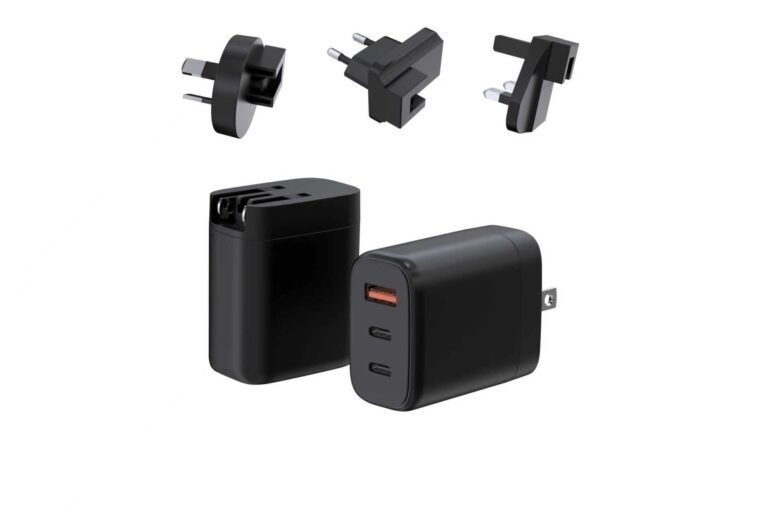
Charging performance is decided by the weakest element in the chain, and that is frequently the cable. Voltage drop turns delivered watts into heat along the conductor, and the effect grows with length, with thin conductors and with current.
This article explains the mechanism, the rating that matters and how to measure a cable rather than trusting its appearance.
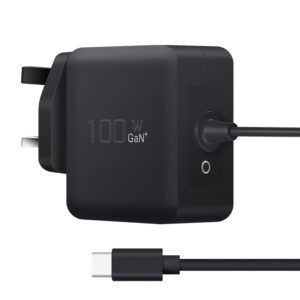
What is voltage drop in a USB-C cable?
Loss along the conductor.
The cable has resistance, so the voltage at the charger is higher than the voltage at the device, and the difference is dissipated as heat rather than delivered as charge.
Every conductor has resistance, and the voltage lost across it is proportional to the current flowing. The charger regulates its output at its own terminals; by the time that voltage reaches the device, some of it has been lost, and the device receives less power than the charger produced (USB-IF: USB Power Delivery).
The effect is invisible in normal use except as slower charging and a warmer cable, which is why it is often misattributed to the charger or the device.
Conductor gauge, length and contact resistance
Three factors set the loss: the cross-sectional area of the conductors, the length of the cable, and the contact resistance at each connector. Doubling the length doubles the loss; reducing the conductor area has the same effect.
The connector contributes as well. A worn or poorly made plug adds contact resistance at the point where the current enters the device, and a cable whose shell has loosened typically shows both mechanical and electrical symptoms.
Why a 3A cable caps a 60W charger
Cables carry a current rating, and the higher-power profiles require the corresponding current. A cable rated below that threshold cannot deliver the profile’s full power, so the negotiation settles at a lower level regardless of the charger’s capability.
| Cable rating | What it supports in practice | Where it belongs |
|---|---|---|
| Basic 3A cable | Lower-power charging profiles | Phones, accessories, bundles at low tiers |
| Higher-current cable with e-marker | Higher power profiles | Laptop chargers and multi-device use |
| Long cable, small conductors | Reduced delivered power for any profile | Occasional use where reach matters more than speed |
| Short cable, adequate conductors | Full negotiated power | Bundles where the charger’s rating is claimed on the box |
Negotiation failures caused by voltage drop
Where the voltage arriving at the device falls below what it expects, the device may interpret the condition as an unsuitable supply and step down to a lower profile, or stop charging briefly and retry. That behaviour looks like an intermittent fault in the charger when the cause is the cable.
This is one reason a charger specification should include the cable in the same document: the two together determine whether the packaging claim is reproducible in the customer’s hand.
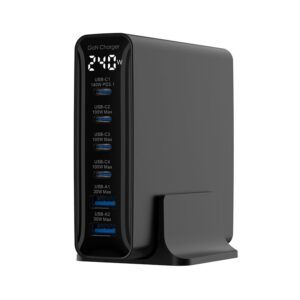
Measuring drop with a meter or a load tester
A USB power meter placed between charger and cable, or a meter with two ports, makes the effect visible: the voltage at the charger and the voltage at the load can be compared under the same current. The difference is the drop.
For a supplier, the equivalent test is a bench measurement at rated current, recorded per cable type. WECENT applies functional testing and load aging to charger and cable bundles at the quality control gates, with per-batch records, which is the evidence a marketplace or retail compliance review will ask for.
Cable specification guidance for bundles
A bundle specification should name the connector pair, the current rating, the length, the conductor construction and the connector build. Those five lines make the cable’s performance predictable and comparable between suppliers.
Efficiency and documentation duties for the charger alongside it follow the destination market’s external power supply rules (Regulation (EU) 2019/1782 and 10 CFR Part 430), and EMC compliance follows frameworks such as the FCC Part 15 rules (47 CFR Part 15).
Where thin cables are perfectly acceptable
Data-only and low-power applications do not need heavy conductors, and a short thin cable is the right choice for accessories where the load is small. The error is not thin cables as a category; it is pairing them with a charger whose claim depends on a higher current.
For a product range, the practical control is to match the cable to the tier: entry bundles with a basic cable, laptop-tier bundles with a rated cable, and documentation that states the pairing rather than leaving it to chance.
Two practical rules reduce the problem in the field. Keep the cable as short as the use case allows, because length is a direct multiplier on loss, and match the cable’s current rating to the charger’s tier, since an under-rated cable silently caps the delivered power. Where a device reports slower charging than expected, testing a second cable is the fastest way to identify whether the cable or the charger is responsible.
For a programme, the same two rules become specification lines. The cable rating and length belong with the charger’s tier, and the bundle documentation should state the pairing so that a customer who replaces the cable knows what to look for (USB-IF: document library publishes the standard documents, and 10 CFR Part 430 covers adapter efficiency rules in the US market).
Where several devices share one charger, the effect compounds: the port allocation reduces each device’s share, and the cable attached to each device removes a further fraction of what remains. Testing the actual combination, rather than the charger alone, is what produces a specification that holds up in daily use.
FAQ
How many volts can a USB-C cable handle?
The voltage is negotiated by the connected devices rather than fixed by the cable, and the cable’s contribution is its current rating and its resistance. A cable rated below the required current limits the power that can be delivered regardless of the charger’s capability.
What is the 3% voltage drop rule?
It is a general electrical guideline that losses along a conductor should stay within a small percentage of the supply voltage. In USB-C charging the practical expression is that a cable with inadequate conductors or excessive length reduces delivered power noticeably, especially at higher currents.
Why is my long USB-C cable charging slowly?
Length adds resistance, so the voltage reaching the device is lower than the voltage at the charger, and the device may settle at a lower power profile. A shorter cable with adequate conductors usually restores the expected rate.
Does a thicker USB-C cable charge faster?
A cable with adequate conductors for the negotiated current avoids unnecessary loss, so it allows the full negotiated power to reach the device. Beyond that, the charging rate is set by the device and the charger rather than by the cable alone.
What should a brand specify for a bundled cable?
Connector pair, current rating, length, conductor construction and connector build. Those lines make performance predictable and allow a supplier to be compared on the same basis as its competitors.
Specifying charger and cable bundles?
Share the wattage tiers, cable lengths and markets, and WECENT will confirm the cable rating, connector build, test records and MOQ from a written specification.