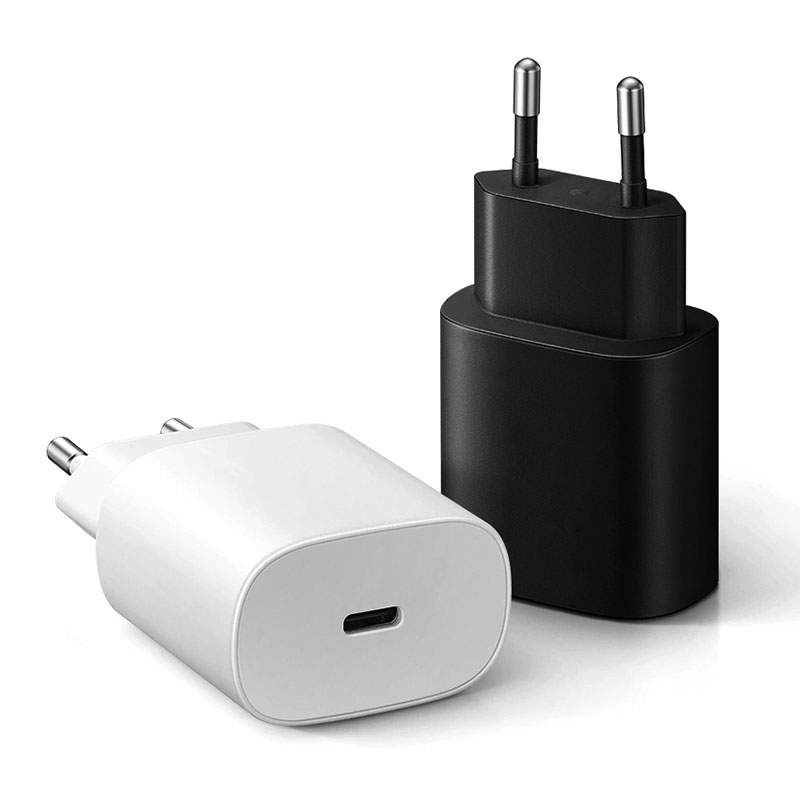
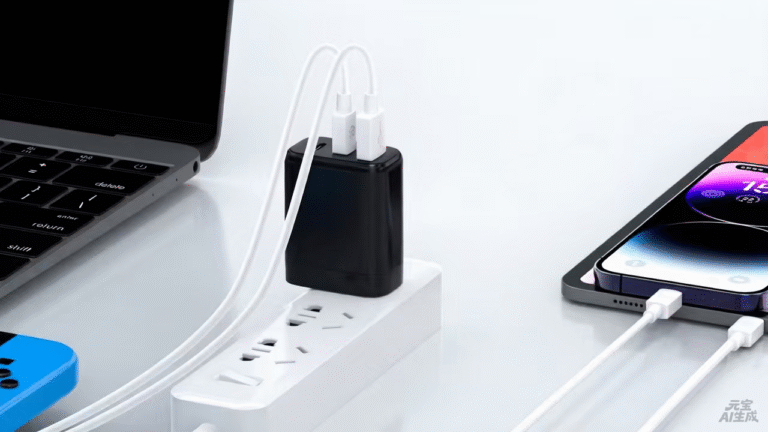
"45W sounds twice as fast as 25W" — and on the right phone it is, in the early charging window. But the difference depends entirely on PPS negotiation and the model's ceiling. This guide compares the two tiers honestly so buyers pick the one that matches their Galaxy.
How Samsung chooses charging power
Samsung's charging system negotiates power through USB PD with PPS: the phone requests voltage and current steps, and the charger adjusts dynamically. The phone decides the ceiling; the charger decides whether it can reach it. A 45W charger on a 25W-capped model delivers 25W.
Samsung's charging system balances speed, heat and battery longevity through three inputs: the phone's hardware capability, the charger's advertised profile, and live battery temperature. The phone, not the charger, decides the actual power at every moment. That architecture means a 45W charger only matters on phones whose firmware accepts 45W, and even then only when temperature allows it.
25W charging: what it looks like in practice
25W is the workhorse tier for most Galaxy phones: it fills a typical flagship battery to about 50% in roughly 30 minutes and covers Z Fold/Flip and most A-series models at their ceiling. A 25W PPS charger is the safe default recommendation for the Galaxy lineup.
At 25W, a typical flagship battery reaches roughly 50% in about 30 minutes and full in 60–75 minutes depending on capacity and temperature. The session is gentle enough that most users never notice the charger getting warm. This is the tier that covers the vast majority of Galaxy phones, which is why it is the sensible default for both users and retailers.
The 25W session also shows the value of a good PPS profile: a charger whose PPS window matches the phone holds the requested voltage longer, which keeps the first half of the curve fast. A narrow-window charger may step down earlier, producing a slower 0–50% despite the same label. This is why Samsung users who upgrade from a generic 25W brick to a properly profiled one sometimes notice a real speed gain.
45W charging: where the extra speed shows
On models that accept 45W, the extra wattage shortens the early window — the first 30 minutes gain more charge than at 25W — and helps while the phone is in use. The total-to-full time gains less, because charging tapers near the top; the benefit is concentrated in the 0–60% range.
The 45W advantage also appears during use-while-charging: navigation, gaming and screen share draw 5–15W, leaving more headroom for the battery at 45W than at 25W. For heavy phone users, this is the more valuable difference than the empty-to-full time. Listings that mention both metrics — first-30-minute gain and use-while-charging headroom — give buyers a complete picture.
PPS range and phone compatibility
PPS works in defined voltage-current ranges, and each phone negotiates within its supported window. Compatibility is model-dependent: check whether your specific Galaxy supports 45W before buying the bigger brick, and confirm the charger's PPS profile matches.
Compatibility is decided by the overlap between the charger's PPS window and the phone's request range. A charger advertising "PPS 3.3–11V/5A" covers the common 25W and 45W Galaxy profiles; a charger with only a narrow PPS window may negotiate a lower power on some models. Before stocking a third-party 45W charger, verify the exact PPS profile against the Galaxy models you actually sell.
Battery health trade-offs
Faster charging generates more heat, and Samsung manages temperature through its own power management. The battery-health difference between 25W and 45W is small for typical users because both taper and the phone controls the session; extreme heat, not wattage, is the real longevity factor.
Samsung's power management keeps 45W charging within safe limits by tapering aggressively as temperature rises, so the practical battery impact is small for most users. The bigger longevity factors are ambient heat and charge cycling habits, not the charger's wattage. Recommending a 45W charger for a 45W-capable phone is defensible; claiming it preserves battery health would not be.
Which tier to stock for Galaxy users
Stock 25W as the volume SKU and 45W as the premium tier for flagship owners across our Galaxy-compatible GaN range. In independent charging comparisons-style testing, the measurable 45W advantage appears only on compatible models — market it as "for 45W-compatible Galaxy flagships," not as twice the speed.
Charging time comparisons in practice
As a rough guide: a 25W charger takes a typical flagship from empty to 50% in about 30 minutes; a 45W charger on a compatible model can shorten that by several minutes and improve use-while-charging. Full-charge times converge because of the taper phase.
When comparing published charge times, check the starting battery level and ambient: "0–50% in 30 minutes" measured at 25°C tells you more than "full charge in 75 minutes" without conditions. Independent reviews that state conditions are the ones to trust. Standardizing your own test protocol makes your comparisons reproducible and credible.
PPS negotiation explained simply
PPS is like a dial instead of a switch: the charger adjusts voltage in small steps over the USB Type-C link as the battery fills and temperature changes. This keeps efficiency high and heat low — the reason PPS is built into Samsung flagships from recent generations onward.
Battery temperature and longevity
Both 25W and 45W chargers run cooler than you might expect because the phone's power management tapers current — the efficiency and thermal behavior that matters for sustained charging. Charging in hot environments or under thick cases raises temperature more than the charger's wattage does; keep the phone cool for the best longevity.
Which Galaxy models benefit from 45W
Only models whose firmware supports 45W see the benefit — primarily recent S-series flagships. Z Fold/Flip and most A-series cap at 25W, so a 45W brick is headroom, not speed, for those users.
The model list for 45W benefit is short and worth keeping accurate: primarily recent S-series flagships whose firmware accepts the higher profile, and even then only when the battery is cool and low. Z Fold and Flip models, and most A-series units, cap at 25W regardless of the charger. This asymmetry is the core of the honest 25W vs 45W conversation: the 45W charger is not faster for most Galaxy owners, it is faster for a specific subset. Retailers who market 45W as "for compatible Galaxy flagships" avoid the return wave that follows "twice the speed" claims. Buyers who know their model's ceiling can then decide whether the premium tier is worth it or whether 25W fully covers their phone.
Stocking decisions for retailers
For retailers, carry 25W PPS in depth and 45W as a smaller premium line. Label both with the compatibility note ("fast charges Galaxy S-series; 45W for compatible flagships") to avoid returns from buyers whose phones cap lower.
Inventory discipline for Samsung chargers: stock 25W PPS deep, 45W PPS shallow, and label both with compatible model ranges. Returns spike when buyers assume 45W is universally faster — clear labeling and a compatibility note on the listing prevent most of them. Track return reasons; if "charges slow" appears on 45W SKUs, the labeling is failing, not the product.
FAQ
Is a 45W Samsung charger faster than 25W?
On Galaxy models that accept 45W, the early charging window is faster; on 25W-capped models the speed is identical. Check your phone's supported wattage first.
Does every Samsung phone support 45W charging?
No. Recent S-series flagships support 45W on some models; Z Fold/Flip and A-series generally cap at 25W.
Do I need a PPS charger for a Samsung?
For Samsung's advertised fast-charge speeds, yes. Without PPS, the phone charges at slower standard PD rates.
Is 45W charging bad for the Galaxy battery?
No — the phone manages temperature and tapers current. Keep the phone out of extreme heat and use a quality PPS charger.
Stocking Samsung-compatible chargers? Send your target models and volume to our team through the contact page — we can supply 25W and 45W PPS SKUs with verified compatibility data.
This article is part of Android & Multi-Device Charging, the guide that covers this topic in decision order.