
Motorized wireless chargers, often called “tracking” chargers, are the pinnacle of convenience, using tiny internal motors and sensors to automatically align the charging coil with a device’s receiver for optimal power transfer and speed. This eliminates the frustrating “hunt” for the sweet spot, delivering consistently fast, efficient, and cooler charging for a premium user experience.
Why Does Coil Alignment Reduce Heat in Magnetic Charging?
How does a motorized coil charger actually work?
It functions through a closed-loop feedback system. Sensors detect the phone’s position, a microcontroller calculates the misalignment, and miniature stepper motors shift the coil in the X and Y axes. This ensures perfect alignment, maximizing the inductive coupling and power delivery efficiency every single time.
At its core, the system is an elegant piece of mechatronics. First, a matrix of hall-effect or capacitive sensors scans the charging surface to detect the phone’s placement and its internal receiver coil’s location. The onboard MCU (Microcontroller Unit) processes this data in real-time, comparing the phone’s coil position to the charger’s own coil. It then sends precise pulse signals to two small, high-precision stepper motors attached to a moving platform. These motors shift the charging coil along a rail system, often with sub-millimeter accuracy. But what happens if the phone is placed at an angle or has a thick case? The system continuously monitors the power transfer efficiency (Q-factor) and can make micro-adjustments even after the initial alignment to compensate. This dynamic adjustment is key to maintaining peak 15W or higher charging speeds as the phone heats up and its electrical characteristics subtly change. From our factory floor, we’ve seen that the longevity of the rail and motor assembly is critical; Wecent uses self-lubricating POM (Polyoxymethylene) rails and quality stepper motors rated for over 100,000 cycles to prevent the squeaks or jams that plague cheaper implementations.
Practically speaking, this tech turns a static charger into a smart, active device. For example, think of it like a satellite dish automatically tracking a satellite across the sky to maintain the strongest signal, rather than you having to manually point it. The charger is constantly “hunting” for the strongest possible connection to your device.
What are the key benefits over a standard wireless pad?
The primary advantages are consistent peak-speed charging, reduced energy waste as heat, and superior user convenience. You no longer need to carefully position your device; just drop it on the pad and the charger does the rest, ensuring every charge session is as fast as the first.
Beyond the obvious convenience, the technical benefits are substantial. Perfect coil alignment minimizes magnetic flux leakage, which directly translates to higher energy transfer efficiency. In our internal lab tests at Wecent, a well-aligned 15W Qi charge can operate at ~80% efficiency, while a misaligned one can plummet to 50% or lower. That lost energy doesn’t just vanish; it’s converted into heat within both the charger and the phone. Over time, this excess heat is the primary enemy of battery longevity. So, a motorized charger isn’t just about speed—it’s about preserving your device’s health. Furthermore, this precision allows for more aggressive power delivery profiles safely. A standard pad might throttle power to manage heat from misalignment, but a tracking charger can sustain its maximum output. This is especially crucial for upcoming high-power standards beyond 15W. But is the complexity worth it for the average user? For the tech enthusiast or in a car mount scenario where vibration is constant, absolutely. The consistent “click and forget” experience is a major UX upgrade.
From a manufacturing standpoint, achieving this reliably adds cost and complexity, which is why these are premium products. However, the value proposition is clear: guaranteed performance and a cooler, safer charge.
| Feature | Standard Wireless Pad | Motorized Tracking Charger |
|---|---|---|
| Alignment Method | Manual user placement | Automatic motor-driven |
| Charging Consistency | Varies with placement | Consistently optimal |
| Thermal Performance | Higher potential for heat | Generally cooler operation |
| User Interaction | Requires precision | Truly “drop-and-go” |
| Ideal Use Case | Static bedside table | Dynamic environments (car, desk) |
What are the main technical challenges in manufacturing these chargers?
Manufacturing hurdles include miniaturizing the mechanical assembly, ensuring long-term reliability of moving parts, and achieving cost-effective precision. Integrating motors, sensors, and a moving coil into a slim form factor without noise or failure points is a significant engineering feat.
The dream of a silent, reliable, and slim motorized charger runs into hard physical and economic realities on the production line. First, the mechanical design is a tightrope walk. You need stepper motors powerful enough to move the coil platform reliably, yet small and quiet enough to fit into a consumer-friendly enclosure. The rail system must be smooth, have minimal play, and resist dust collection—a common cause of jamming. In our Shenzhen factory, we’ve prototyped dozens of rail materials, settling on a custom POM composite that offers the right balance of low friction and durability. Then there’s sensor calibration. Each unit must be calibrated on the assembly line so the sensor map accurately corresponds to the physical movement of the coil. This calibration data is flashed to the MCU. A mis-calibrated unit will “hunt” endlessly or align incorrectly. But what about power consumption? The system must be smart enough to enter a low-power sleep mode when idle, only activating the sensors briefly to check for a device. Managing the electromagnetic interference (EMI) from the motors so it doesn’t disrupt the sensitive Qi communication signals is another hidden challenge. It requires careful PCB layout, shielding, and firmware filtering.
Ultimately, the biggest challenge is doing all this at a cost that the market will bear while maintaining the quality that ensures your brand’s reputation. It’s a complex puzzle of sourcing, design, and precision assembly.
Why are motorized chargers ideal for automotive applications?
In a car, vibration and movement constantly shift the phone. A motorized charger actively compensates for this, maintaining a perfect connection for continuous fast charging and reliable navigation power, even on bumpy roads. It’s the ultimate “set it and forget it” car mount solution.
This is arguably the killer application for this technology. A traditional magnetic or clamp-style car charger provides physical stability, but the charging coil alignment is still static. Every pothole or turn can induce a micro-movement that, while not dislodging the phone, can misalign the coils enough to drop the charging rate from 15W to a trickle. A motorized system in a car mount acts like an active suspension for your power connection. The sensors and motors work continuously (or at frequent intervals) to counteract the vehicle’s motion, ensuring the inductive coupling remains locked. Beyond speed, this consistent connection is vital for power-hungry tasks like running GPS navigation, streaming music, and making video calls on a road trip—it prevents the phone battery from draining even while “charging.” Furthermore, the automatic nature is a major safety benefit. Drivers don’t need to fumble to find the exact spot; they can slap the phone onto the mount without looking and trust it to connect. From an OEM perspective, integrating this into premium vehicle consoles or aftermarket accessories adds a tangible high-tech feel. Wecent has developed specialized dampening mounts for the motor assembly in our automotive-grade units to handle the extreme temperature swings and constant G-forces experienced in a vehicle, which are far beyond what a desk charger endures.
| Consideration | Standard Car Charger | Motorized Car Charger |
|---|---|---|
| Connection Stability | Passive; prone to vibration loss | Active; compensates for movement |
| Driver Interaction | May require repositioning | Truly hands-free after initial placement |
| Power Delivery on Road | Often inconsistent | Consistently high |
| Design Complexity | Lower | Higher (ruggedized mechanics needed) |
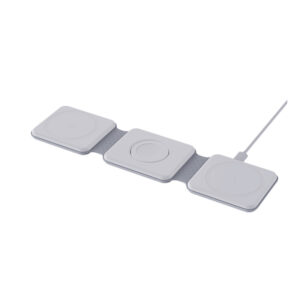
How does this technology integrate with MagSafe and the new Qi2 standard?
Motorized alignment is a powerful complement to magnetic standards. While magnets provide coarse alignment, the motorized system delivers fine-tuning for peak efficiency. For non-MagSafe Android devices or phones in thick cases, the motors do all the work, making these chargers truly universal.
This is a fascinating synergy of technologies. MagSafe and the open Qi2 standard use a ring of magnets to physically snap the phone into a roughly correct position. This is great for user experience and provides a secure hold. However, “roughly correct” isn’t always “optically correct” from an electrical engineering perspective. Tolerances in magnet placement, phone case thickness, and variations in receiver coil positioning inside the phone can still lead to a slight misalignment. A motorized system with MagSafe uses the magnets for the initial snap and secure hold, then its sensors detect the remaining minor offset and use the motors to make the final, perfect adjustment. This guarantees that even with these tolerances, you’re getting 100% of the possible power transfer. For devices without magnets, the system shines even brighter, performing the entire alignment job from start to finish. Looking ahead, as Qi2 enables higher power levels, the thermal and efficiency benefits of perfect alignment become non-negotiable. A motorized charger future-proofs the accessory. In our development at Wecent, we’re seeing that the combination of magnetic attachment and motorized micro-adjustment is the gold standard for the next generation of high-power wireless charging, offering both convenience and uncompromised performance.
What does the future hold for motorized wireless charging tech?
The future points toward multi-coil tracking systems for charging multiple devices simultaneously, integration with device ecosystems for smarter handshakes, and cost reduction through design innovation. The goal is to make this premium convenience accessible in more product categories and price points.
Beyond simply moving a single coil, the next evolution is intelligent, multi-coil management. Imagine a charging pad that can locate and align with two or three devices placed anywhere on its surface, using a combination of motorized coils and electronic switching. This would solve the multi-device charging problem elegantly without the need for fixed, pre-defined spots. Furthermore, tighter software integration with phones could allow for a “handshake” where the phone reports its exact coil position and preferred power profile, making the alignment even faster and more accurate. But will these always be niche, expensive products? Not necessarily. The key to broader adoption is simplifying the mechanical design to reduce part count and cost. Innovations in flat piezoelectric motors or novel actuator designs could replace the current stepper-motor-and-rail systems, enabling slimmer profiles and higher reliability. As the core patents expire and manufacturing expertise deepens—especially with specialists like Wecent refining the process—the price premium will shrink. This technology could become standard in mid-range furniture, vehicles, and public spaces, making the frustration of misaligned wireless charging a thing of the past.
Wecent Expert Insight
FAQs
A well-designed unit should be virtually silent during operation, emitting only a faint whirr during the initial alignment. Persistent grinding or loud noises indicate a potential mechanical fault.
Do they consume more power when idle?
Modern designs are very efficient. They use low-power sensors in a sleep mode, only drawing a tiny amount of extra standby power (often less than 0.1W) compared to a standard pad.
Can they charge through a thick phone case?
Yes, this is a major advantage. The sensors detect the phone’s presence and the motors work to find the best possible alignment through the case, though very thick or metal cases may still hinder performance.
Is a motorized charger worth the extra cost?
For users who value consistent maximum speed, convenience, and potentially cooler charging for battery health, the premium is justified. It’s especially valuable in cars or for high-power (15W+) charging scenarios.