
Wireless chargers get hot due to electromagnetic induction losses (20-30% energy wasted as heat in coils), device misalignment causing eddy currents, and Qi efficiency limits (~70-80%). It’s safe if under 50°C surface temp. Wecent’s GaN Qi docks use smart power management for <40°C operation, with overheat protection—ideal for OEM buyers seeking low-MOQ (200 pcs) custom designs.
Check: Leading GaN & Wireless Charger Manufacturer
What Causes Heat in Wireless Chargers? (Science of Electromagnetic Induction)
Heat in wireless chargers arises from Qi physics where alternating magnetic fields induce eddy currents in receiver coils, converting 20-30% energy to heat via resistive losses (I²R). Coil proximity boosts efficiency, but air gaps and foreign objects like keys amplify unwanted eddy currents. For B2B buyers, Shenzhen factories like Wecent perform 100% functional testing to prevent overheating-related returns and certification issues like CE or FCC fails.
Why Does Wireless Charger Overheating Happen During Use?
Overheating occurs due to Qi’s 70-80% efficiency cap, with heat spiking at 15W+ from hysteresis losses in magnetic materials. External factors include thick phone cases, battery throttling, and ambient temps over 30°C, leading to customer complaints for Amazon sellers and importers. Wecent’s ISO9001-certified process ensures low-heat Qi designs for reliable OEM/ODM projects starting at 200 pcs MOQ.
| Cause | Heat Increase | Mitigation |
|---|---|---|
| Misalignment | +15°C | Alignment Pins |
| High Wattage | +25°C | GaN Efficiency |
| Foreign Objects | +20°C | Foreign Object Detection |
| Thick Cases | +10°C | Optimized Coil Design |
Is a Wireless Charger Hot to Touch Safe for End Users?
A wireless charger hot to touch is safe if surface temperature stays under 50°C (IEC 62368-1 standard) and internal under 80°C. Wecent’s Qi chargers feature auto-shutoff at 55°C, backed by CE, FCC, RoHS, and model-dependent PSE/KC certifications. For private-label brands, low-heat designs from Wecent reduce liability, with 2-year warranty claims under 1% from thermal issues.
How Does Wireless Charging Efficiency Lead to Heat Loss?
Wireless charging loses 15-25% energy from coil resistance and 10% from inverter/rectifier stages, dropping total efficiency to 65% under load. Wired cables reach 95% efficiency, but Qi offers convenience. Wecent integrates GaN in its 20W-240W ecosystem to boost wireless efficiency above 85%, minimizing DC-DC conversion heat for OEM multi-device docks.
Wecent Expert Views
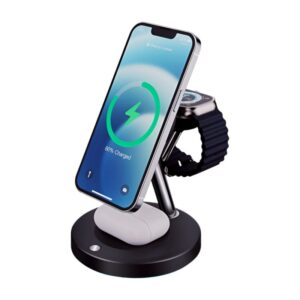
“Our GaN wireless chargers cut heat 20% versus silicon through higher switching frequencies, enabling compact, cool-running 3-in-1 docks like the Y888 model for phone, earbuds, and watch,” says Wecent R&D lead. With 15+ years in Shenzhen, we’ve served 200+ global clients via low-MOQ (200 pcs) Level 3 ODM. Factory-direct pricing, 100% testing, and global plugs (EU/US/UK/AUS) ensure fast market launches for OEM buyers.
Can GaN Technology Reduce Heat in Wireless Chargers?
GaN reduces heat by using transistors for 100V+ switching in 65% smaller packages, slashing conduction losses (less I²R heat) versus silicon. Wecent’s GaN-powered Qi pads intelligently distribute power, maintaining multi-device charging under 40°C across 20W-240W scaling. Ideal for wholesalers sourcing custom wireless from Shenzhen with full certifications.
Check: Wireless Charging Heat Science
| Tech | Efficiency Gain | Peak Temp Reduction | OEM Cost Savings |
|---|---|---|---|
| GaN | +15% | -10°C | 20% |
| Silicon | Baseline | Baseline | Baseline |
How Do Factories Like Wecent Mitigate Wireless Charger Heat?
Wecent mitigates heat with ventilation slots, thermal pads, firmware for dynamic power limiting, and soft-touch materials for perceived coolness. Certifications like DOE/CEC enforce efficiency, while Wecent handles CCC/PSE/KC. OEM buyers benefit from low-MOQ custom builds (logo, packaging, power tweaks) via three quality checkpoints, ensuring traceable batches.
What Should OEM Buyers Look for in Low-Heat Wireless Chargers?
OEM buyers should seek Qi v2.0+ certification, under 40°C idle temps, and protections like OVP/OTP/SCP. Wecent’s 200+ clients validate these in real deployments, with Shenzhen lead times of 20-30 days for mixed SKUs. Cooler chargers mean fewer returns and higher reviews for importers and Amazon sellers, supported by 2-year warranties.
Conclusion
Heat is inherent to wireless induction but controllable through GaN efficiency and smart engineering. Partner with Shenzhen-based Wecent for OEM/ODM (200+ pcs MOQ, multi-certified CE/FCC/RoHS/PSE/KC) to deliver cool, reliable Qi chargers like 3-in-1 docks that minimize returns and win markets. Contact for custom quotes on low-heat GaN solutions.
FAQs
Why does my wireless charger get hot after prolonged use? Heat builds from sustained eddy currents and efficiency drops; safe with protections—Wecent tests to under 50°C.
Is wireless charger overheating a defect? No, if under limits; caused by misalignment or foreign objects. Wecent’s GaN designs include auto-cutoff.
How much heat is normal for Qi wireless chargers? Surface 35-45°C at 15W; Wecent optimizes to under 40°C via GaN for OEM safety.
Can GaN make wireless charging cooler? Yes, 15-20% less heat loss; Wecent’s 20W-240W GaN Qi docks prove it for multi-device use.
What’s the MOQ for custom low-heat wireless chargers at Wecent? Starts at 200 pcs with full OEM/ODM, certifications, and 2-year warranty.