
A grounded travel adapter (3-prong/earthed) includes a third pin that connects to ground, safely dissipating fault current in high-wattage devices like 100W+ GaN laptop chargers. An ungrounded adapter (2-prong) lacks this protection, raising shock and overheating risks. For B2B procurement, grounded plugs are mandatory for GaN chargers 65W and above, especially across CE/FCC-regulated markets. This guide explains the critical safety differences and how to spec compliant grounded adapters for your OEM sourcing strategy.
Check: What Are Global Plug Standards for Universal Travel Chargers?
Why Do Grounded Travel Adapters Matter for High-Wattage GaN Chargers?
A grounded travel adapter provides a dedicated earth pin that safely diverts fault current away from users and connected devices. When a fault occurs in high-wattage GaN chargers (65W–240W), the ground pin acts as a low-resistance pathway, preventing dangerous voltage buildup on the adapter chassis. This is critical because GaN chargers operate at elevated power levels, and any insulation failure without grounding creates severe shock and fire hazards.
While GaN technology delivers exceptional efficiency—up to 96% power conversion with minimal heat loss—this efficiency refers only to normal operation, not fault conditions. High-power designs (120W+) still require proper grounding to manage residual fault currents in ungrounded or faulty wall outlets, particularly in travel environments where outlet quality is unpredictable. In B2B liability terms, ISO9001-certified OEM suppliers like Wecent mandate grounded specifications for multi-certification compliance across EU, US, and Asia-Pacific markets, significantly reducing product recall risk and protecting your brand reputation.
What Are the Key Differences Between 2-Prong and 3-Prong Adapters?
The fundamental difference lies in the presence of a ground pin. A 2-prong (ungrounded) adapter carries only live and neutral conductors, making it safe only for low-power applications under 20W. A 3-prong (grounded) adapter adds an earth pin that connects to the building’s ground infrastructure, enabling safe operation up to 240W depending on the current rating. Below is a detailed comparison:
| Aspect | 2-Prong (Ungrounded) | 3-Prong (Grounded/Earthed) |
|---|---|---|
| Design | Live + Neutral only | Live + Neutral + Ground (earth) |
| Power Capacity | ≤20W safe; risky above 30W | 20W–240W safe (with proper rating) |
| Safety Mechanism | No fault current path; relies on double insulation | Earth pin diverts fault current safely |
| Best For | Low-power phones (5W–18W); short-term travel | Laptops, GaN chargers 65W+; permanent setups |
| Certifications | Limited CE/FCC scope; not recommended for high-power | Full CE/FCC/RoHS compliance; required for 100W+ in EU |
| OEM Sourcing Cost | Lower; 200 pcs MOQ feasible | +5–10% premium; Wecent ISO-certified options available |
Voltage and current handling capacity also differs significantly. A 2-prong adapter is designed for maximum 15A; a 3-prong unit supports 16A–20A, enabling safe delivery of multi-port GaN charger designs with PD 3.1 protocol. Regional standards further drive the distinction: EU outlets (Schuko/CEE) default to grounded-only; US outlets (NEMA 5-15) offer both options; UK and Australian standards mandate grounding exclusively. For B2B procurement targeting global distribution, this means specifying separate grounded SKUs per region—a complexity that experienced Shenzhen OEM partners like Wecent manage through regional mold inventory and per-market certification strategies.
When Must You Use a Grounded Adapter for GaN Chargers?
Use a grounded adapter whenever your GaN charger exceeds 65W or requires international certification compliance. Here’s the decision framework: low-power smartphone chargers (5W–20W) remain safe with 2-prong adapters in ungrounded environments, but 65W+ laptop designs, multi-port stations, and any charger deployed across EU/US/Asia markets must use 3-prong grounded configurations.
Certification mandates reinforce this rule. The EU (CE marking), US (UL/FCC standards), China (CCC for regulated products), Japan (PSE), and South Korea (KC) all require grounding for high-wattage adapters. Wecent’s multi-certification capability—CE, FCC, RoHS, CEC, DOE, PSE, and KC—ensures your OEM order meets all regional requirements simultaneously, eliminating the cost and complexity of sourcing compliant adapters from multiple suppliers. Use-case specificity also matters: laptop travel kits universally require 3-prong (100W–240W designs); hybrid work charging stations demand grounding for both safety and permanence; budget smartphone-only sets under 20W can tolerate 2-prong in low-risk deployments.
How Does Grounding Prevent Electrical Shock and Overheating?
Grounding prevents shock by providing a low-impedance return path for fault current that bypasses the user entirely. In an ungrounded adapter, any insulation failure forces fault current to seek return through the user’s body touching the adapter chassis—a direct shock hazard. The ground pin eliminates this pathway by safely conducting the fault to earth, leaving zero current available to harm the user.
Thermal management is equally critical. High-power GaN chargers generate significant heat; without proper grounding, voltage buildup on the chassis can degrade insulation and trigger thermal runaway—a condition where heat accelerates failure exponentially, potentially igniting the adapter. Grounding prevents voltage accumulation on conductive surfaces, maintaining stable thermal conditions even under fault. Class II double insulation—used in some premium 2-prong chargers—provides some protection, but Class I grounding remains the safety standard mandated for 100W+ B2B deployments across regulated markets. In real-world travel scenarios, an ungrounded adapter on a 120W GaN charger plugged into a faulty hotel outlet in a humid environment creates compound risk: shock hazard plus fire potential. Certified grounded design combined with 100% pre-shipment functional testing—standard at Wecent factories—mitigates this entirely.
What Are the OEM/ODM Options for Sourcing Grounded Adapters from China?
Wecent offers three levels of OEM/ODM grounded adapter sourcing, each balancing speed, customization, and investment. Level 1 (Quick OEM Launch) applies your brand to proven grounded designs using existing EU Schuko, US NEMA, or UK plug molds—fastest route to market with MOQ starting at 200 pcs, 6–8 week lead time, and included logo printing and packaging customization. Level 2 (Enhanced OEM) tunes specifications around your sales channels: custom foldable form factors, integrated GaN charger modules (65W–120W), bundled cables and pouches, and regional plug variants; MOQ typically 500–1,000 pcs with 8–10 week production.
Level 3 (Full ODM) co-creates proprietary designs exclusive to your brand—industrial design, internal circuitry, thermal management systems—requiring MOQ of 1,000+ pcs and 12–15 week development plus production. All levels include ISO9001-certified manufacturing, simultaneous multi-certification (CE, FCC, RoHS standard; PSE, KC, CCC model-dependent), 100% functional testing per unit, batch traceability, and a standard 2-year warranty. Grounded adapters command a +5–10% premium over ungrounded due to additional earth pin engineering and certification overhead—an investment easily justified by accessing EU/US distribution channels and eliminating product liability exposure. For B2B buyers, this premium is negligible against the cost of market rejection or legal consequences of non-compliant adapters.
What Common Misconceptions Surround Grounded Adapters and GaN Chargers?
Myth 1: “GaN chargers are so efficient they don’t need grounding.” Reality: Efficiency (96% power conversion) refers to normal operation, not fault-current handling. High wattage inherently requires grounding regardless of semiconductor choice.
Myth 2: “2-prong adapters work fine for travel.” Reality: Risky for 100W+ devices. CE and FCC regulations explicitly reject ungrounded adapters for high-wattage in regulated markets, exposing you to compliance rejection and recalls.
Myth 3: “Grounding adds too much cost for my OEM margins.” Reality: The +5–10% premium is offset by avoided liability, product rejection, and market access expansion. Wecent’s 200 pcs MOQ reduces per-unit risk and enables profitable entry into protected markets.
Myth 4: “Universal adapters solve everything.” Reality: Most off-the-shelf universal adapters ship ungrounded. B2B buyers must explicitly spec 3-prong earthed in OEM purchase orders and verify certification before mass production commitment.
How Should You Specify Grounded Adapters in Your OEM Purchase Order?
Precise specification at the PO stage prevents costly design revisions mid-production. Include: voltage/current rating (100–240V, minimum 16A for 100W+ GaN); ground pin presence (“mandatory 3-pin earthed” or specific standards like “Schuko Type E/F for EU”); plug type per region (itemize EU/US/UK/AUS separately if multi-kit); certification list (CE, FCC, RoHS minimum; add PSE/KC/CCC if targeting Japan, Korea, or China); and 100% functional testing requirement with traceability per batch.
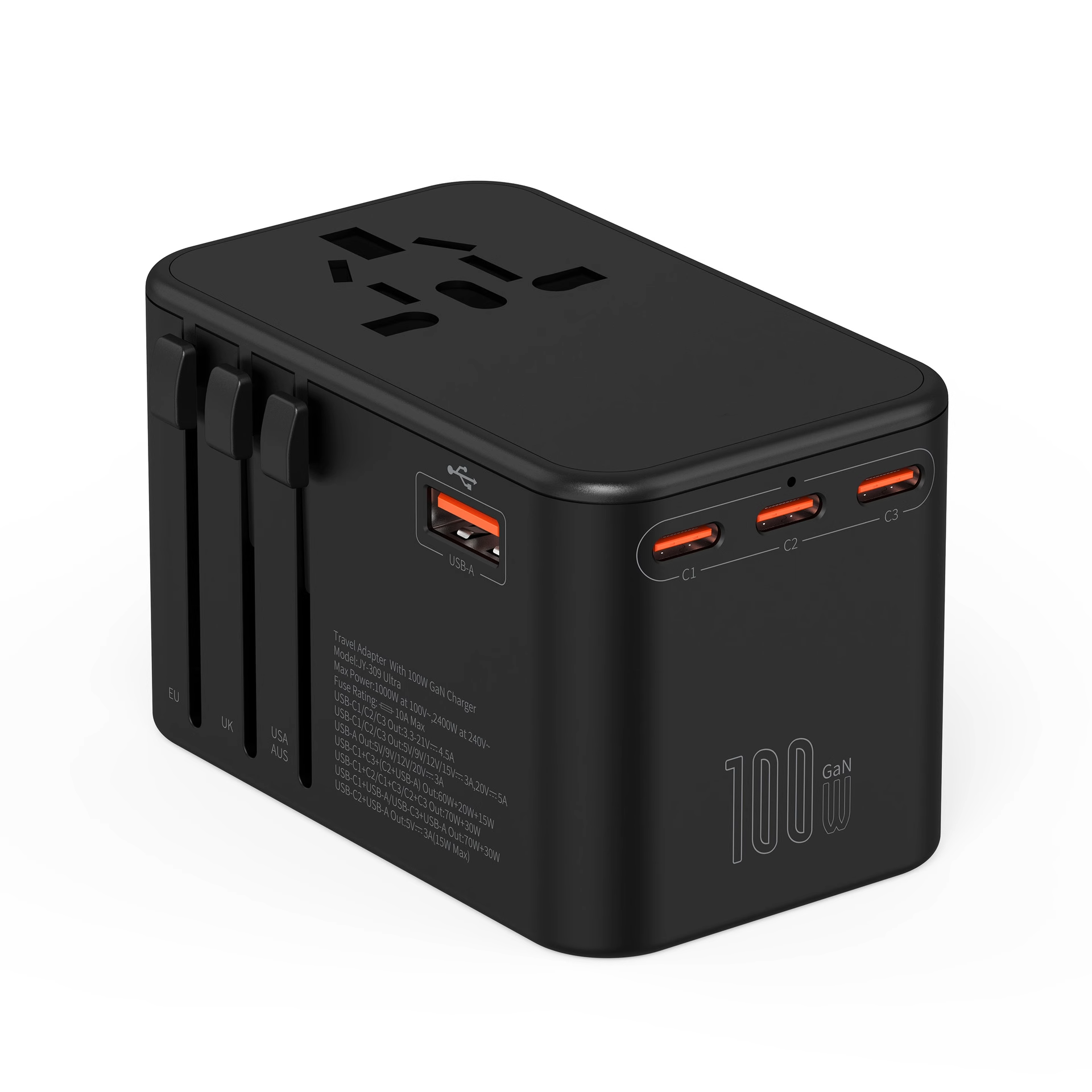
Wecent’s OEM workflow captures these specs at the EVT (Engineering Validation Test) phase, preventing expensive mid-production tooling changes. The ISO9001 quality gate includes grounding continuity testing (pin-to-pin resistance under 0.1Ω per IEC 60320 standards), batch traceability for all 200+ global clients, and documented certification pathways. Request a detailed design review with your supplier’s engineering team before committing to tooling; this conversation clarifies grounding architecture, certifications achievable within your timeline, and any regional compliance nuances affecting your target markets.
What Are the Regional Plug Standards and Grounding Requirements by Market?
Global distribution demands multi-region compliance. Below is a reference table covering the major markets served by B2B charger importers and private-label brands:
Check: Travel Charger
| Region | Standard Plug | Grounded? | Max Safe Power | Key Certification |
|---|---|---|---|---|
| EU | Schuko (Type E/F) | Yes (mandatory) | 240W (16A @ 240V) | CE marking |
| US | NEMA 5-15 | Yes (3-prong option) | 120W (15A @ 120V) | UL/FCC |
| UK | BS 1363 | Yes (mandatory) | 240W (13A @ 240V) | BS 1363 |
| Australia | AS/NZS 3112 | Yes (mandatory) | 240W (10A @ 240V) | RoHS |
| China | GB 1002 (Type I) | Yes (3-prong option) | 240W (16A @ 240V) | CCC (certain products) |
Sourcing implication: OEM buyers targeting multi-market distribution must order separate grounded SKUs per region rather than attempting universal designs. Wecent manages mold inventory for each regional plug type and handles certification per specification, substantially reducing buyer complexity and accelerating time-to-market. US market presents a slight exception—both 2-prong and 3-prong NEMA adapters exist, though grounded (3-prong) is strongly recommended for 65W+. Additionally, DOE/CEC compliance in the US increasingly favors certified grounded designs for 100W+ chargers, adding efficiency certification value to your OEM order specification.
Wecent Expert Views
“Grounding is non-negotiable for any GaN charger exceeding 65W targeting global markets. From our Shenzhen factory’s perspective, we’ve served 200+ clients across North America, Europe, and Asia-Pacific, and the compliance requirement is universal: CE-marked adapters must be grounded; FCC approval for 100W+ designs demands it; PSE and KC certifications in Japan and Korea enforce it without exception. The +5–10% OEM cost is trivial against the alternative—a single product recall or customer injury claim costs multiples more. Our ISO9001 system incorporates grounding continuity testing into every production run; we’ve never shipped an ungrounded adapter to a B2B client requiring 65W+. For importers and private-label brands, I recommend specifying grounded at OEM outset and requesting design review with your supplier’s engineering team. This conversation clarifies regional mold requirements, certification timelines, and volume pricing before tooling commitment.”
Conclusion
Grounded (3-pin/earthed) travel adapters are the safety and compliance standard for high-wattage GaN chargers in global B2B supply chains. While 2-prong adapters suffice for low-power devices under 20W, they expose procurement teams to electrical liability, market rejection in EU/US/Asia-Pacific regions, and product recall risk. Specifying grounded adapters at the OEM stage is a low-risk, high-ROI investment that eliminates compliance friction, protects your brand, and opens premium market channels unavailable to ungrounded competitors.
Wecent’s 15+ years of Shenzhen manufacturing, ISO9001 quality certification, multi-regional mold inventory, and simultaneous multi-certification capability (CE, FCC, RoHS, PSE, KC) position the factory as a trusted partner for B2B buyers navigating global grounding standards. With MOQ starting at just 200 pcs, grounded adapter OEM sourcing is now accessible to startups, wholesale importers, and private-label brands—no longer an exclusive option for high-volume manufacturers. By standardizing on 3-prong earthed designs for your 65W+ GaN charger portfolio, you differentiate from ungrounded competitors, simplify global distribution logistics, and deliver certified, 100%-tested solutions backed by a 2-year warranty that consumers and regulators trust.
FAQs
Do all GaN chargers require grounded adapters?
No—low-power (5W–20W) smartphone chargers are safe with 2-prong adapters; 65W+ laptop and multi-device GaN chargers should use grounded 3-prong, especially in regulated markets (EU/US/Asia). Wecent offers both types; clarify your power rating and target markets in your OEM inquiry to ensure compliant specifications.
Can I retrofit an ungrounded adapter to add grounding?
No—the ground pin must be engineered during the mold and design phase and internally wired to the transformer chassis. Retrofitting is unsafe and voids all certifications. Always order the correct specification from your OEM supplier at the outset; Wecent’s EVT phase catches such design issues before costly mass production.
What is the typical MOQ and lead time for custom grounded travel adapters?
Wecent offers Level 1 (quick white-label) grounded adapters from 200 pcs MOQ with 6–8 week lead time. Level 2 customization (foldable designs, integrated GaN modules) starts at 500–1,000 pcs, 8–10 weeks. Level 3 proprietary designs require 1,000+ pcs, 12–15 weeks. All include ISO9001 certification and multi-cert (CE/FCC/RoHS standard).
Are grounded adapters significantly more expensive, and does the cost justify compliance?
Grounded adapters command +5–10% OEM cost premium due to additional earth pin engineering and certification overhead. This is easily justified by EU/US market access, reduced product liability, avoided recalls, and consumer trust. The cost is negligible against legal exposure of non-compliant designs.
Which certifications are mandatory for grounded 100W+ GaN adapters?
Minimum certifications: CE (EU), FCC (US), RoHS (global). Market-specific requirements: PSE (Japan), KC (South Korea), CCC (China certain products). Wecent simultaneously achieves all certifications; clarify your target markets in your PO to prioritize certification sequences and timelines.