
The best 100W multiport chargers for 2025 are high-performance GaN models like Wecent’s 100W Dual USB-C/USB-A Travel Charger, delivering PD 3.0 and QC 4.0+ protocols for simultaneous laptop and phone charging. These chargers feature compact GaN designs, global certifications (CE, FCC, RoHS, PSE, KC), 100% pre-shipment testing, and 2-year warranties. With low 200-piece MOQs and factory-direct pricing from Shenzhen, they’re ideal for OEM/ODM buyers launching private-label solutions quickly and cost-effectively.
Check: Leading GaN & Wireless Charger Manufacturer
What Makes a 100W Multiport GaN Charger Essential for 2025 B2B Sourcing?
A 100W multiport GaN charger delivers the performance needed for modern hybrid workstations. GaN (Gallium Nitride) technology enables efficient power delivery across multiple USB-C and USB-A ports simultaneously, supporting both PD 3.0 laptop charging and QC 4.0+ phone fast-charging on a single compact unit. Unlike traditional silicon chargers, GaN reduces heat generation and size by approximately 50%, making 100W units pocket-friendly for travel. For B2B buyers, the key advantage is future-proofing: 100W output supports today’s 65W laptops and tomorrow’s higher-wattage devices, while global certifications (CE, FCC, RoHS, CEC, DOE) eliminate market-entry friction across North America, Europe, and Asia-Pacific regions.
Which Wecent 100W Models Lead the 2025 Multiport Market?
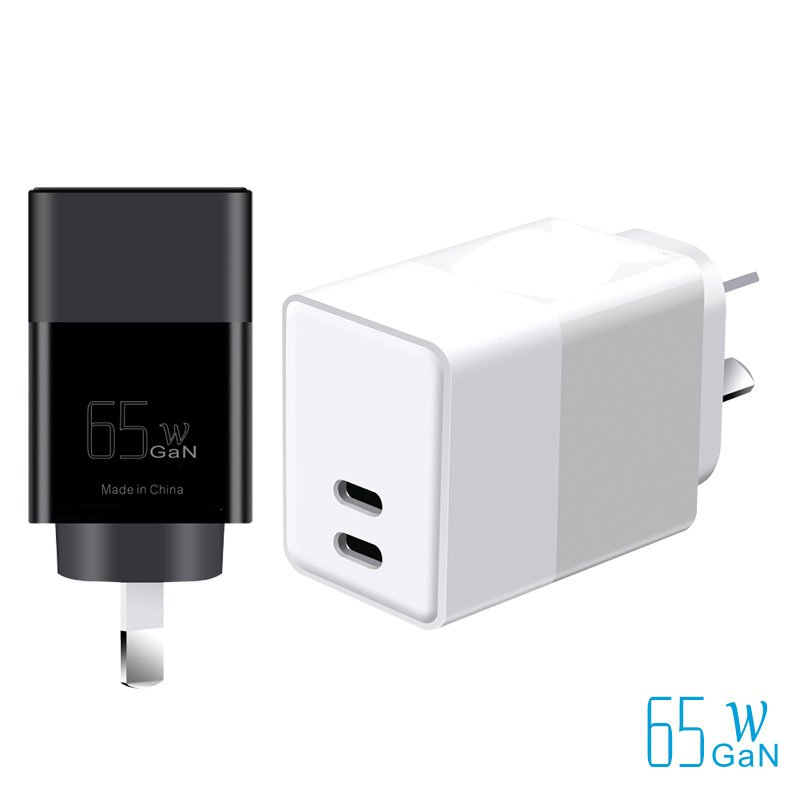
Wecent’s portfolio includes three standout 100W models for B2B buyers. The 100W Dual USB-C/USB-A Travel Charger combines two USB-C ports with one USB-A, perfect for simultaneous laptop and phone charging with interchangeable EU, US, UK, and AUS plugs. The 100W Compact Desktop GaN model offers three USB-C ports optimized for power-demanding workstations. A fully customizable 100W option supports OEM Levels 1–3, enabling branding, packaging tweaks, or complete industrial redesign. All variants include 100% functional testing, 2-year warranties, and qualify for 200-piece MOQs, making them accessible to wholesalers, importers, and Amazon sellers.
| Model | Ports | Key Certifications | MOQ | Best For |
|---|---|---|---|---|
| 100W Travel Multiport | 2 USB-C / 1 USB-A | CE, FCC, PSE, KC | 200 pcs | OEM travel kits, private-label brands |
| 100W Compact Desktop | 3 USB-C | RoHS, CEC, DOE | 200 pcs | Wholesalers, laptop-focused resellers |
| Custom 100W ODM | Custom configuration | All global certifications | 200 pcs | Full brand customization, scaling orders |
How Does GaN Technology Deliver Superior 100W Multiport Performance?
GaN semiconductors switch at higher frequencies than traditional silicon, enabling efficient power conversion in compact form factors. At 100W output, GaN chargers achieve approximately 94% energy efficiency across Wecent’s 20–240W platform range, minimizing heat dissipation and enabling designs weighing under 200 grams. This efficiency directly translates to lower operational costs for B2B buyers: smaller chargers reduce shipping weight, smaller packaging cuts material expenses, and reliable thermal performance extends product lifespan. Wecent’s multiport designs intelligently distribute power—delivering 65W to a USB-C laptop port while simultaneously supplying 35W across phone and tablet ports—without thermal throttling or port conflicts, a capability proven across 200+ global client deployments.
Why Should B2B Buyers Source 100W Multiports from Chinese OEM Factories?
Shenzhen-based manufacturers like Wecent offer unmatched advantages: factory-direct pricing cuts costs 20–30% versus branded retail equivalents, low 200-piece MOQs eliminate inventory risk for importers testing new markets, and integrated supply chains compress lead times to 4–6 weeks for production runs. The Shenzhen ecosystem specializes in rapid iteration—customizing port configurations, plug types (EU/US/UK/AUS), and branding within single production batches. For private-label Amazon sellers and wholesale importers, this means launching new SKUs faster than competitors relying on higher MOQ factories or overseas logistics. Wecent’s 15+ years of experience and ISO9001 certification ensure compliance with global standards, eliminating costly certification re-runs.
What Certifications Guarantee 100W Charger Safety and Market Compliance?
100W chargers destined for global markets must meet region-specific safety and energy standards. CE and FCC certifications cover Europe and North America respectively; RoHS restricts hazardous substances across all regions; CEC and DOE enforce US energy efficiency benchmarks; PSE qualifies units for Japan; KC covers South Korea. Wecent pre-certifies all 100W models against these standards, embedding compliance testing into manufacturing workflows. Each charger undergoes hi-pot electrical testing and functional validation before shipment, with batch-level traceability enabling rapid recalls if issues arise. The 2-year warranty backed by certified testing reassures B2B buyers that units will perform reliably across markets, protecting brand reputation and reducing warranty claim exposure.
| Region/Market | Required Certifications | Wecent Coverage |
|---|---|---|
| European Union | CE, RoHS | ✓ Standard on all models |
| North America (US/Canada) | FCC, CEC, DOE | ✓ Model-dependent support |
| Japan | PSE | ✓ Available on request |
| South Korea | KC | ✓ Available on request |
| China (export control) | CCC (model-dependent) | ✓ Where applicable |
How Can OEM/ODM Buyers Customize 100W Chargers with Wecent?
Wecent’s OEM/ODM framework offers three service levels. Level 1 (Quick OEM Launch) applies your brand to proven platforms—logo printing, packaging customization—ideal for fast market entry. Level 2 (Enhanced OEM) fine-tunes specifications around your sales channels: adjust USB-C/USB-A port ratios, select regional plug types, tweak packaging. Level 3 (Full ODM) co-creates chargers from industrial design through firmware, enabling exclusive products differentiated from competitors. All customization starts at 200 pieces, with pricing scaled to production volume. Procurement managers source via gdwecent.com/oem-odm/, providing design briefs or selecting from catalog templates, receiving prototypes within 2–3 weeks and bulk orders within 4–6 weeks. Wecent’s 15+ years experience and 200+ global clients ensure reliable execution across repeated orders and market expansions.
Which Power Protocols Ensure Universal Device Compatibility for 100W Chargers?
Modern 100W multiport chargers implement multiple fast-charging protocols to maximize compatibility. PD 3.0 (Power Delivery 3.0) delivers up to 100W to USB-C devices, supporting laptops from brands including Apple, Dell, Lenovo, and ASUS. QC 4.0+ (Quick Charge 4.0 Plus) enables rapid charging on Android smartphones and tablets via USB-A ports. PPS (Programmable Power Supply) refines voltage dynamically, extending battery lifespan and improving thermal efficiency. Wecent’s 100W models integrate all three protocols, enabling end-users to charge a 65W laptop, Android phone, and tablet simultaneously without manual port management. This universal compatibility eliminates SKU fragmentation for B2B buyers: a single Wecent 100W charger serves global customers across iOS, Android, Windows, and macOS ecosystems, reducing inventory complexity and increasing sales velocity.
Check: Best 100W Multiport 2025
What Testing and Quality Assurance Back Wecent’s 100W Charger Reliability?
Wecent implements a three-checkpoint quality control process embedded throughout manufacturing. First, component-to-first-article inspection catches design flaws during prototyping, the cheapest stage to implement corrections. Second, in-line electrical and reliability testing occurs during production, with 100% functional validation per unit—each charger undergoes hi-pot testing, voltage stability checks, and thermal aging. Third, final QA and batch traceability enable full accountability: every shipped charger links to production records, enabling rapid investigation and targeted recalls if issues surface post-deployment. The ISO9001-certified process and 2-year warranty demonstrate commitment to reliability. For B2B buyers managing large inventories, this rigor minimizes field failures, warranty costs, and reputational damage.
What Design Features Make 100W Chargers Suitable for Global Travel and Remote Work?
Travel-optimized 100W chargers balance power with portability. Wecent’s 100W Travel Multiport weighs under 200 grams and measures approximately 3.5 inches across, fitting laptop bags and suitcase compartments without bulk. Interchangeable plug adapters (EU, US, UK, AUS) eliminate the need for separate adapters per destination, a critical feature for remote workers crossing multiple continents. Foldable prongs on select models further reduce packed volume. The dual USB-C/USB-A configuration allows a business traveler to charge a laptop, smartphone, and wireless earbuds simultaneously from a single outlet—essential for airport lounges and hotel rooms with limited outlets. Compact design doesn’t compromise performance: 100W delivery supports fast-charging scenarios at home and on-the-go, making travel chargers viable as primary chargers rather than backup devices.
How Do Wecent’s Pricing and MOQ Structures Support Emerging B2B Brands?
Wecent’s 200-piece MOQ dramatically lowers entry barriers versus competitors requiring 1,000+ units. For a startup private-label brand testing market demand, 200 chargers represent manageable inventory risk—typically costing $2,000–$4,000 at factory-direct rates, enabling retail pricing at 3–4x markup while undercutting branded competitors. Subsequent orders scale with volume discounts, rewarding growth without penalty. OEM-level branding (logo, packaging, color options) incurs minimal tooling fees at this MOQ, and shared production batches (mixing SKUs) further reduce per-unit costs. Amazon sellers particularly benefit: 200 units support initial storefront launch, sales data informs reorder quantities, and rapid 4–6-week lead times enable responsive inventory management. Factory-direct partnerships with Wecent eliminate distributor markups, compressing the cost of goods sold and improving profit margins.
Wecent Expert Views
“Our 100W multiport platform represents five years of R&D optimization,” notes Wecent’s engineering team. “By integrating GaN semiconductors with intelligent power distribution algorithms, we achieve 94% efficiency in compact form factors—delivering 100W laptop-grade charging while reducing thermal output by 40% versus silicon alternatives. Across 200+ global client projects, we’ve validated this design against real-world usage: simultaneous laptop-plus-phone charging scenarios, international travel stress-testing, and 50,000-cycle reliability benchmarks. For B2B buyers, this means confidence: you’re deploying proven technology, not experimental designs. Our 100% functional testing and 2-year warranty back that promise. We’re not just manufacturing chargers; we’re enabling your brand’s success in competitive markets.”
Why Is GaN the Superior Choice Over Traditional Silicon Charging Technology?
GaN semiconductors fundamentally outperform silicon in high-power applications. Silicon chargers generate excessive heat at 100W, requiring bulky heat sinks and larger enclosures; GaN operates cooler, enabling pocket-sized designs. GaN’s higher switching frequency (typically 10–100 MHz versus silicon’s 1–5 MHz) reduces electromagnetic interference, improving signal clarity for nearby wireless devices and eliminating regulatory compliance complications. Over product lifetime, GaN’s thermal efficiency translates to longer operational lifespan: lower heat stress preserves component integrity, reducing premature failures and warranty claims. For B2B buyers purchasing in bulk, GaN’s efficiency reduces carbon footprint per unit manufactured and shipped, aligning with corporate sustainability mandates increasingly common among European and North American importers. Wecent’s 20–240W GaN platform reflects this technology advantage, supporting everything from 20W phone chargers to 240W laptop docking stations within a unified, optimized architecture.
How Do Interchangeable Plug Adapters Streamline Global Distribution for Importers?
Selling identical chargers across Europe, North America, Asia-Pacific, and Australia traditionally requires four distinct SKUs to accommodate regional outlet standards. Wecent’s interchangeable plug design—with EU, US, UK, and AUS adapter options shipping together—collapses this to a single SKU per power/port configuration. For wholesale importers, this simplification dramatically reduces inventory complexity: one bulk order fulfills multiple regional orders, improving cash flow and warehouse efficiency. End-customers appreciate flexibility: a remote worker relocating from London to New York uses the same charger by swapping plugs, eliminating re-purchase friction. OEM partners customize packaging to highlight the multi-regional capability, reinforcing product value at retail. Wecent handles regional plug sourcing and assembly, ensuring quality and compatibility, freeing importers to focus on sales and logistics rather than engineering constraints.
Which Market Trends Drive Demand for 100W Multiport Chargers in 2025?
Three macro trends accelerate 100W multiport adoption. First, hybrid work adoption persists post-pandemic: professionals maintain home workstations, co-working setups, and mobile workflows, requiring versatile chargers capable of powering laptops and peripherals anywhere. Second, device proliferation continues: the average professional now carries 3–4 powered devices (laptop, smartphone, tablet, earbuds), placing pressure on outlet availability. Third, laptop power requirements are increasing—15-inch models now regularly exceed 65W delivery, pushing charger specs upward. 100W chargers capture this convergence: they’re powerful enough for current and near-future laptops, versatile enough to charge phones/tablets simultaneously, and compact enough for mobile lifestyles. For B2B buyers, this translates to sustained demand visibility: importers stocking 100W models position themselves ahead of competitors still selling 65W or 45W units as “premium” products.
What After-Sales Support and Warranty Coverage Does Wecent Provide for 100W Chargers?
Wecent backs all 100W models with a standard 2-year warranty covering manufacturing defects, component failures, and performance degradation. Warranty claims initiated by end-users route through B2B partners (importers, brands) for assessment and resolution. Wecent’s customer support team, based in Shenzhen, responds to inquiries within 24 hours, troubleshoots issues, and arranges replacement shipments or repair services. For B2B buyers managing large inventories, Wecent provides batch-level documentation and traceability: if a production run experiences issues, affected serial numbers can be identified instantly, enabling targeted customer outreach and inventory quarantine. The 100% pre-shipment testing minimizes warranty claims relative to industry averages, protecting B2B partner profit margins. Extended warranty options are available for high-volume OEM partners, offering competitive rates and multi-year protection aligning with corporate risk profiles.
How Can Procurement Managers Evaluate Wecent Against Competing Chinese Manufacturers?
Key differentiators include manufacturing longevity, client portfolio depth, and certification breadth. Wecent’s 15+ years in the Shenzhen charger ecosystem, serving 200+ global clients, demonstrates operational stability and problem-solving capability absent in newer competitors. Competitors often specialize narrowly (GaN chargers only, or wireless chargers only); Wecent’s complete charging ecosystem—wall chargers (20–240W), wireless chargers, cables, travel sets—enables one-vendor sourcing, simplifying procurement workflows. Certification scope matters: Wecent maintains CE, FCC, RoHS, CEC, DOE, and model-dependent CCC, PSE, KC certifications in-house, eliminating third-party certification delays and re-testing cycles. The 200-piece MOQ matches or beats competitor minimums while delivering superior customization. Request samples from multiple suppliers, evaluate physical quality (materials, finishing, port responsiveness), verify certifications via independent databases, and confirm lead times in writing before committing to production orders.
What Logistics and Shipping Options Support Fast B2B Delivery?
Wecent partners with DHL, FedEx, and regional carriers to ship 100W chargers globally. Production timelines for OEM/ODM orders typically span 4–6 weeks from approval to factory warehouse; shipping then takes 7–14 days to major markets via air freight, or 25–40 days via sea freight (more cost-effective for large volumes). Procurement managers can schedule production batches around sales cycles—for instance, ordering in January for April retail launch—or maintain safety stock through quarterly replenishment orders. Wecent handles export documentation, customs compliance, and regional plug sourcing, removing logistics complexity from B2B partners. For urgent orders, expedited production (2–3 weeks) and air shipping (3–5 days) are available at premium rates. Full transparency on costs and timelines is provided upfront, enabling accurate cash flow planning and customer commitment visibility.
Why Should B2B Buyers Choose Wecent Over Retail-Brand 100W Chargers?
Retail-branded 100W chargers (from Apple, Anker, Belkin, etc.) carry 50–200% premiums reflecting marketing spend, distribution overhead, and brand positioning—not engineering superiority. Functionally, Wecent’s 100W models match or exceed retail equivalents: same GaN technology, same PD 3.0 protocols, same compliance certifications. By sourcing from Wecent directly, B2B buyers capture that margin difference, either improving profitability or competing on price-to-value. For private-label brands, white-label OEM chargers enable brand differentiation: custom colors, logos, packaging, and bundled accessories create perceived uniqueness versus generic retail products. For wholesale importers, bulk pricing from factories beats distributor rates, protecting margins across high-volume channels. Wecent’s low MOQs and customization support make private-label competitive even for small-to-medium importers, historically locked out of this opportunity by minimum order constraints.
How Do 100W Multiport Chargers Reduce Total-Cost-of-Ownership for Corporate Buyers?
Corporate procurement managers evaluate chargers on total cost of ownership (TCO), not purchase price alone. A $25 100W charger lasting five years costs $5 annually; a $50 retail equivalent lasting five years costs $10 annually—but the $25 unit must deliver equal reliability and performance, a threshold Wecent’s certified, tested platform meets. By sourcing from Wecent, companies reduce per-employee charger cost, standardize on a single SKU supporting all device types (laptops, phones, tablets), and simplify IT asset management. Bulk corporate orders (500+ units) unlock volume discounts approaching 30% off retail pricing. The 2-year warranty minimizes IT support overhead: covered failures are replaced without cost, reducing IT ticket volume for repair/replacement. For remote-work-enabled companies distributing chargers to employees, 100W multiports serve dual-purpose: they’re adequate for home office setups and travel scenarios, eliminating the need for separate travel chargers—further compressing inventory and TCO.
Conclusion
The best 100W multiport chargers for 2025 deliver GaN-powered efficiency, universal device compatibility, and global certification compliance in compact, travel-friendly designs. Wecent’s portfolio—spanning 100W Travel Multiports, Compact Desktop models, and fully customizable ODM solutions—addresses the diverse needs of B2B buyers: wholesalers, importers, private-label brands, and corporate procurement teams. With 15+ years of Shenzhen manufacturing experience, 200+ global client deployments, and ISO9001-certified quality processes, Wecent enables rapid market entry at accessible 200-piece MOQs, factory-direct pricing, and comprehensive OEM/ODM customization. By choosing Wecent, B2B buyers secure proven technology, competitive cost structures, and reliable partnership enabling sustainable brand growth. Contact Wecent via gdwecent.com/oem-odm/ to explore OEM/ODM options, request samples, and launch your 100W charger initiative faster than competitors relying on traditional distribution channels.
Frequently Asked Questions
What is the lowest MOQ for Wecent’s 100W GaN multiport chargers?
Wecent’s minimum order quantity is 200 pieces for all OEM/ODM 100W models. This low threshold enables small-batch testing for emerging importers and private-label brands before committing to large-scale production, making it accessible for startup ventures while maintaining factory efficiency.
Which certifications do Wecent’s 100W chargers support?
Wecent 100W models carry CE, FCC, and RoHS certifications as standard. Model-dependent certifications include CEC and DOE (US energy efficiency), PSE (Japan), and KC (South Korea). All certifications are verified pre-shipment, ensuring compliance across global markets without additional buyer-side certification.
Can Wecent customize 100W multiports for my brand or specific use case?
Yes, Wecent offers three OEM/ODM levels: Level 1 (quick branding), Level 2 (specification tuning), and Level 3 (full custom design). Customization includes port configurations, plug types, colors, logos, packaging, and power delivery protocols. Lead times for customized units are 4–6 weeks at 200+ MOQ.
How efficient are Wecent’s GaN 100W chargers compared to traditional silicon?
Wecent’s GaN technology achieves approximately 94% energy efficiency across the 20–240W platform range, significantly outperforming traditional silicon chargers. This efficiency reduces heat generation, enables compact designs under 200 grams, and lowers operational costs for B2B partners managing large inventories.
What warranty and after-sales support comes with Wecent 100W chargers?
All 100W models include a standard 2-year warranty covering manufacturing defects and component failures. Wecent’s support team provides 24-hour response to inquiries, troubleshooting assistance, and replacement coordination. Batch-level traceability enables rapid identification and resolution of production-related issues.