Inspect Products · GaN & Wireless Charger QC

Inspect Products: Turning Every Charger into a Consistent Promise.

To your customers, a charger is just a small accessory. To your brand, it is a promise: safe, stable power every time they plug in. On this page, we open a window into how WECENT inspects your products — not with complicated flow charts, but with the checkpoints that keep your reputation safe.
- Multi-gate QC from materials to shipment
- ESD-protected PCBA lines
- Compliance-minded for CE · FCC · RoHS
We design the inspection system so that every batch is traceable, every non-conformity is caught early, and every shipment aligns with your spec sheet & market regulations.

Live Charger QC Snapshot

Inspection gates passed
12 functional tests From PCBA tin surface to final appearance
ESD control
Bracelet 100% Required whenever touching components
Sampling plan
QC QA FQC per batch With shipping inspection report archived
Safety checkpoints
Hi-pot · Aging Pressure test & product aging before packing

For the people who cannot afford “maybe” on quality.

Instead of walking you through every screw on the line, we focus on what matters to you: how inspection turns into fewer complaints and more repeat orders.

For the brand owner

For the brands in the spotlight

You invest in industrial design, packaging and marketing. A faulty charger can damage all of that in one single review. Our inspection flow is built to keep your launch schedule safe without asking you to become a factory engineer.
For the e-commerce & retail teams

For the teams watching review stars

A spike in “charger issues” or “overheating” tickets is a margin lost on replacements and returns. We design QC around the usage scenarios your customers care about: fast charging, multi-port sharing, and safe travel-ready power.
For purchasing & compliance

For the people holding the spec sheet

You sign off on power ratings, plug standards, and certifications. Our job is to ensure each batch actually behaves like the datasheet: same output, same protocols, same safety margin — with supporting reports ready when your auditors ask.

How We Inspect Your Chargers

Internally, each product has a detailed “Manufacturing Operation Instruction” sheet covering tools, ESD requirements, operation contents, cautions and judgments for every station. For you, we summarise this into a few understandable inspection gates — enough to feel in control, without drowning in documentation.

From raw materials to packed cartons — in clear checkpoints.

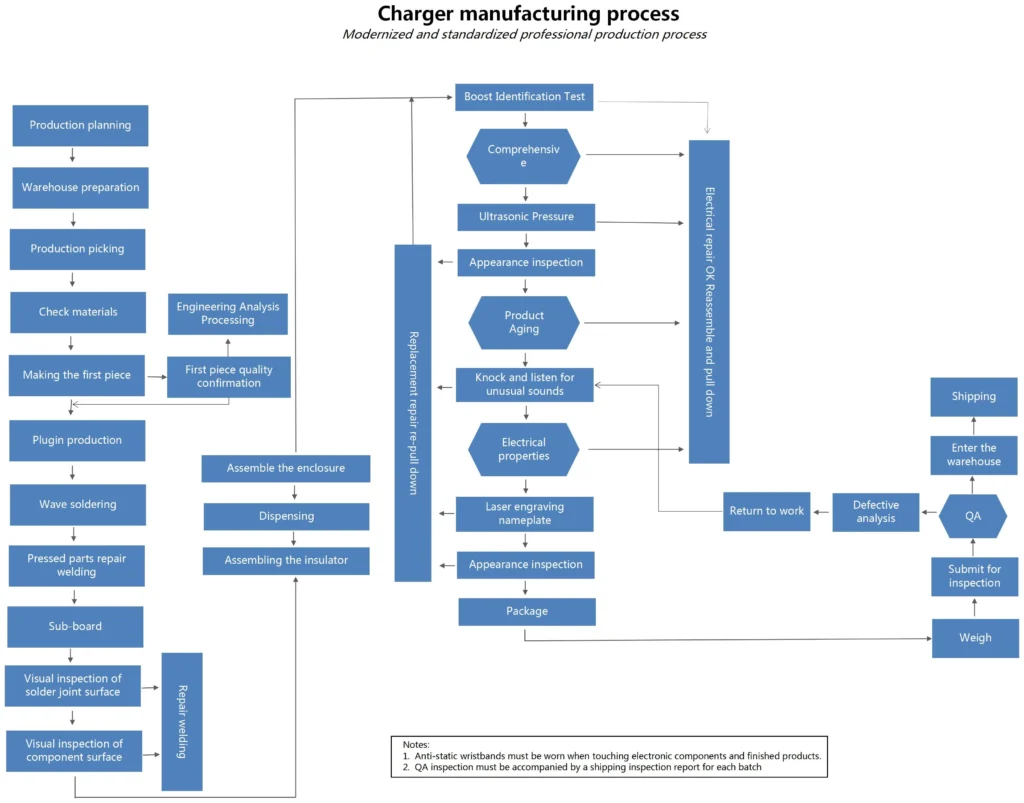
Our overall charger manufacturing flow includes material preparation and checking, first-piece quality confirmation, plug-in production, wave soldering, multiple visual inspections, product aging, pressure tests, comprehensive electrical tests, QA sampling, and warehouse release.

Gate 01 · Before the line

Incoming material & BOM verification
Every charger starts long before assembly: with transformers, controllers, capacitors, shells and cables. We check materials against the work order and BOM, verify key parameters and RoHS status, and block any non-conforming lot before it reaches the operators.
For you, this means issues are stopped at the source — not after thousands of units have been assembled.
Gate 02 · PCBA in process

Plug-in, wave soldering & ESD-safe handling

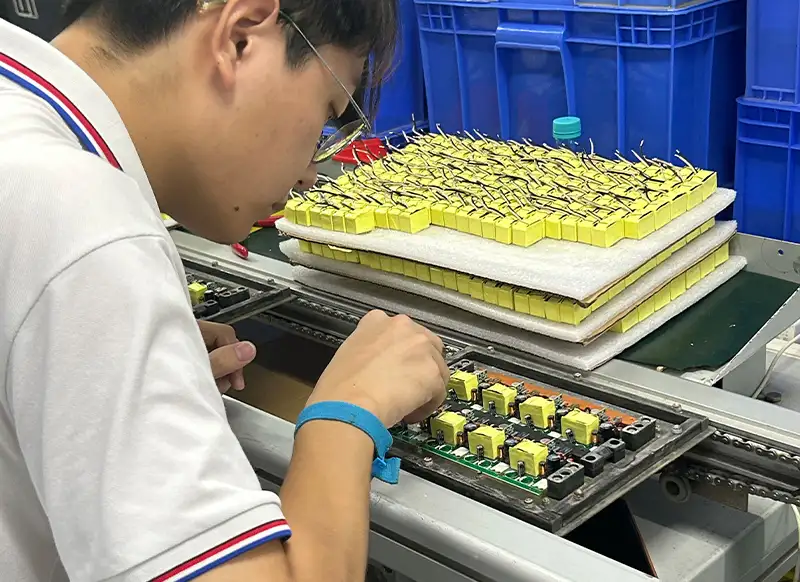
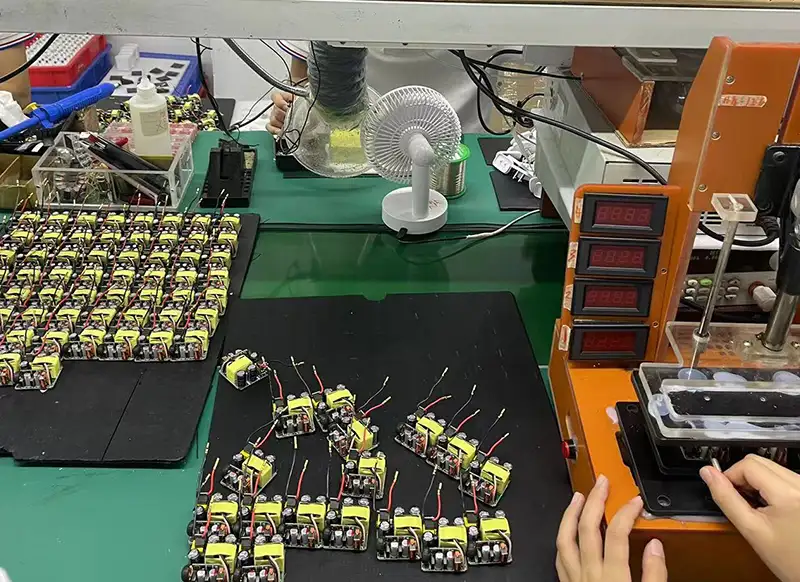
On the PCBA line, each model has its own SOP. Operators wear electrostatic bracelets whenever they touch electronic components or semi-finished plug-in boards, and use dedicated fixtures to place and guide PCBAs into wave soldering.
The goal is simple: no skewed boards, no missing parts, and no invisible ESD damage that might show up as “early failure” in your market.
Gate 03 · Board-level inspection

Tin surface & component visual checks
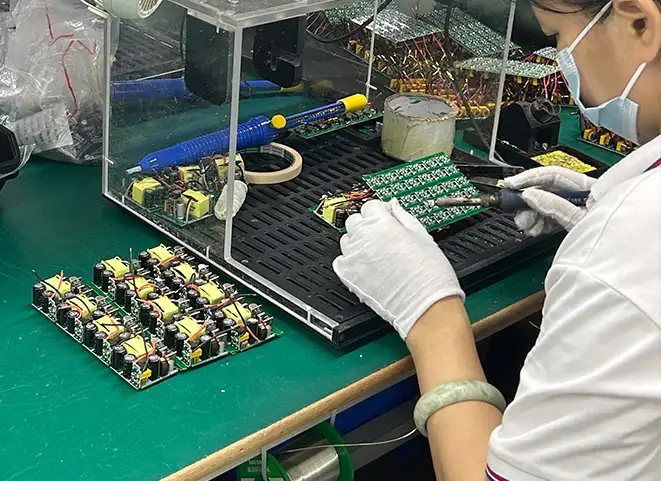
After soldering, inspectors check the PCBA tin surface and component layout: looking for bridges, weak solder, tin tips, cracks, misalignment, reversed parts or damaged PCB edges. Defective boards go into dedicated NG boxes; good boards flow to the next station under clear judgment criteria.
You do not need to memorise these checks — you just need to know that each board is screened before it ever becomes a finished charger.
Gate 04 · Function & safety

Electrical test, pressure test & aging

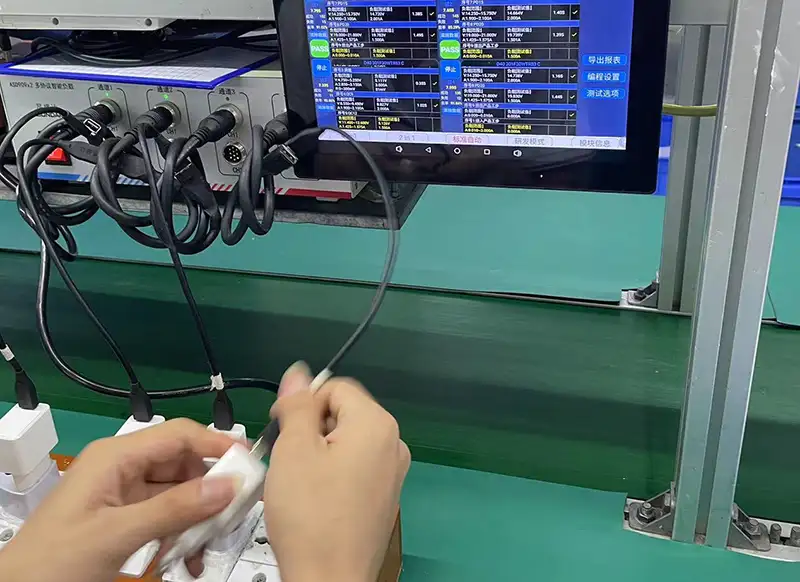
Once assembled, chargers go through comprehensive electrical tests: output behavior, load conditions, and protection features. Pressure (hi-pot) tests and aging tests are integrated into the standard flow, followed by appearance checks and noise inspection before packing.
This is where we make sure your 20W, 65W, 100W or 140W GaN chargers behave like they should in the hands of your users.
Gate 05 · Before shipment

QA sampling & shipment inspection report

Before the goods move into the warehouse and onto trucks, QA performs sampling inspection for each batch, issues a shipment inspection report, and confirms visual appearance again. Only after QA approval are cartons released for shipping.
For long-term customers, this becomes a shared record of stability across repeat orders — a quiet but powerful asset for your business.

What We Actually Measure

Whether it is a 20W phone charger or a 240W laptop GaN charger with multiple Type-C and USB-A ports, each product family comes with its own matrix of power profiles, protocols and plug standards. Our inspection focuses on the parameters that translate directly into user experience and compliance.

CATEGORY WHAT WE CHECK WHAT YOUR CUSTOMER FEELS
Power & ports That single-port and multi-port output combinations (e.g. 140W + 100W, 65W + 20W) behave according to the agreed spec for your model series. “My laptop and phone both charge fast, and the ports share power intelligently.”
Protocols That supported standards such as PD2.0/3.0/3.1, QC, PPS, FCP, SCP, AFC and Apple 2.4A are functioning as intended for your chosen models. “It just works with my devices — no random disconnects, no slow fallback charging.”
Safety & compliance That safety functions and hi-pot tests align with the certification standards (CE, FCC, RoHS and others) you target in your market. “The charger stays cool, feels safe, and carries the marks my market requires.”
Appearance That shells, logos, engravings and labels are clean, aligned and consistent with your brand guidelines, with additional visual inspections before and after assembly. “The product looks premium out of the box — no scratches, misprints or crooked labels.”
Reliability That chargers pass aging tests and percussion/noise checks in the production flow, so that early-life failures are minimised before shipping. “It keeps working after months of daily use, not just in the first week.”

Certified for Your Market, Ready for Your Brand

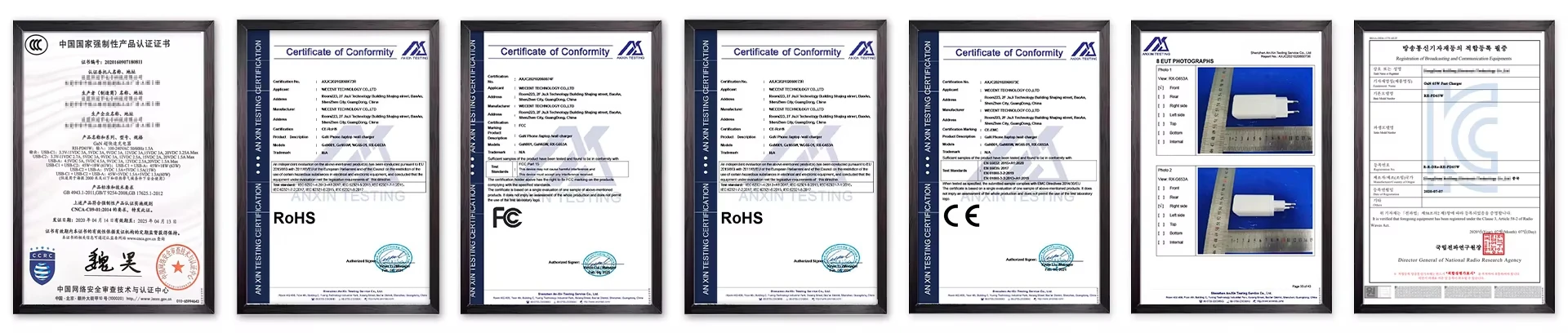
From CE, FCC and RoHS to PSE, KC and more, each WECENT charger comes with the compliance foundation your listings and audits demand, so your team can focus on sales instead of paperwork. We build, test and document to the standards of your target countries from day one, turning complex regulations into a simple, reliable green light for every shipment.
Modernized Charger Manufacturing, Visualized

From production planning and material checks to PCBA soldering, product aging, QA sampling and shipping, this flow maps how every WECENT charger travels through controlled steps and inspection gates. It gives your team a clear view of where quality is built in, and why each shipment arrives consistent, compliant, and launch-ready.
Powering your world, quietly

Inspection as the quiet engine behind your next release.
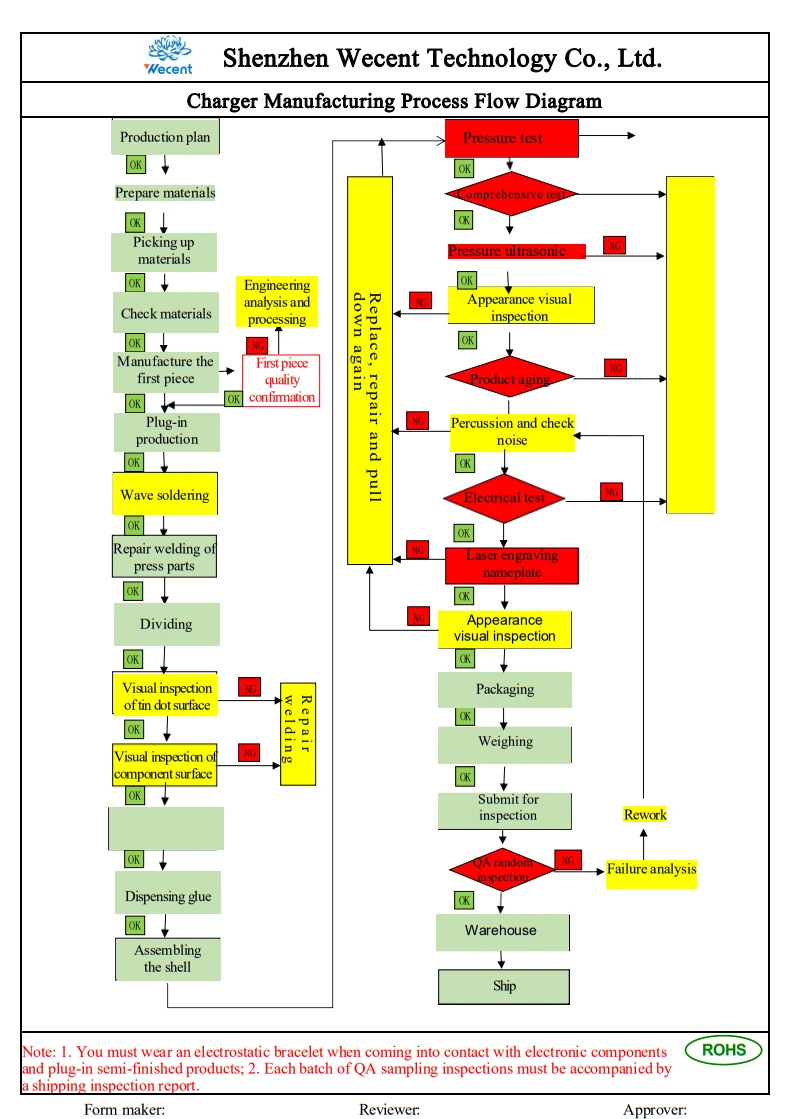
When you work with WECENT, you do not have to re-build a quality system from zero. Our inspection flow is already woven into our GaN and wireless charger lines — from incoming materials to QA sampling and warehouse release.
Most of our chargers come with a 2-year warranty, backed by strict quality control and responsive after-sales support. That confidence is not marketing copy; it is the result of thousands of inspected units, shift after shift.
Your customers will never see our SOPs, tin inspections, or ESD bracelets. They will only feel that your chargers are reliable. This page is here to reassure you that there is a disciplined inspection system standing behind that feeling.

Bring your spec sheet. We’ll take care of the inspection.

Share your target markets, power profiles and certifications. We will map them to an inspection plan, provide test data where needed, and keep you updated from first samples to mass production.